Combining forces
Two Eastern Canadian wheat breeding programs team up to produce superior fungal disease resistance
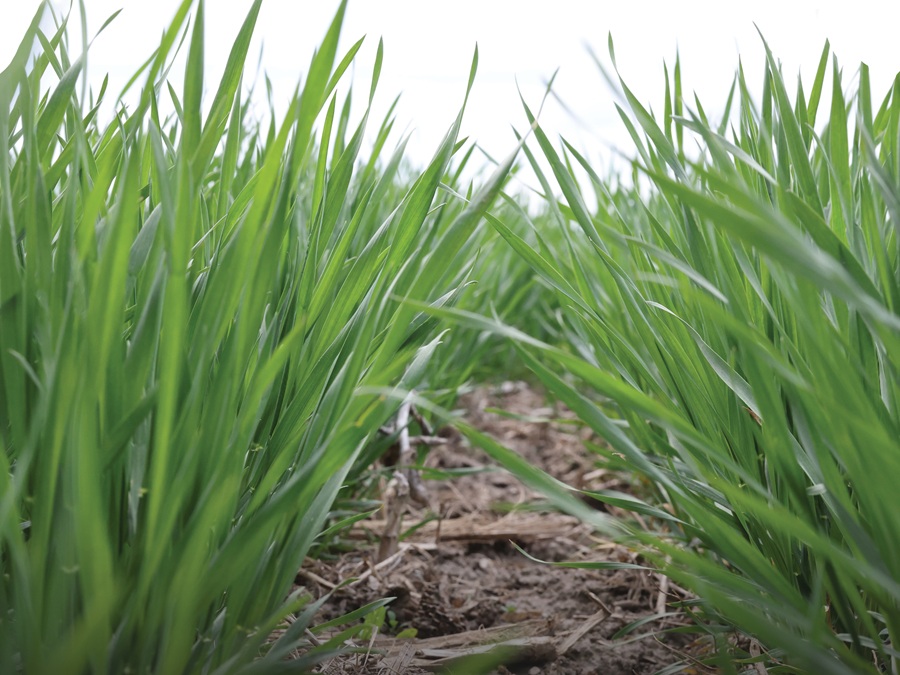
Quebec and Guelph-Ridgetown researchers aim to register new winter wheat cultivars with better fusarium head blight resistance.

Ontario wheat growers are constantly on guard against fusarium head blight (FHB). In Eastern Canada, FHB is the wheat disease that affects profitability the most.
And that’s unfortunate for soft red winter wheat (SRW) growers in particular. FHB resistance is relatively poor, even though dedicated SRW breeding efforts have led to great yield and end-use quality profiles.
Dr. Michel McElroy at the Centre de recherche sur les grains (CÉROM) in Quebec says most varieties listed in the Ontario winter wheat performance trial are rated as moderately susceptible or susceptible to FHB. That means fungicide applications are necessary when conditions favourable to this pathogen are present.
But that’s a problem in itself. Fungicide applications are expensive and ineffective if not applied within the critical period, McElroy says.
Ideally, genetic resistance would serve as the first line of defense against FHB. However, variety choices for this crucial part of a grower’s disease management strategy are limited.
WORKING TOGETHER
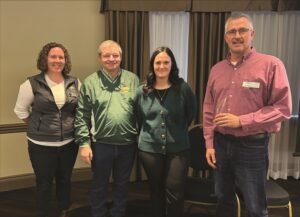
Against this backdrop, McElroy and Dr. Lily Tamburic-Ilincic at the University of Guelph–Ridgetown Campus joined forces last spring on a major FHB management project.
With funding from Grain Farmers of Ontario (via the Canadian Wheat Research Coalition), the Seed Producers of Quebec and SeCan, they’re combining their breeders’ skills to select the most promising lines in their two provinces and deliver new germplasm for other public breeders in Eastern Canada.
“In the end,” Tamburic-Ilincic says, “the goal is to register new cultivars with much-improved FHB resistance and make that seed available to winter wheat growers in this part of Canada.”
TRAIT COMPLEXITIES
Integrating FHB resistance genes into superior SRW germplasm without bringing along undesirable or unwanted traits mainly related to plant height, maturity date, and susceptibility to rust diseases is difficult.
And even when traits are not directly linked to resistance, certain genes simply do not combine well, McElroy says. So, it’s critical to consider regional adaptation traits and how to integrate genes related to FHB resistance that are present in one distinct wheat line into others that are in another quality class.
Many FHB genes – over 500, in fact – have already been identified by wheat geneticists. Several gene groupings with large resistance effects have been well-characterized and are now used in wheat breeding programs across the world. Among these, two stand out: Fhb5 (type I resistance, relating to initial infection) and Fhb1 (type II resistance, relating to infection spread). These gene groupings have been found in some of the public winter wheat programs in Eastern Canada, but they’re mainly concentrated in hard red wheat.
One variety worth noting is AAC Harfang. It has superb FHB resistance and demonstrates exceptional winter survival and yield. It was recently released by CÉROM in collaboration with Agriculture and Agri-Food Canada (AAFC). McElroy and Tamburic-Ilincic will create lines with this variety using UGRC Ring as a parent (UGRC is an acronym for University of Guelph-Ridgetown Campus). This SRW variety carries neither Fhb1 nor Fhb5 resistance. It offers good pastry flour quality, plus it displays high yield and strong adaptability to conditions across eastern Canada.
A SNEAK PEEK AT PROGRESS
In 2025, McElroy and Tamburic-Ilincic completed seed multiplication for the current panel of cultivars. They also planted plots in Tupperville, Ont. for agronomy evaluation in 2026, and in Ridgetown for infection with FHB in 2026.
“So far, things are going well,” McElroy says. “The plots that we harvested were mainly for multiplication, but they also allowed us to get a sneak peek at how the population looks. We are pleased to see there’s a good amount of variation, which is good for our purposes.”
Eventually, superior lines will be submitted into variety registration trials in the region where they are most adapted, Ontario or Quebec. They’ll have been evaluated over a 3-year period for agronomic performance, disease resistance and end-use quality.
If registration is successful, CÉROM will pursue a licensing agreement with a seed distributor through its commercialization program.
PART OF A BIGGER VISION
This research project fits into a bigger strategic vision to integrate the activities of public winter wheat breeding programs across Eastern Canada for the benefit of Canada’s entire wheat industry.
“Collaboration is really the lifeblood of breeding, and that need is stronger more now than ever with the challenges pressed on us by climate change,” McElroy says.
The public winter wheat programs in Eastern Canada have always traded trials and germplasm. But lately, he says, there’s been a desire to do more.
“One big barrier to trading germplasm has been the fact that some breeding programs, such as UGRC, focus on soft red wheat, and others like those at CÉROM, focus on hard wheat,” McElroy says. “And there has always been a reticence to cross the soft and hard types over fears that we will lose the important end-use qualities that millers need. But at the same time, if we keep them siloed off from each other, then both types will end up missing important genes that the other can offer.”
McElroy and Tamburic-Ilincic hope that besides identifying some lines that will lead to SRW varieties with much better FHB resistance, this research will also create a map for how to cross the breeding bridge between hard and soft wheat types. With that map in hand, researchers across the public wheat breeding spectrum will be able to more fully use all breeding material available.
SELECTING PROGENIES IS TOUGH
McElroy notes that in southern Quebec, winter survival can be a problem. Some years, entire trials must be canceled. On the other hand, sometimes conditions are too cool or dry to get good fusarium infection, even in their disease nursery.
For her part, Tamburic-Ilincic says selecting progenies is the most challenging part ahead, finding those with good yield outcomes and FHB resistance, as well as good quality traits needed for soft and hard red wheat.
But challenges aside, both researchers are excited by the potential of combining their two chosen varieties.
“UGRC Ring has been an excellent variety for Quebec producers looking for big yields without lodging,” McElroy says. “And AAC Harfang has really pushed the limits for disease resistance. The idea of a whole new variety that combines the best of both of them would be a great result for producers all across Eastern Canada.” •