Growing yields, sharing knowledge
Highlights from the 2025 Great Lakes YEN
A growing network of farmers, agronomists and researchers across Ontario and the U.S. Great Lakes region is using shared data and field insights to unlock higher wheat yields.
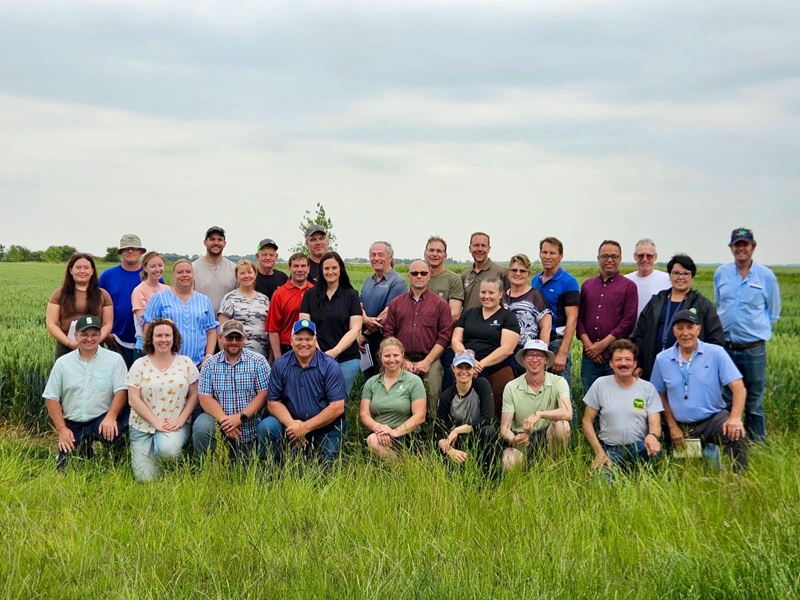
Farmers, agronomists, extension specialists, and researchers met in London in February to attend the year-end Great Lakes Yield Enhancement Network (YEN) wrap-up meeting. The meeting capped off the fifth year of this innovative program.
Inspired by the ADAS YEN program in the UK, the Great Lakes YEN launched in 2021 through a partnership between Grain Farmers of Ontario, Michigan State University Extension, Michi-gan Wheat Program, Ontario Ministry of Agriculture, Food and Agribusiness, and the University of Guelph.
As part of a global YEN network, the Great Lakes YEN empowers local farmers to better understand their yield potential and identi-fy what may be holding them back. The YEN brings together ag-ricultural organizations, extension specialists, academics, agrono-mists, and farmers, all working to boost crop returns by narrowing the gap between potential and actual yields.
In addition to Ontario, wrap-up meetings were held in Michigan and Kentucky. Over 180 farmers and their agronomists had the opportunity to dive deeper into data collected from the 2025 growing season, talk with other top grower participants, and hear from world-class researchers.
2025 SEASON OVERVIEW
The 2025 winter wheat season in Ontario and the U.S. was marked by successful planting, favourable overwintering, and resilient yields despite weather-related challenges.
HIGHLIGHTS:
- Timely fall planting and strong crop establishment in Ontario, with 1.18 million acres seeded across the province.
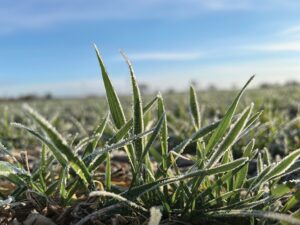
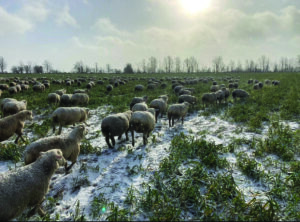
- Good overwintering conditions, with consistent snow cover and few freeze-thaw events. Overall, vigorous spring growth supported rapid recovery from snow mould.
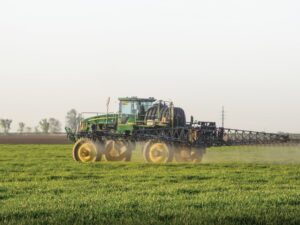
- Timely split nitrogen and sulphur applications boosted growth; U.S. fields benefited from gradual warming and extra tillering.
- Low early disease pressure in Ontario; however, as the sea-son progressed, powdery mildew and stripe rust were a chal-lenge in many regions. US fields managed powdery mildew throughout the season.
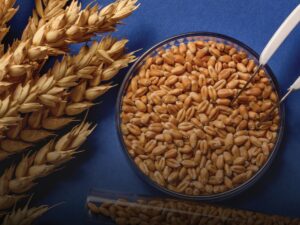
- Weather allowed for wide spray windows but high day-time temperatures impacted grain-fill; Ontario produced high-quality grain, and the U.S. maintained quality despite late rains.
Overall, the season showcased effective management and crop resilience, resulting in strong yields and quality across the region.
2025 GREAT LAKES YEN YIELD WINNERS
1. Nick Suwyn (Wayland, Michigan):
182.7 bu/ac (achieved 118 per cent of his calculated yield potential).
2. Wayne Metzger (Proton Station, Ontario):
170.1 bu/ac (achieved 93 per cent of his calculated yield potential).
3. Ben Wilson (Carson City, Michigan):
156.2 bu/ac (achieved 82 per cent of his calculated yield potential).
THE UK CONNECTION
The Great Lakes YEN was honoured to have Roger Sylves-ter-Bradley join the Michigan and Ontario wrap-up meetings. Sylvester-Bradley co-founded the YEN concept, is a leading expert in crop performance with ADAS’s Crop Physiology Group, and recently received the Royal Agricultural Society of England’s Science and Technology medal for 2025. With over 50 years of experience in crop productivity and nutrition, Roger remains pas-sionate about advancing ‘farm action research’ alongside farmers and has contributed to more than 250 scientific publications.
During his presentation, Sylvester-Bradley highlighted findings from 15 years of the UK YEN, showing that 40 per cent of wheat yield is tied directly to farmer decisions, including management strategies and field-specific factors. He also described the ideal ‘ideotype’ for winter wheat in the UK, detailing the characteris-tics, such as the targeted number of heads, number of grains, nutrient requirements, variety , and rooting characteristics that enable UK farmers to achieve world record yields.
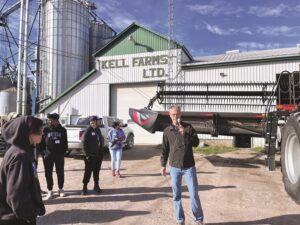
Several Great Lakes YEN participants had the opportunity to see those record-breaking wheat fields up close during the 2025 YEN summer networking tour, where 30 tour participants toured Tim Lamyman’s impressive wheat fields. The tour also show-cased how farmers in the UK are adopting innovative, sustain-able practices, as well as world-class research on wheat breed-ing and weed control.
The Great Lakes YEN leadership team hosted their first summer tour in Michigan in 2024, followed by a second successful tour in Ontario in 2025. These tours, in addition to the in-person wrap-up meetings, several virtual help sessions, and the very active WhatsApp chat group, offer program participants unique oppor-tunities to learn from cutting-edge research and connect with experts, underscoring the YEN’s commitment to sharing practical, field-tested knowledge that em-powers farmers and agronomists across the Great Lakes region.
WRAPPING UP THE 2025 GREAT LAKES YEN
This year’s wrap-up meetings featured two nota-ble speakers from Michigan State University. Con-servation Systems Agronomy educator Rich Price shared how variable rate nitrogen mapping is giv-ing farmers a better understanding of how they can optimize fertility across their fields. Kurt Steinke, an expert in soil fertility and nutrient management, provided an engaging overview of what the data revealed about using nitrogen stabilizers in wheat.
Another highlight of the wrap-up meetings is al-ways the farmer and agronomist panels. At each session, selected farmers and agronomists offered brief overviews of their practices and management strategies. Participants were encouraged to ask questions, hearing directly from other YEN mem-bers about how they’ve applied YEN learnings to their own management decisions.
Over the past five years, the YEN program has gathered complete datasets from more than 600 fields – an invaluable resource for researchers and extension specialists alike. Currently, the Great Lakes YEN leadership team is partnering with the University of Guelph to conduct an in-depth analysis of this five-year dataset. The goal is to uncover trends that can inform recommendations for farmers.
Alongside the comprehensive year-end reports that benchmark participants’ results against their peers, the leadership team has introduced in-teractive data dashboards. These dashboards empower participants to explore the full dataset themselves, and investigate insights on soil man-agement, planting strategies, fertilizer and crop protection use, and key crop modelling factors — all tailored by soil type, region, or wheat class.
Currently focused on winter wheat, the Great Lakes YEN serves Ontario and the Great Lakes region of the U.S. More than 160 farmers have already signed up for the 2026 program. To stay in the loop and be among the first to hear about 2027 registration, visit the Great Lakes YEN website and join the mailing list: https://greatlakesyen.com/.
Alexandra Dacey is Grain Farmers of Ontario’s agronomy project coordinator. •