
Ontario’s corn P recommendations still deliver
Agronomic information from Ontario's crop specialists

Fertilizer prices have been trending up recently, particularly phosphorous (P). Last time fertilizer prices rose significantly (~2022) crop prices saw a similar rise. This time however, crop prices have remained more muted. A squeeze on farm margins might put fertilizer rates under more scrutiny for the 2026 corn crop.
Recommendations for P application in Ontario (Table 1) are built on data that is over 50 years old. Crop production and yields today are much different now. This begs the questions – are current P recommendations still relevant?
| Phosphorous Soil Test (sodium bicarbonate, ppm) | Phosphate (P2O5) Required) | |
| (kg/ha) | (lb/ac) | |
| 0-3 | 110 | 99 |
| 4-5 | 100 | 90 |
| 6-7 | 90 | 81 |
| 8-9 | 70 | 63 |
| 10-12 | 50 | 45 |
| 13-15 | 20 | 18 |
| 16-20 | 20 | 18 |
| 21-30 | 20 | 18 |
| 31-60 | 0 | 0 |
| 61+ | 0 | 0 |
Table 1. Ontario corn phosphate recommendations
In 2015, Greg Stewart and Ken Janovicek, then of the Ontario Ministry of Agriculture, Food, and Rural Affairs and the University of Guelph, respectively, collected as much newer Ontario P response data that they could find that were not used in the original recommendation calibrations. This included 77 multi-rate response trials from 1969-2010, which allows for the calculation of economically optimum P rates. These trials also include soil test data, so one could look at economically optimum P rate by soil test (Figure 1).
When comparing optimum P rates from the newer P response data (points on graph in Figure 1) to Ontario corn P recommendations (green line on graph in Figure 1), it appeared that recommended rates would have met or exceeded optimum P rates at most of the newer trials. Thus, current recommendations appeared to do a good job delivering rates that met optimum P requirements in this newer data set up to 2010.
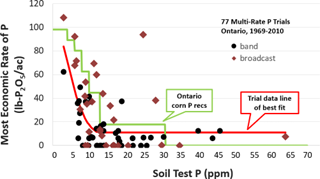
Even when fertilizer prices are high, if you have a very low soil test P, there is a good probability of a large yield response and return on fertilizer investment. Conversely, when soil test P is high, probability of a yield response in that year is likely low. If 2026 looks to be a cost squeeze year for farmers, and your main concern is applying the most economic rate of P for that year, the current recommendations will do a good job of pointing you to the right rate. These recommendations are generally known as the “sufficiency” approach – apply the rate that provides the most optimum response for the current year.
Where sufficiency recommendations are often challenged is that as yields increase, the soil test value you must get to before recommendations are at least applying crop removal is driven down. Thus, soil test values will slip as yields increase. Some prefer to not let soil test values drop this low and use a “build and maintain” approach. Long term P and K trials in Ontario suggest that there can be yield penalties if soil test values are allowed to slip to very low levels, even when applying an optimum rate of P or K for that low soil test. However, in a year where fertilizer:grain price ratios may be higher than normal, and economics may be under a squeeze, sufficiency recommendations are likely a good way to balance agronomic risks and cash flows.
It should be noted that the data used in the above re-evaluation now ranges from 15-55+ years old. A research project funded by Grain Farmers of Ontario and led by Dr. Adrian Correndo, cropping systems professor at the University of Guelph, is underway to revisit the question of whether Ontario P and K recommendations still deliver optimum rates today. He is currently running rate trials on stations and farms across Ontario. •