
Making late nitrogen applications work
Producers should rethink best management practices for post-canopy corn fertility treatment
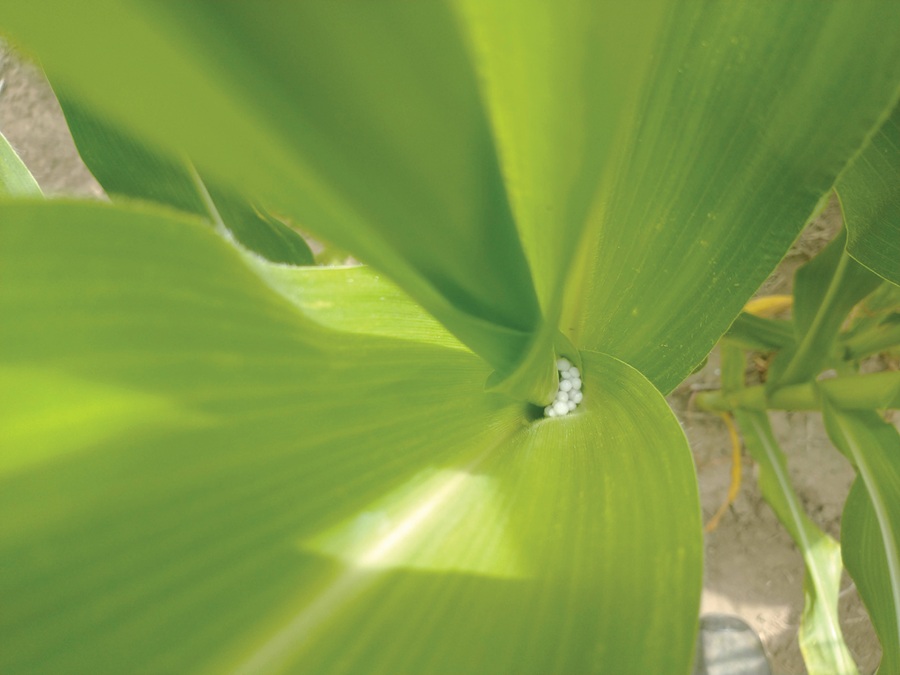
Applying nitrogen in late season corn allows more opportunity to fine-tune fertility rates, spread out labour requirements, and rescue corn impacted by early dry conditions.

To get the most out of post-canopy applications, producers need to rethink some common assumptions about how nitrogen fertilizer and volatilization inhibitors interact with moisture, soil texture, and plant physiology.
That’s the overall finding of a 4-year research study by a University of Guelph team trying to determine best management practices for post-canopy applications.
Research team leader Dr. Joshua Nasielski says the key was to identify factors limiting or encouraging the absorption of nitrogen in corn at or past V8, while reducing the risk of losses from vola-tilization.
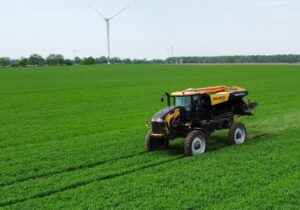
Some growers broadcast, others use Y-drop systems, Nasielski says. The researchers tried to address the right split for nitrogen applied late – how much nitrogen can you delay in terms of your total nitrogen budget, what’s the best placement for urea and UAN, and what’s the best use case for volatilization inhibitors.
MEASURE ATMOSPHERIC LOSSES
Here’s why volatilization inhibitors are important.
As urea breaks down, it turns into plant-available ammonium. That ammonium can also volatilize to gaseous ammonia though, which can be lost to the atmosphere. Volatilization is more common with insufficient soil moisture, but it’s not the only way volatilization can happen.
Nasielski’s study (using dositubes as measuring devices) found average volatilization losses in Ontario were 38 pounds per acre, although the range of results was significant. Individual results vary from field to field, rate to rate, and year to year. But Nasielski says their research at field sites in Winchester, Elora and Ridgetown confirmed some long-held assumptions about volatilization risk.
First, and most obvious, is that rain is required to push top-dressed nitrogen into the soil profile, and in late season applications, that nitrogen is needed by the plant as soon as possible. Researchers say findings consistently showed corn yields suffered if late season applications were combined with a prolonged no-rain period.
OTHER FINDINGS WERE LESS INTUITIVE
The yield benefits of late applied nitrogen were more consistent on sandier soils. No benefit was observed in other locations with different soil types, in part due to a short absorption window.
Nasielski says applying nitrogen at V13 in Ontario, 10 to 12 days before silking, is too late to expect a yield response if there is no rain. Further south, in corn-producing US states such as Illinois or Indiana, where 20 or more days intercede between V13 and silking, a greater possibility exists of seeing that response. But in Ontario, Nasielski says economically you would be losing yield applying nitrogen that late. There would not be an economic payback at V13, but applications made at V10 might be more worthwhile for Ontario growers.
Nasielski says the amount of rainfall required to supress volatilization late in the season was also surprising – a result of the physiology of tall, closely planted corn – as was the impact of wet soils at application time.
Corn leaves channel rain away from the row middle where fertility product is placed, limiting contact with surface-applied product and the rate at which it enters the soil profile. Significantly more rain – as much as 7.5 centimetres (3 inches) – is needed to avoid this problem. And if urea is broadcast on wet soils, volatilization starts immediately.
“Even if it rains three days later you can lose a lot,” Nasielski says.
TO INHIBIT, OR NOT?
Volatilization inhibitors are widely regarded as an effective go-to tool for increasing the longevity of nitrogen fertilizer. However, in some cases, their use has been proven to actually hurt the bottom line.
“If you’re applying any nitrogen on the surface, urease inhibitors will significantly reduce losses from volatilization,” Nasielski says. “This was consistent at every site location every year. But they are much more economically beneficial if you’re using urea compared to UAN because UAN already has much less loss.”
Applying 50 pounds of urea per acre, plus an inhibitor at $0.125 per pound of urea, provides an average return of $14 per acre more (assuming corn is priced at $4.50 bushel). Applying the same rate of UAN, with an inhibitor costing $0.105 per pound of fertilizer and the same average corn price, also returned about $14 per acre. There were notably more cases where the additional cost of the inhibitor incurred financial losses when added to UAN, though.
“Sometimes we weren’t getting high losses with UAN, so net returns could have been negative. But I think overall, if you’re surface applying urea or UAN, the net returns are going to be positive,” Nasielski says.
UREA IS SAFE TO TOP-DRESS
Yield penalties from fertilizer whorl and leaf burn were also analyzed. In experimenting with what Nasielski calls the worse case scenario – 160 pounds of urea or UAN directly entering the whorl of corn plants across one acre – yield impact was not observed at or below 5 per cent damage. Above that, yield potential starts dropping at half of 1 per cent for every additional per cent of leaf burn. Six per cent damage to the canopy, that is, will incur half of one per cent drop in relative yield.
Similar losses to yield potential begin once 15 per cent of the surface area of ear leaves are burned.
“Leaf scorching has to be very significant to matter,” Nasielski says, adding crop insurance assessments for hail-induced leaf loss account for a similar yield penalty model.
“The takeaway is broadcast urea rarely caused burn severe enough to cause yield loss. Only UAN consistently caused enough burn to reduce yield potential. I think that is the big take away: urea is safe to top-dress. Even with observable burn, it won’t cause yield loss.”
Cation exchange capacity (CEC) – a soil property, measured in cmol (100 mol) per kilogram, used to predict plant nutrient availability and retention – was also found to significantly impact the net returns of inhibitor additives.
Nasielski says when soil CEC is above 23 cmol(+)/kg, volatilization losses are already going to be low. So, the chance of positive net returns to using an inhibitor on surface-applied UAN or urea on a soil with CEC greater than 23 are less frequent (33 per cent chance of positive net return). On soils with CEC less than 23 cmol(+)/ kg, volatilization losses are often higher, so the chance of positive net returns to an inhibitor were 90 per cent when used on surface-applied urea or UAN.
“The bottom line is that in heavy clay, an inhibitor is much less likely to make a difference late in the season. You’re not losing a ton of money, but in terms of profitability you have a lower chance,” he says.
Finally, Nasielski and his colleagues determined “luxury nitrogen” – nitrogen taken up by the plant and stored in the lower stems for potential later use – can benefit the plant during grain fill, if occurring under dry conditions.
“Plants use the luxury nitrogen in place of taking up more nitrogen from roots,” he says. “It’s also good in very high yielding conditions because you’re getting extra yield with bigger kernels, not just more kernels per plant. Those kernels are helping to contribute to high yield.”
Overall, Nasielski says split nitrogen applications late in the season can work. Whether he recommends the approach, though, is another matter.
“As a scientist, you have to look at what the data says, and the data makes me more cautious about recommending more aggressive splits going later than V10 in Ontario. I still think late applications have a place, if you’re adjusting your rates, because it gives the farmer more control. Something like adding the last 50 pounds of nitrogen at V10 is likely no problem if you have 150 pounds up front.”
ACKNOWLEDGEMENTS:
This research was funded by Agriculture and Agri-Food Canada and the Ontario Agri-Food Innovation Alliance, a collaboration between the Government of Ontario and the University of Guelph.
The support of the Natural Sciences and Engineering Research Council of Canada is also acknowledged. •