
A new twist in the spider mite fight
Insecticide resistance grows and new species emerge
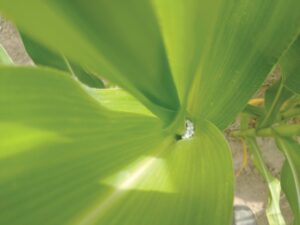
With hotter and drier summers, mites’ populations spread and increase, making them more visible. Growers are helping provide field samples to researchers looking at appearance and resistance patterns.

Soybeans have been hammered by an increasing number of challenges, from aphids to herbicide-resistant weeds to increased genetic resistance in soybean cyst nematode. Now, researchers are responding to insecticide resistance in two-spotted spider mites…and with it, some concerning trends.
Research funded in part by Grain Farmers of Ontario is supporting a team led by Prof. Vojislava Grbic of Western University’s Department of Biology that is studying two-spotted spider mites’ rapidly developing resistance to insecticides.
Team members are particularly concerned about dimethoate, the active ingredient in Lagon 480-E and Cygon 480-AG, the only products registered for use against two-spotted spider mites in soybeans. This insecticide has been used extensively to combat other pests like soybean aphid for more than 20 years. And there are questions about registration and cost-effectiveness.
The lab is working on discovering the unique features of mite biology. Work to date has focused on testing the spider mite’s resistance to 6 actives other than dimethoate:
- abamectin (Agri-Mek)
- bifenazate (Acramite 50 WS and Floramite SC)
- cyflumetofen (Nealta and Sultan)
- etoxazole (TetraSan 5 WDG)
- pyridaben (Nexter and Dyno-Mite) and
- spiromesifen (Oberon and Forbid).
Oberon is registered for use in Canada in corn and dry beans. Pyridaben (Nexter) is registered for use with fruits and tree fruits. Marketed as Dyno-Mite, it’s registered for use in the greenhouse sector and in ornamentals. As an insecticide in field crops, neither product is cost-effective.
RESISTANCE ON THE RISE
According to a post on the Ontario Ministry of Agriculture, Food and Agribusiness (OMAFA) website, mites cause yellowing (stippling) on the upper leaf surface. Plants may appear to be drought stressed, with the yellowing becoming severe before the leaves turn grey-brown in colour, indicating necrosis.
Grbic notes that the mites have been present in Ontario fields for years. However, with weather extremes – especially hotter and drier summers – the insects’ populations spread and increase, making them more visible.
Since 2021, Grbic, Dr. Joseane Moreira do Nascimen-to and Dr. Vladimir Zhurov – with support from Tracey Baute of OMAFA and Dr. Ian Scott from Agriculture and Agri-Food Canada (AAFC) (London) – have been gathering and testing spider mite samples from across Ontario.
In 2021 and 2022, the researchers tested 31 mite populations from soybean fields. Samples were mostly provided by growers. This sampling showed 18 populations (58 per cent) tested resistant, based on a 40 per cent kill rate threshold to dimethoate.
In 2023, there were no samples submitted due to heavier-than-normal rainfall across Ontario, which would have washed spider mites off leaves. According
to the 2024 summary report, the team received 10 mite populations. In contrast, during the 2025 growing season, 52 samples were submitted, and 38 contained enough live mites for the analysis.
The primary species of interest is Tetranychus urticae. But what complicates matters is the emergence of two other species of spider mites: T. turkestani, also known as the four-spotted or strawberry spider mite, and another species newly discovered in greenhouses and some soybean fields.
Grbic says the key to this broad analysis has been support from growers. “They see mite damage and they collect leaves and send them to us,” she says. “The fact the mites are already widely spread in southern Ontario would indicate that growers are being alerted and are collecting the leaves with damage caused by mites.”
Adds researcher Moreira do Nascimento: “It was remarkable how many samples were sent in 2025, representing a substantial increase in monitoring efforts and mite occurrence.”
PARTNERSHIPS FOR PROGRESS
Grbic says the researchers are pleased to have established partnerships with grower associations. “This dialogue with growers lets us know what are the burning issues, so we can put our efforts into that work for the greatest benefit of growers. We thought we should establish contacts with growers, realizing that people are actually losing money because of this organism.
We have a responsibility to give back to people who have it, affecting their ability to produce the crop and earn profits out of that.”
Work is also underway to develop an RNAi-based pesticide against mites. Researchers are collaborating with a U.S.-based company, which at press time was planning to submit a dossier to the Environmental Protection Agency. The product is said to be a completely different mode of action (IRAC MOA 35) which would be helpful in battling resistance. The company involved has already registered RNAi-based pesticides against Colorado potato beetle and Varroa mite.
This research was supported in part by Mitacs through the Mitacs accel-erate program. •