Expanding the wheat-breeding pipeline
Here’s a boost to help producers be prepared for the sector’s future needs
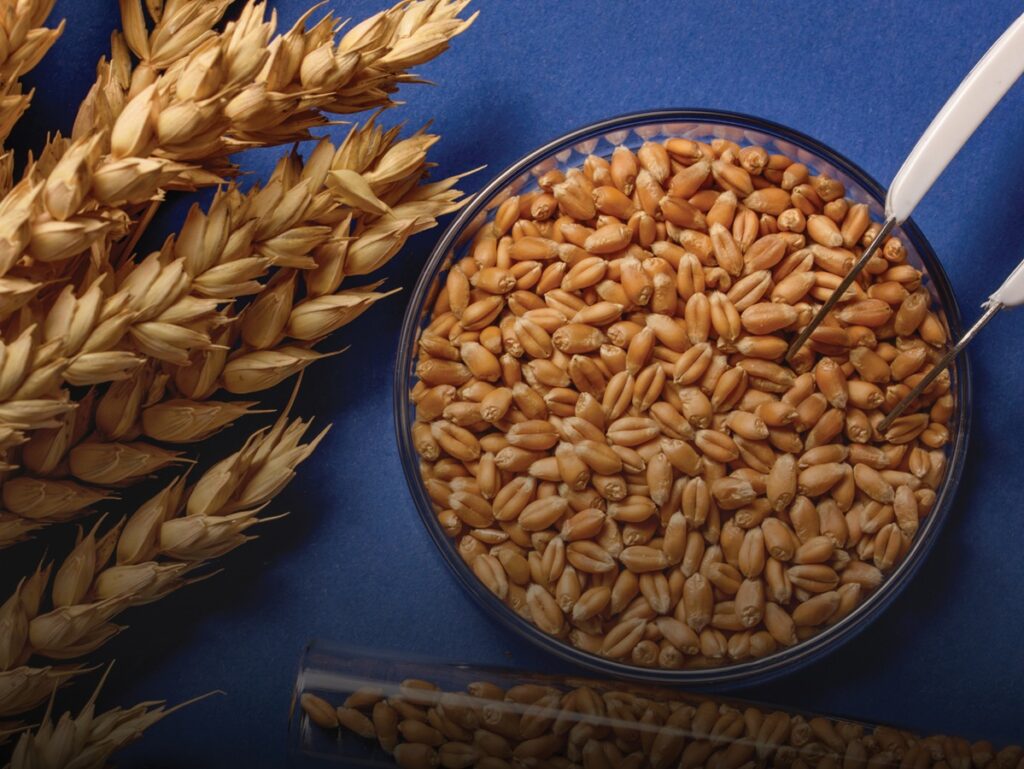
A hard red wheat (HRW) research project is helping Ontario’s wheat industry by boosting germplasm development efforts to pinpoint the traits growers need in the years ahead.

By incorporating a focus on the early identification of forward-looking traits, researchers are expanding the wheat breeding pipeline to develop a more diverse suite of characteristics.
This approach is poised to deliver enhanced resilience, improved sustainability and new, improved varieties for growers.
The 3-year project – dubbed “Climate-smart trait development to increase resilience of Eastern Canadian hard red wheats” – aims to develop new hard red winter-and spring wheat traits and varieties that will strengthen the resiliency of future wheat production in Ontario, Quebec, and the Maritimes.
That’s encouraging news for wheat growers. But what makes this initiative unique is its stronger emphasis on germplasm development. This pre-breeding investment takes a deeper dive into identifying the traits growers will need in the years ahead, including new germplasm with multiple disease resistance, higher and more stable yield, improved nitrogen-use efficiency, and biological nitrification inhibition.
In the variety development phase, researchers will focus on developing market-ready HRW varieties by combining key traits and testing them in field trials across different regions and growing conditions in the province and across Eastern Canada.
By combining the germplasm and variety development approaches, new desirable genetics will be identified and incorporated into hard red spring- and winter wheat varieties.
BREEDING FOR RESILIENCE
Dr. Andrew Burt, Agriculture and Agri-Food Canada (AAFC) research scientist at the Ottawa Research and Development Centre, where the germplasm development component of the project is being conducted, says the instability of our environment is making it increasingly difficult for Ontario farmers to grow cereals, especially in recent years.
“The only real way to tackle increasing disease, weather stress and yield challenges is by improving genetics,” he says.
That’s why Burt and fellow AAFC research scientist Gavin Humphreys have teamed up with Dr. Michel McElroy, a research scientist from Centre de recherche sur les grains (CÉROM) in Saint-Mathieu-de-Beloeil, Que., who is leading the variety development portion of the project.
Burt says that the AAFC team is identifying traits that will enhance the resilience of HRW and can be integrated into variety development programs. He says these climate-adapted traits will enhance the resilience of wheat under stressful and variable environmental conditions along with new disease pressures that come with changing weather patterns.
“The greater the genetic diversity, the greater the opportunities our downstream breeding partners will have in developing varieties that will reduce the long-term risks growers face,” he says.
Adding a strong germplasm development phase to the variety development process will increase the number and diversity of traits available for further breeding. The next step of the project focuses on incorporating these traits into variety development programs, ultimately providing seed companies with advanced genetic lines. These new lines will lead to a wider range of HRW varieties that perform well for Ontario growers, meet the quality needs of end users, and hopefully expand Ontario’s HRW acres.
GENETIC SOLUTIONS
To identify the necessary traits that will help farmers cope with the new realities of climate change and expand opportunities for HRW acres, researchers need only to look at the current challenges growers are facing… and expect the need for solutions-based genetics to amplify.
For example, researcher Humphreys says that fusarium head blight has been getting worse in recent years because of changing weather conditions. The AAFC team also expects rust diseases, including leaf and stripe rust, to become more common and damaging in Ontario wheat fields. Team members also predict powdery mildew to become more prevalent. In an effort to achieve the strongest possible disease-resistance package, the research team is planning ahead, working toward stacking several resistance sources into one line and one set of germplasm.
“Disease pressures change when new inoculum arrives due to southern wind patterns, and we need to be able to protect our crops, especially against these key yield-robbing diseases,” Humphreys says. “Our best defence will always be genetic resistance.”
The team is also taking this in-depth germplasm development opportunity to explore novel genetic traits that can serve the industry, including biological nitrification inhibition. As a proactive climate-resilience trait, the nitrification inhibition trait would improve wheat roots’ ability to suppress the bacteria that turns ammonium into nitrous oxide. In other words, in the future, growers could leverage wheat genetics to retain more plant-available nitrogen in the root zone, while at the same time, reducing greenhouse gas emissions from the field itself.
“We’re still in the early stages of exploring this nitrogen use efficiency germplasm, but this valuable research will provide growers with new tools to manage environmental changes,” says Burt.
GROWING OPPORTUNITIES
Improving the yield and quality of new HRW varieties is another key factor of this research project. There’s plenty of potential for HRW in Eastern Canada, including growing demand for spring- and winter hard red wheat from millers, not to mention the benefits that wheat can offer growers when incorporated into a crop rotation.
Today, millers and flour processors in Eastern Canada rely on local wheat, yet demand for HRW is already more than double what’s currently being produced.
“There’s an incredible amount of potential in Ontario for hard red wheat, especially for millers and bakers who are looking for locally sourced ingredients,” McElroy says. “This project is also looking to expand the growing regions for these wheat classes that will open new market development and agronomic opportunities for growers.”
With its naturally high protein content, HRW often earns higher premiums, making it an attractive choice for Ontario growers. This research aims to enhance that appeal by boosting yield potential and strengthening disease-resistance and environmental resiliency traits.
The HRW project, which launched in 2025 and is slated to finish in March 2028, has completed its first growing season, marking an important step toward delivering future-ready results. With new varieties often taking 10 or more years to reach commercialization, the team must be future focused. “We take a long view on the changing dynamics and needs of wheat growers,” Burt says. “The success of this project will reflect our pre-breeding focus, along with the cross-provincial tests that will provide dependable data for growers making variety decisions 10 to 20 years down the road.”
This HRW project is funded through the AgriScience Program under the Sustainable Canadian Agricultural Partnership (Sustainable CAP), with industry support provided by Grain Farmers of Ontario, SeCan, Producteurs de grains du Québec and the Atlantic Grains Council. •