
Field Observations
SPRING 2026
June 18, 2026
As summer arrives this weekend, crops continue to develop. A welcome break from high temperatures, along with some moisture, will greatly help the grain-fill period for winter wheat. Continue scouting for pests and diseases in all crops.

Corn
Crop development has been rapid, with heat units accumulating quickly before the recent cooler weather. Much of the corn crop is between emergence (VE) and the V8 stage (nine-leaf). The V stage refers to the vegetative stage and is determined by counting collars on the corn stalk. From V6 to V10, corn plants develop the ear, and kernel numbers per row and rows per cob are determined. Stress in the coming weeks from a lack of nutrients or moisture can reduce yield potential by reducing kernel numbers.
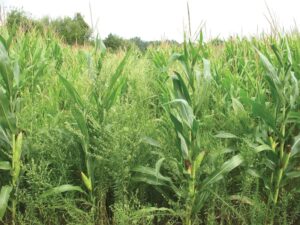
As corn plants develop rapidly, plant variability is showing up as evidence of compaction damage from tillage or planting when conditions were too wet. This can appear as smaller plants that are purple or yellow because limited root development is restricting nutrient uptake in impacted soil.
Tar spot infection is often observed and confirmed in Ontario corn fields in the next few weeks, usually during the first two weeks of July, in fields where tar spot has been present in previous years and spores are present locally. Check the bottom of the canopy for these local infections. There are still some variables, but if weather conditions are conducive — 15 to 21 C, high relative humidity, saturated soil, and leaf wetness — the disease can develop. Disease progression will depend on the weather and the spore load from infected fields. Spores coming from other fields will show infection starting at the top of the canopy. For more information on tar spot and what to look for, read the Grain Farmers of Ontario Tar Spot Factsheet. Tar spot has already been identified in fields in Indiana this year.
Be on the lookout for black cutworm, which can cause problems in corn fields. Fields without insecticide-treated seed or Bt hybrids containing Cry1F or Vip3A should be prioritized for scouting. Learn more about what to look for in this past Field Crop News article. Cooler, wet weather can create ideal conditions for pests.
Soybeans
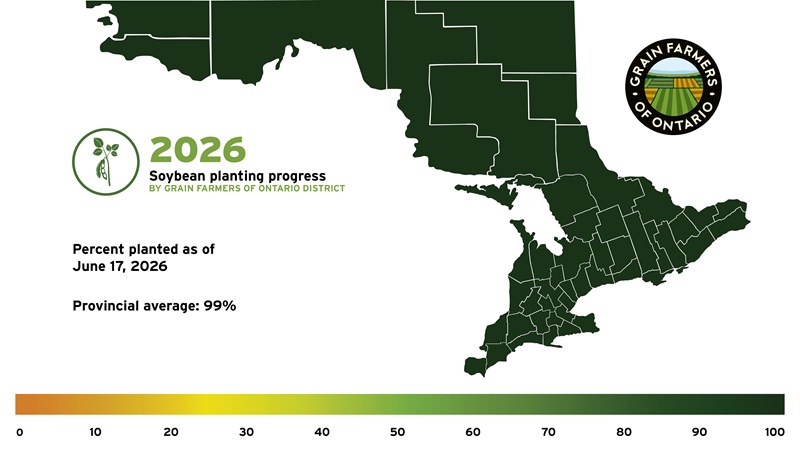
Field Progress, Grain Farmers of Ontario’s weekly estimate of planting and harvest across the province by district, reports that soybean planting is 99 per cent complete across the province as of Wednesday, June 17, 2026.
Soybeans are up to the fourth trifoliate (V4) in many areas, with some later-planted fields just emerging. In recent weeks, some soybeans were struggling in areas that had very heavy rain after planting, which created crusting and slowed emergence. Recent rains have hopefully loosened those heavier soils, allowing soybeans to emerge.
Be on the lookout for insect pressure, especially on fungicide-only or untreated soybeans.
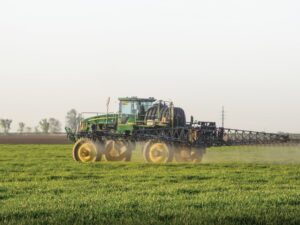
As herbicides and other plant protection products are applied across soybean fields, Be Drift Aware. Simple steps to reduce drift include:
- Choose nozzles that produce the largest droplet size.
- Lower the boom to the lowest practical height.
- Spray in ideal wind conditions, when wind speeds are between three and 10 kilometres per hour.
- If wind speeds are too low, inversion conditions may be present; if they are too high, downwind spray drift increases.
Learn more about managing drift with Dr. Jason Deveau in a past Grain Farmers of Ontario GrainTALK webinar here.
Cereals
Winter barley harvest is ongoing.
Spring cereals are ranging from emergence to stem elongation stage, depending on planting date and location in the province.
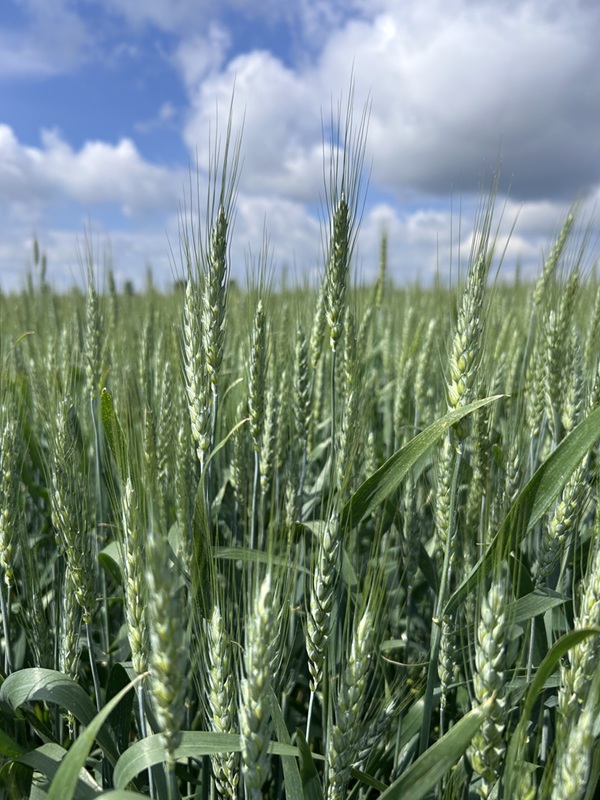
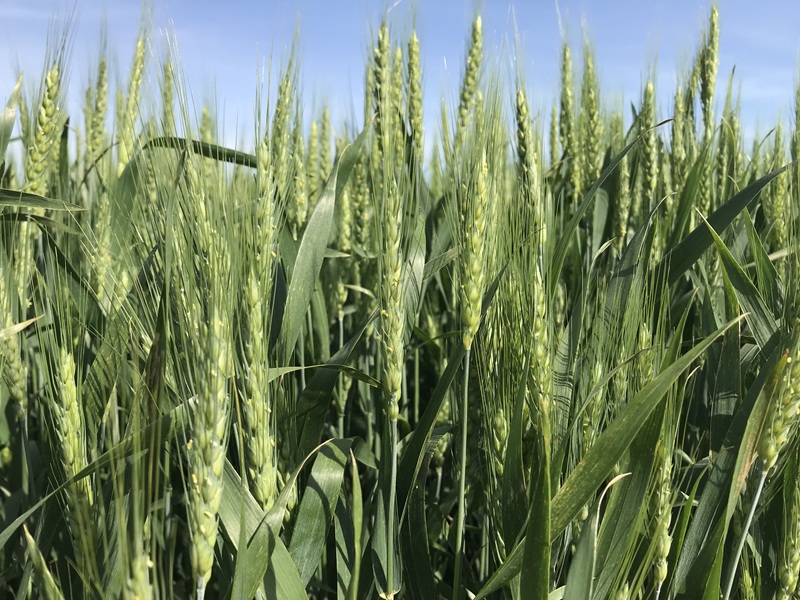
For winter wheat, stages range from milk stage (GS 69 — flowering complete) to dough stage (GS 87 — hard dough). Standability appears good so far in most areas. However, some fields are seeing lodging where nitrogen (N) rates were high, where manure traditionally high in N was applied, or where heavy rain has occurred.
T3 applications are still ongoing in areas where wheat is flowering. Stripe rust continues to be identified, and timely T3 fungicide applications can help protect the crop against the disease.
As temperatures increase, crop development speeds up. The optimum average temperature range for anthesis and grain filling in wheat is 19 to 22 C. The high temperatures seen last week would have affected grain fill for advanced fields, but long-range temperatures are expected to be close to ideal for grain fill across much of the province. Timely rain will be needed, as this is a period of high water demand for the crop. In general, much of the province has a good supply of soil moisture, but this may be tested in the coming days if timely rain does not occur.
Keep an eye out in developing wheat for fusarium-damaged kernels (FDK). Fields showing fusarium infection should be harvested first and combines should be adjusted to blow fusarium-damaged kernels out the back of the combine because of their light weight. This will help improve the grading factor. As harvest nears, be sure to scout for the disease, harvest appropriately, and set combine settings accordingly.
Be on the lookout for true armyworm and cereal leaf beetle provincewide and be prepared to spray as warranted. More on these pests has been covered in past e-news reports. Barley yellow dwarf virus, vectored by cereal aphids, is also being identified in fields.
Interim update: Drone application of pesticides
Health Canada has issued an interim Letter of No Objection allowing remotely piloted aircraft systems (RPAS), including drones, to apply pesticides that already have an aerial application label.
This means that, in certain situations, products labelled for aerial use can now be applied by drone, provided all existing label directions for aerial application are followed exactly, including application rate, spray volume, droplet size, buffer zones, and any other conditions of use.
Additional requirements include:
- Two separate individuals: one for mixing and loading, and the other for drone operation.
- Full compliance with required personal protective equipment for mixers, loaders, and drone operators.
- Adherence to all applicable federal and provincial regulations, including pilot certification.
A final policy on drone application of pesticides from Health Canada will be published in the near future.
As an additional recommendation, farmers should contact the chemical manufacturer for technical guidance to ensure proper drone application. Because this is a new and emerging application technology, technical guidance can help support product efficacy and crop safety.
June 11, 2026
Corn planting has mostly wrapped up, with soybean planting still underway in areas across the province. As the growing season progresses, scouting continues for weeds, diseases, and insects, with a particular focus on stripe rust as it continues to move across the province, along with insect pests in cereals.
Corn
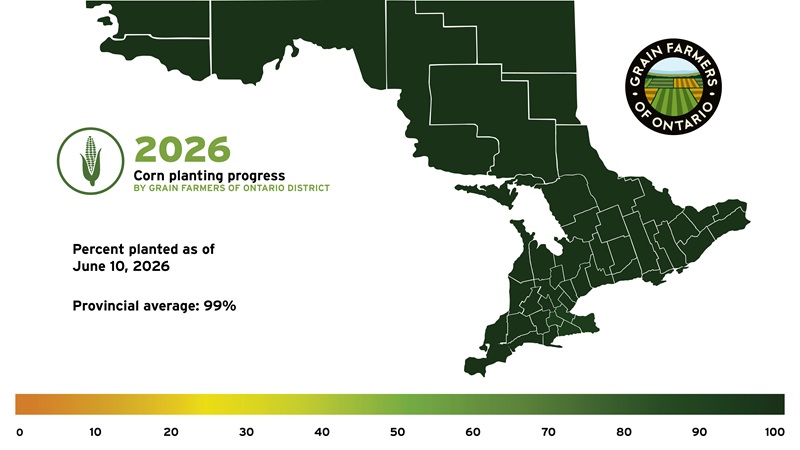
With 99 per cent of the corn crop planted, according to Field Progress as of June 10, any remaining acres will soon be switched to soybeans if they haven’t already. Those who have livestock and need corn for feed will be changing hybrids to account for the later planting. The Agricorp corn planting deadline for Areas A, B, and C for crop production insurance is June 15. Initial and replanted acres must be planted before the deadline to be insured. Replanted acres planted after the deadline will need to be kept separate at harvest; call Agricorp for more details.
Rains moved across the province over the weekend; however, they were spotty. Over the past few days, storms have moved through with some variation in where, and how much, moisture was received. One small upside to things being a bit on the dry side now is that roots will drive deeper into the soil to capture moisture, setting the plant up well for the summer. But rain would be appreciated to give crops a bit of a reprieve.
The growth stage for much of the crop is between three and seven leaves (V2 to V6 collar); however, some corn fields are still emerging in areas that saw later plantings. During the early V stages, the corn plant develops nodal roots under ideal conditions. Before nodal roots develop, the plant depends on support from the seminal roots and kernel. Uneven plant development in the field at this stage could be caused by damage to the seed kernel reserve and seminal roots. Stressors that might affect the young corn plant’s root development include salt injury from fertilizer, herbicide injury, seedling disease, insect feeding, compaction, and very wet or dry soils. Ideally, nodal roots will tap into the starter fertilizer band and use that nutrition for optimum development. Corn seedlings will begin growing rapidly in the coming weeks.
Application of herbicides has been challenging in some cases this year because of higher winds. Timely weed control is critical for top yields. As shared in last week’s writeup, there is a significant loss in both bushels and dollars due to delayed herbicide application during the critical weed-free period. Areas that are still experiencing dry conditions could be seeing limited activity from some herbicides, as different active ingredients have different rainfall requirements for activation. Overall, aim to avoid applying herbicides during extreme temperatures and drought. On the flip side, too much moisture can decrease efficacy, as the active ingredient moves below the weed germination area in the soil. Excess moisture can also cause the active ingredient to affect the growing crop, causing crop injury in some cases. Always read and follow herbicide labels for timing, application instructions, and more.
Nitrogen uptake in corn plants is currently increasing as the season continues, with 63 per cent of plant N taken up by flowering and 37 per cent taken up after flowering (OMAFA Pub. 811). To improve N-rate accuracy, pre-sidedress soil nitrate tests, or PSNTs, are taken in corn to determine the level of soil nitrate-nitrogen (NO3-N) just before plant uptake becomes rapid, as the crop enters a phase of increased growth and development. Testing helps determine whether additional N fertilizer should be applied through sidedressing to meet the crop’s needs. Some updates specific to soil sample handling for PSNTs have recently been made. Find the correct sampling and handling procedures here. Sidedressing is occurring or will be shortly.
Keep an eye out for nutrient deficiencies in fields. Potassium (K) deficiencies show up visually as yellowing and browning of the lower leaves. The symptoms start at the tip of the leaf and spread along the margins. Slow growth can also be observed. Dry weather could especially be affecting the incidence of K deficiency and nutrient uptake in some cases across the province. Phosphorus deficiency shows up as purpling on the lower leaves along the margins, veins, and stems, along with potential stunted growth. N deficiency shows up as yellowing on older leaves that progresses into an inverted “V.” A tissue test or soil sample might be needed to help confirm what is deficient. Try to compare tissue tests from an area experiencing the deficiency with an area that is not. Low soil test levels, environmental conditions, and/or field conditions can all play a role in why a deficiency is showing up.
Corn rootworm trap network participants are needed to help trap and count corn rootworm (CRW). The traps are free, funded by Grain Farmers of Ontario, with trapping to begin in July. Data is entered weekly and helps monitor for Bt-resistant populations and scout the corn crop. Higher levels of CRW are anticipated this year because of the mild winter and warm spring. More information on CRW and insect resistance can be found in this Grain Farmers of Ontario Corn rootworm factsheet. Contact Tracey Baute, OMAFA, if interested.
CHU accumulations for Elora from May 1 to June 9, 2026, are 697 CHU, compared with the five-year average of 666 CHU. For Ridgetown, 948 CHU have accumulated during the same period, compared with the five-year average of 786 CHU. For Kemptville, 738 CHU have accumulated during the same period, compared with the five-year average of 710 CHU.
Soybeans
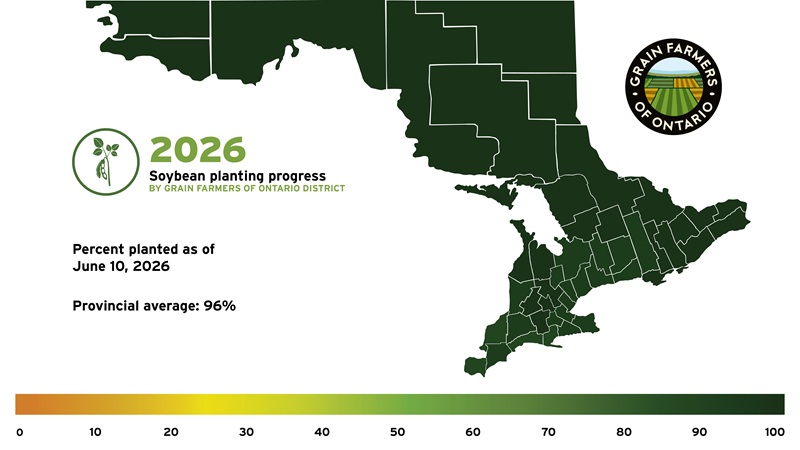
Soybean planting provincewide is 96 per cent complete, according to Field Progress, with several regions still planting.
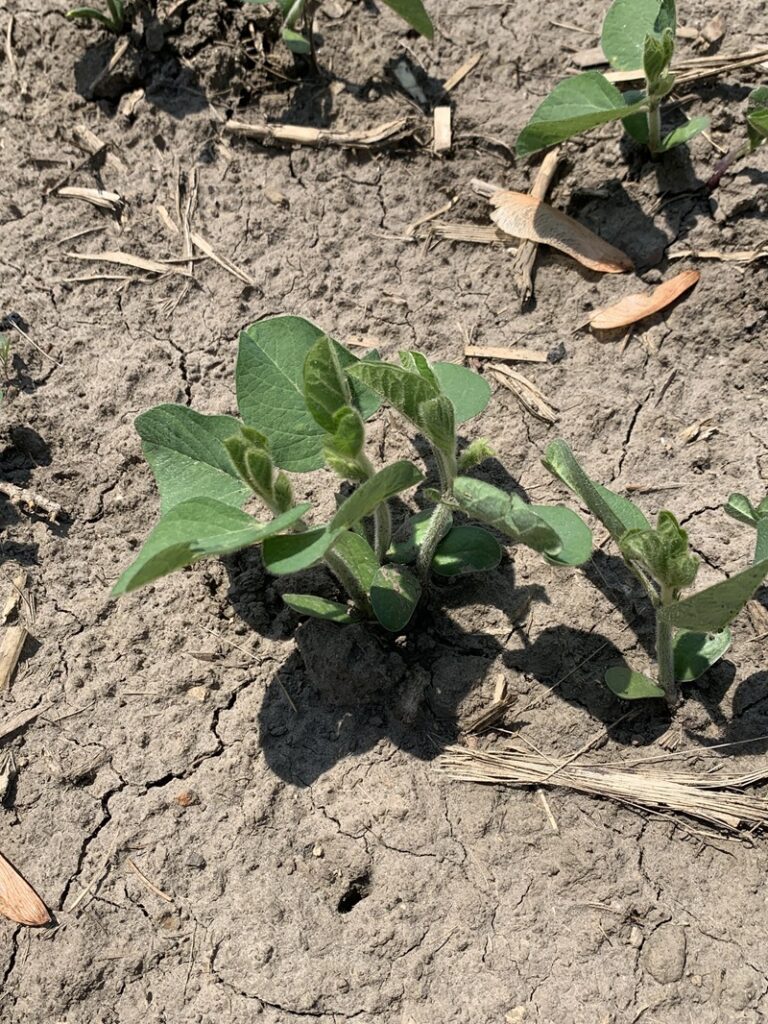
Soybean stages range from just planted all the way up to the second trifoliate (V2). Now is a good time to check plant populations. Soybeans can compensate for lower stands, such as 90,000/acre on a loam or 110,000/acre in clay; however, a later planting date may affect some management decisions this year.
Insects to be on the lookout for:
- Slugs can cause damage this time of the year.
- Bean leaf beetle pressure on emerged fields. This is a good reminder that rotating crops is important, as they often are observed in second-year soybeans.
- Black cutworm and wireworm can also cause damage, lowering plant populations and causing replants in some fields. Be sure to scout and do stand counts, counting only the healthy plants, while assessing the size of the pest to determine if corrective action will need to be taken. If the pest is too large, it will be hard to control.
- Other pests that can affect crops early in the season can be found in the Guide to Early Season Field Crop Pests.
There have been some discussions about switching to shorter-season varieties for areas still planting, seeding rates, and the effects on yield as planting moves further into June. A helpful article shared in past years at Field Crop News can help address these questions. Overall, increasing the seeding rate is advised as the month progresses, but if the plan is to get wheat in the ground in a timely manner, then a change might be warranted. However, planting an early-maturing variety late in the season will produce a short plant with fewer pods, affecting potential yield.
When applying herbicides, fungicides, and insecticides, always aim for best practices. Rotate active ingredients, ensure pests are at threshold, and use other key resistance-management strategies. Manage Resistance Now is a fantastic resource on herbicide, fungicide, and insecticide resistance, as well as IPM practices to avoid resistance.
Drift is the unintended aerial movement of plant protection products away from the intended target. Any time spray is applied, there is a potential for drift. There are simple steps that can be taken to reduce it – Be Drift Aware.
Cereals
Winter wheat is staging from the boot stage to flowering (GS47, flag leaf sheath opening, to GS71, kernel watery ripe). With recent warm weather, the wheat crop is moving through growth stages quickly.
T3 fungicide timing during flowering is occurring across the province, as applicable to staging. While conditions may be lower risk for the incidence of FHB this year, depending on the area and weather patterns being experienced, a T3 fungicide may still be highly recommended to protect the crop from stripe rust.
Stripe rust is still being identified in fields as far east as Wellington County in Ontario and has also been identified in the Maritimes. Be sure to scout, make note of which varieties are highly susceptible, and use those notes to help choose varieties next year. Visit the up-to-date map to see where stripe rust has been identified. Keep scouting across the province for this disease.
Management recommendations from OMAFA for stripe rust-affected areas are to “apply a fungicide immediately in susceptible varieties if T3 timing is 7–10 days away and stripe rust is present. Proceed with T3 fungicide 4–6 days after full head emergence, if an earlier application is made to protect against stripe rust. If within one week of T3 timing, applications can be timed accordingly depending on variety susceptibility.”
Pressure from other diseases is also being observed. Scout and manage as needed.
Ensure the sprayer is cleaned out well prior to spraying fungicides.
Be on the lookout for pests; true armyworm trap counts have increased, and cereal leaf beetle and cereal aphids should be scouted for, as some areas are meeting spray thresholds. More on these pests and their thresholds can be found here. Keep an eye on pre-harvest intervals (PHIs) for insecticides.
Some N deficiencies are showing up in wheat, often as stripes across the field from dry broadcast applications as opposed to liquid applications.
Spring cereals are in the tillering to stem elongation growth stages.
New CropLife Canada Resource for IPM
CropLife Canada has created a national platform for integrated pest management (IPM). Discover guidance for managing weeds, insects, and pathogens across multiple crops and regions. Explore it at the Canadian IPM Toolbox.
June 4, 2026
It’s been a busy several days in the fields, as many wrapped up planting, while others were finally able to get some acres into the ground. Scouting for weeds, insects, and disease is ramping up.
Corn
The last remaining acres were planted over the past week as fields dried out. Field Progress, Grain Farmers of Ontario’s weekly estimate of planting and harvest across the province by district, reports that corn planting is 93 per cent complete across the province as of Wednesday, June 3, 2026.
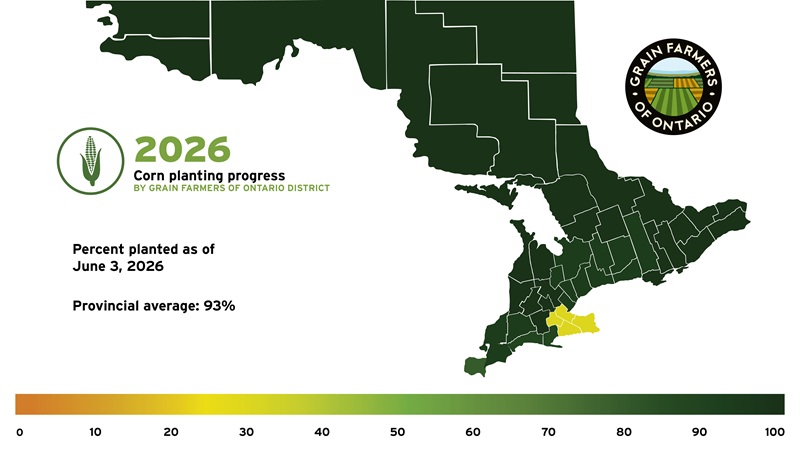
Corn is staging from emergence to the five-leaf stage (VE to V4). Weed control at this time is critical, as this is the weed-free period of the crop’s life, and any competition will affect yield. Research by Peter Sikkema in high-density weed environments has shown that if corn is seven days post-emergence with no weed control, there will be a $ 28-per-acre loss ($4 per day, with corn at $6.38 per bushel), and losses rise from there. Apply post-emergent herbicides as soon as possible to minimize losses.
Fields with little to no nitrogen applied will likely be side-dressed in the next couple of weeks, while those with N applied with starter or pre-plant fertilizer will be treated a few weeks later, when the crop has a higher demand for nitrogen. At the V3 stage, kernel reserves are starting to dwindle, and the corn seedling needs to switch to relying on nutrients delivered through the nodal roots. Any delay in that switch can affect plant growth.
To improve N-rate accuracy, pre-sidedress soil nitrate tests, or PSNTs, are taken in corn to determine the level of soil nitrate-nitrogen (NO3-N) just before plant uptake becomes rapid, as the crop enters a phase of increased growth and development. Testing helps determine whether additional N fertilizer should be applied through sidedressing to meet the crop’s needs. Some updates specific to soil-sample handling for PSNTs have recently been made. Find the correct sampling and handling procedures here.
Be sure to report acres before the Agricorp planting deadlines.
Soybeans
Field Progress reports that 80 per cent of soybeans had been planted as of June 3, 2026. Just a few acres remain to be seeded, although some clay fields have only recently become fit for planting after being oversaturated by the rain that fell in May.
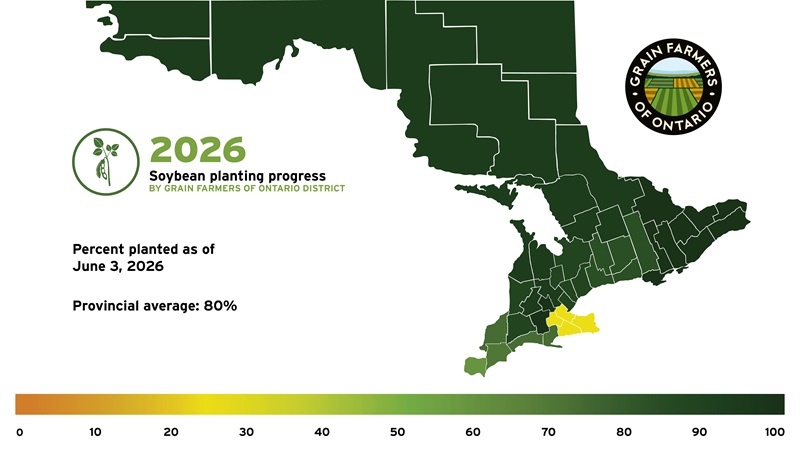
Fields should be checked two days after planting to see whether the seed has imbibed moisture and whether germination has begun, although imbibing moisture should not be a problem in most of the province this year. Soybeans are staging from emergence (VE) to first trifoliate (V1).
Some scouting questions to ask this week include:
- How is emergence? (More on stand assessments here.)
- What seeding mistakes are now visible as the crop emerges? What should be done differently next year?
- What weeds are in the crop, what stage are they at, and how soon can they be managed? The critical weed-free period for soybeans is the first to third trifoliate stage (V1 to V3). Overall, start clean and stay clean is a good rule to follow with soybeans, as yield is affected by weed pressure from emergence to V3.
- Did the herbicide application work, or are there weed species that are hard to control? Ensure an IPM method is being used to manage tough-to-control weeds (more at Manage Resistance Now).
- Which insect pests are affecting the crop (use Crop IPM to help identify them)?
There have been discussions about switching to shorter-season varieties, adjusting seeding rates, and the effect on yield as planting moves into June. A helpful article posted in a previous year on Field Crop News can help address these questions.
Be on the lookout for root rots, as many roots have been sitting in saturated soils. Phytophthora root rot and Pythium seedling and root rot could be present in fields.
Cereals
Spring cereal planting is now wrapped up, with Field Progress reporting it is 100 per cent complete.
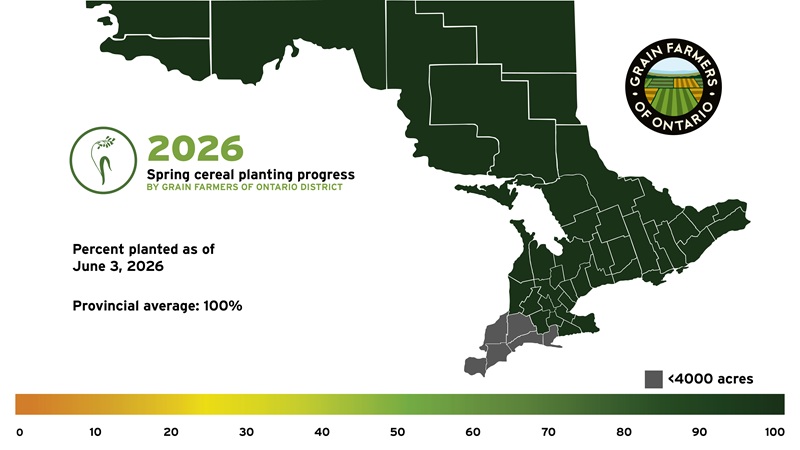
Winter wheat across most of the province is staging from flag leaf just visible (GS 37) to the beginning of flowering (GS61). T3 fungicide applications may occur as fields reach the spray window to protect the crop, as cereal crops are most susceptible to Fusarium head blight during the flowering period. Once 75 per cent of the wheat heads across a field have emerged, this is considered Day 0 for T3 timing. The optimum T3 timing is Day 2, the beginning of flowering, when anthers are dangling outside the florets in the middle of the wheat head. If days are warm, wheat can move very quickly through the growth stages, making the ideal window for a fungicide application limited.
Stripe rust has been identified in regions of southwestern Ontario. For a current map showing where stripe rust has been identified and reported in Ontario this spring, view the Ag Pest Monitor for wheat map. Stripe rust can be identified by small chlorotic lesions with yellow to light-orange pustules that emerge from the lesions. The pustules develop parallel to leaf veins, giving wheat a striped appearance. Ontario wheat varieties differ considerably in susceptibility. Investigate whether your wheat has high or low susceptibility by contacting the seed supplier or checking the provincial ratings at GoCrops.ca. All fields should be monitored closely through scouting. Left unchecked, stripe rust can cause significant yield reductions. Continue scouting for this disease across the province now that it has been identified, as this will help determine when a fungicide application is required. There are several variables that affect spray timing, depending on the crop stage and severity of infection. More on stripe rust can be found in this Grain Farmers of Ontario factsheet.
Pressure from other diseases is also being observed. Scout and manage as needed.
Around this time of year, insects become a hot topic in cereal fields. Monitor for cereal aphids, cereal leaf beetle, and armyworm, as they have been identified in fields across Ontario. More on scouting, identification, and thresholds is available here. For the best economic return, ensure the insect population threshold has been reached before spraying for control, and always follow the product label.
Ontario Herbicide-Resistant Weed Interactive Database
Explore herbicide resistance by county, see where species occur, and learn more here.
Mental Health
This has been a rough spring, with weather and geopolitical worries adding pressure. Managing stress and mental health is not easy for anyone. There are several support resources available if you need to speak with someone.
May 28, 2026
Planting is still ongoing across the province, with intermittent rain and variable soil conditions slowing progress in some regions. Corn and soybeans that have been planted are emerging.
Corn
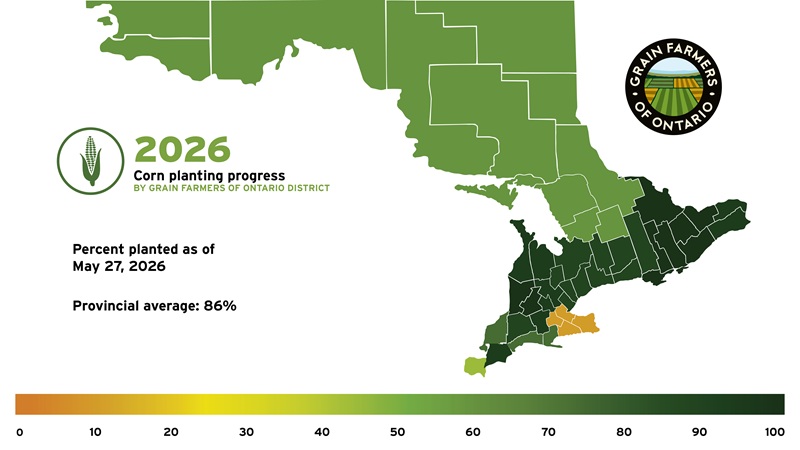
Field Progress, Grain Farmers of Ontario’s weekly estimate of planting and harvest across the province by district, reports that corn planting is 86 per cent complete as of Wednesday, May 27, 2026.
As shown in the map below, some areas have finished planting, while others are just getting started because of differences in rainfall, soil type, and field conditions.
Corn staging across the province ranges from just emerging (VE) to the two-leaf (V1) stage. With warm temperatures expected this week, emergence and growth in planted corn should progress well. Rapid emergence is ideal for newly planted seed.
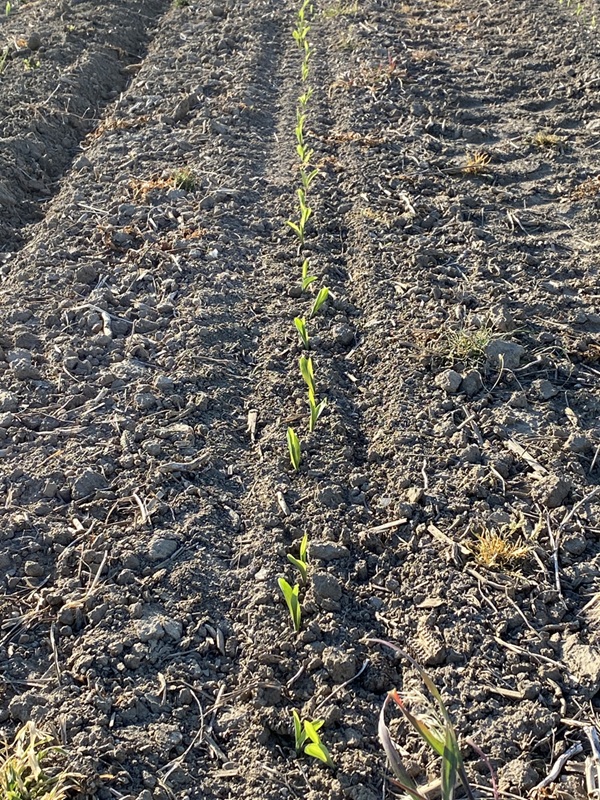
Rains moved across much of the province this past weekend, with some areas receiving more than two inches. Fields planted in loose, finely textured seedbeds that have received heavy rains after seeding should be monitored for crusting. Breaking the crust will allow seedlings to emerge and prevent leafing out underground, which would cause a reduction in plant stands.
In some parts of the province, remaining corn acres are being switched to soybeans as the calendar turns to June. In the deep southwest, it may still be worth staying the course with corn if a high-yielding short-season hybrid is available and the long-term rotation can be maintained. However, in areas that receive fewer crop heat units, there may not be enough CHUs left to mature corn planted this late and still achieve low moisture, high test weight, and strong yield at harvest.
Some emerged corn fields experienced a frost last week and into the weekend. For corn, there are no concerns at this time as the growing point is still well below the soil and protected. More on May frosts, here.
Soybean
Soybean planting is still underway. Field Progress reports that planting is 61 per cent complete, with some heavy-clay areas still not really underway.
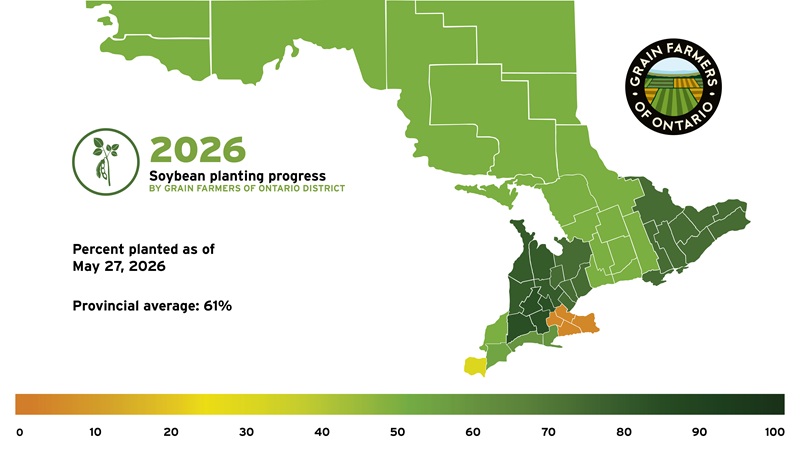
Yield potential for corn and soybeans is influenced not only by the calendar, but also by seedbed conditions. Planting into unfit soil can set the crop up for early stress and limit root development, reducing the plant’s ability to take up moisture and nutrients.
There has been discussion about switching to shorter-season varieties, adjusting seeding rates, and the potential effects on yield as planting moves into June. A recent Field Crop News article can help answer these questions.
Soybeans planted into ideal conditions earlier this month are emerging (VE).
As plants emerge, it is a good time to assess plant stands. Poor stands can result from seed rots, herbicide injury, insect pressure, and planter issues such as seed depth or compaction. One common way to do soybean stand counts is with a hula hoop. For example, toss a hula hoop that is 32 inches in diameter randomly into the field, count the emerged plants inside it, and multiply by 7,800 to estimate plants per acre.
Soybeans need significant force to push through the soil surface as they emerge. If there are fields of concern, check stand counts by taking physical counts and evaluating uniformity. The chart below can help estimate final yield potential based on stand uniformity under your field conditions.
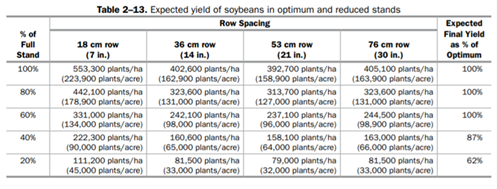
SOURCE: AGRONOMY GUIDE FOR FIELD CROPS, PUB 811.
Be on the lookout for root rots, as many roots are sitting in saturated soils. Phytophthora root rot and Pythium seedling and root rot could be seen in fields.
Do not be caught off guard with pre-emerge herbicide applications. In many fields, soybeans are up and growing, which limits which herbicides can still be sprayed. Speak with your agronomist about other options if soybeans are close to emerging. A good rule of thumb after a pre-emerge application is to set calendar reminders for seven, 14, and 21 days later to scout fields and determine whether the treatment worked or whether a rescue application is needed. Annual weeds are emerging.
Cereals
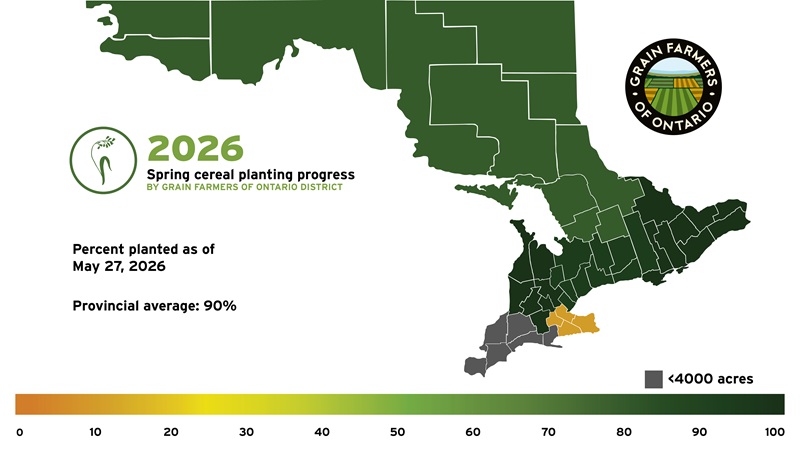
Field Progress reports that spring cereals are 90 per cent planted as of May 27, 2026. Spring cereals that were planted earlier have emerged and are in the early seedling growth stages.
Winter wheat is progressing slightly more slowly than in some years because of cool temperatures, and some areas still experienced frost this past weekend. Across the province, winter wheat ranges from stem elongation (GS 32, second node detectable) to heading (GS 51, first spikelet of the head visible) in the deep southwest. T3 applications for advanced wheat are approaching in the next few days to weeks. Timing is critical, ideally between GS 61 and 65 during flowering, to protect yield and grain quality.
Stripe rust was identified in Ontario at the end of last week in southern Ontario. Stripe rust can be identified by small chlorotic lesions that have yellow/light orange pustules that emerge from the lesions. The pustules develop parallel to leaf veins, giving the wheat a “striped” appearance. Within Ontario wheat varieties, there are sizeable variety differences in susceptibility. Investigate whether your wheat has a high or low susceptibility by contacting the seed supplier or checking the provincial ratings at GoCrops.ca. All fields should be monitored closely through scouting. Left unchecked, stripe rust can cause significant yield reductions. Continue to scout for this disease now that it has been found in the province, as it will help determine when a fungicide application is required. There are some variables for when spraying should occur, depending on the growth stage and infection of the disease. More on stripe rust can be found in this Grain Farmers of Ontario Factsheet.
Do not forget about other diseases such as powdery mildew, leaf rust, and septoria, which are also being identified. More information on these diseases has been shared in past e-news articles.
Winter barley is beginning to head out in southern areas of the province. Monitor for T3 timing.
Cereal leaf beetles are starting to show up in some cereal fields, more on scouting and thresholds in this past Field Crop News article.
Spray tank cleanout
With fungicide applications imminent or already underway, a thorough tank cleanout is essential. Removing the previous product from the tank as soon as possible after spraying, followed by proper rinsing and draining, are all important steps. More information on proper cleanout procedures is available at Sprayers101. As a reminder, wear appropriate PPE during cleanout and any other time you are handling or working near chemicals.
Managing off-target pesticide movement
Sprayers are running and acres are being covered. Do you know how to mitigate drift? Join Dr. Jason Deveau (also known as Spray Guy) as he shares valuable insights on off-target pesticide movement, strategies to limit movement, temperature inversions, and more in the Grain Farmers of Ontario GrainTalk webinar on drift management. For more information on drift, you can also visit the BeDriftAware.ca site.
May 21, 2026
The May long weekend saw a lot of activity in the fields, from fertilizer being spread and ground being worked to crops getting planted; it was a very productive time for much of the province.
Corn
Between rains, and where the ground is fit, the past few days have been ideal for corn planting. Field Progress, Grain Farmers of Ontario’s weekly estimation of planting and harvest across the province, by district, shares that corn planting is 74 per cent complete across the province as of Wednesday, May 20, 2026.
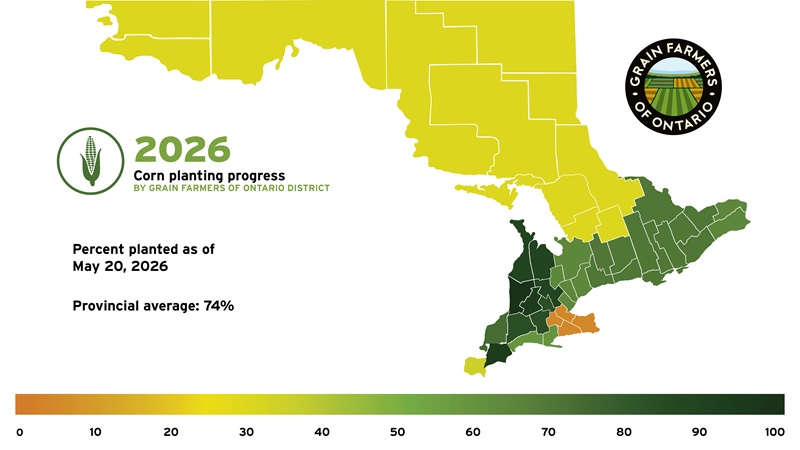
Keep an eye out for soil crusting; with various planting dates, soil textures, and weather patterns, some fields may have crusting issues and corn plants may need some assistance to emerge.
As corn emerges, it is a good time to do stand counts. Using a tape measure on 30-inch rows, measure a length of 17 feet, five inches. Count how many plants have emerged. Multiply the number of plants in the measured area by 1000, giving you the final plant stand.
Many things can affect plant stands. Planting into cold, wet conditions can cause delayed emergence and reduce plant populations due to seedling rots, insect feeding and seedbed compaction. A planter set up with too much down pressure on the closing wheels can make the seedling work hard at emergence and cause the seedling to leaf out underground, emerge late, and look like a corkscrew. Heavy rains after planting can compact the soil and make it difficult for the plant to emerge. Adjusting the planter to the conditions of each field is important to maximize emergence.
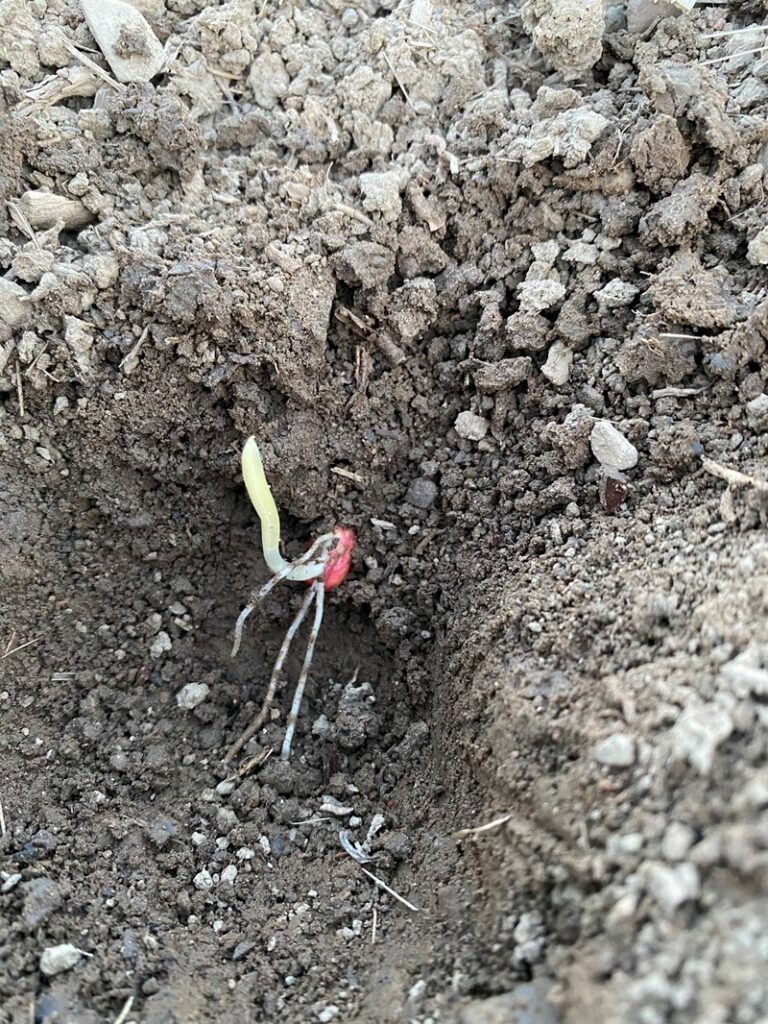
Emergence can be variable across a field. Many different things could create emergence concerns, including moisture, temperature, soil structure, and insects feeding in a grassier area or edges of the field. A hybrid change could be considered in future years if it is not area-specific.
When looking at crop heat units (CHU) for Elora from May 1 to 17 this year, the area received 341 CHUS; the 5-year average as of May 17 is 346 CHU. Fields that have been planted have seen increased CHUs from the warm weather experienced this past long weekend.
In shorter growing season areas of the province, it’s now time to consider a hybrid switch from full season to shorter season.
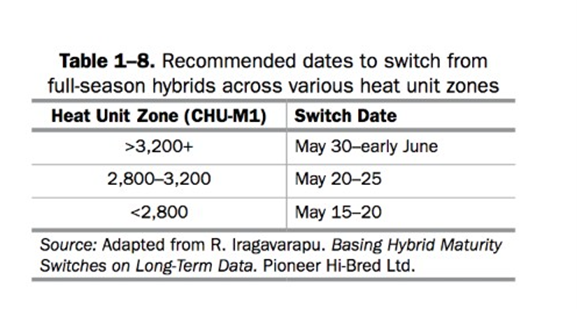
For further information, visit Field Crop News.
As the end of May draws near, it is important to keep Agricorp spring planting deadlines in mind, as some areas have a May 31 deadline (area E).
Soybeans
Soybean planting has also had a good run; however, no-till ground and some heavier soils were still a bit too wet in several areas. Field Progress shares that soybean planting is at 39 per cent across the province as of May 20, 2026.
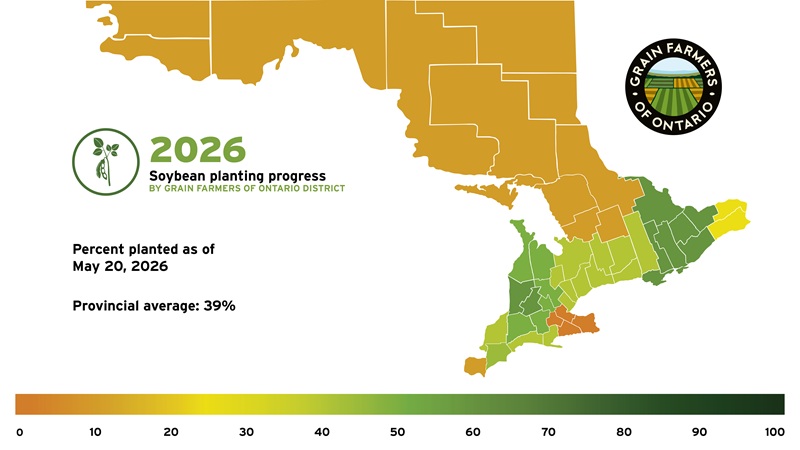
For those areas that have planted and then did get a hard, pounding rain, similar to corn, keep an eye out for crusted soils and be prepared to take remedial action if needed to help get those soybeans out of the ground.
The northern area of the province is still experiencing cold soil temperatures and, in some cases, snow, which is causing some delays in planting.
Cereals
Field Progress reports spring cereal planting at 75 per cent as of Wednesday May 20, 2026. Spring cereals that were planted at the start of the planting period have emerged and are in the seedling growth stage (GS 10 to GS 14).
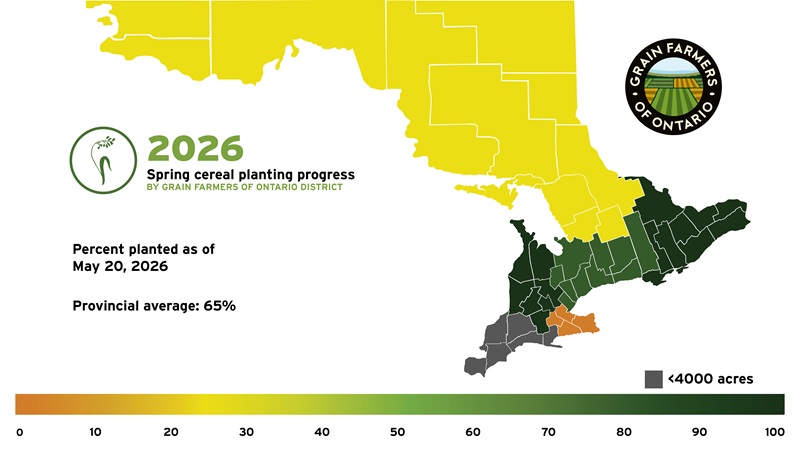
Winter wheat is staging across the province from stem elongation (GS 32, 2nd node detectable) to GS 39 (Flag leaf collar just visible). GS 39 to 41 is the T2 fungicide application window timing.
Scout for disease. Powdery mildew, septoria and Stripe Rust have been confirmed in Ontario wheat fields. For more information on identifying Stripe Rust, click here.
Are you a farmer and interested in your own hard copy of A visual guide to winter wheat staging? Email adacey@gfo.ca to request a free copy.
Spray tank cleanout
With fungicide applications imminent or occurring, it is essential to have a good tank cleanout before applying fungicide. Getting the previous product out of the tank as soon as possible after spraying, rinsing, and proper draining are all part of the process. More can be found on proper cleanouts at Sprayers101. Remember to wear proper PPE while performing a cleanout (and any other time handling or when close to chemicals) and follow all labels.
Updated PSNT testing
Pre-sidedress soil nitrate tests (PSNT tests) are taken in corn and spring barley to determine the level of soil nitrate-nitrogen (NO3-N) at the point when N uptake by the plant is about to become rapid, as the plant enters a phase of increased growth and development. Testing helps determine if additional N fertilizer should be applied, via sidedress, to meet the crop’s needs.
Some updates specific to the handling of the soil sample for PSNT have recently been made. Find the correct sampling and handling procedures here. The Ontario Soil Management Committee (OSMC) regularly updates Ontario guidelines on soil management and provides recommendations that are included in OMAFA crop production guides, and other resources to help strengthen 4R practices and knowledge, among other goals. Grain Farmers of Ontario sits on the committee.
May 14, 2026
Spring planting has been stop-and-start across many areas of the province over the past week as rain, frost, and, in some cases, snow moved through. Warmer weather in the long-range forecast will be appreciated to help get the planted crop germinated and emerged.
Corn
Where ground has been fit, some areas have seen a large variation in moisture received, and corn has gone in the ground. Field Progress, Grain Farmers of Ontario’s weekly estimation of planting and harvest across the province by district, shares that corn planting is 52 per cent complete across the province as of Wednesday, May 13, 2026.
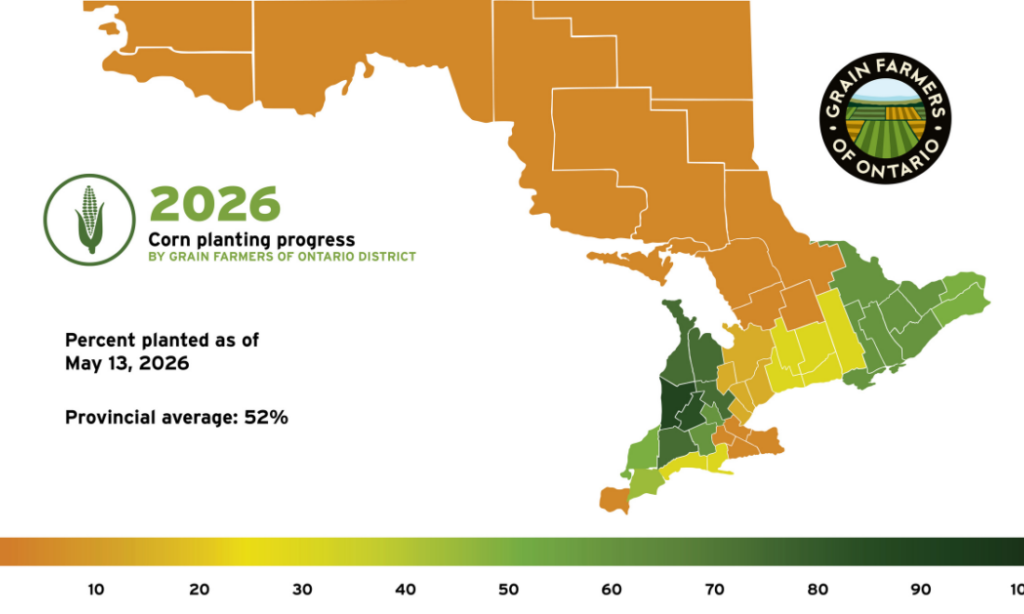
Some of the earlier-planted corn is close to emerging, if not already emerged (VE when the coleoptile emerges above the soil and the first leaves begin to unfold). Pre-emergent herbicide and nitrogen applications will be going on planted corn ground as able, between rains.
With warm weather, corn heat units (CHU) accumulate faster than they do with cool weather, and corn seeds will germinate and emerge quicker. If planted and maximum CHU accumulation (30 per day) is seen, the corn could be out of the ground in five to six days, which is a lot less time for insects to be active. It is not time that gets the crop out of the ground; the heat drives the enzymatic process to get the seed to germinate, and continued heat encourages cell growth in the developing plant seedling.
For best corn yields, U.S. corn specialists say that if the crop emerges uniformly within a 12 growing degree day (GDD) (~20 CHU window), the crop will be maximized by having a picket fence stand. A great way to evaluate emergence timing is to use the flag method – planting flags beside the plant as it emerges. Start by measuring 1/1,000 of an acre; that way, you are also doing a population count at the same time. On the first day you can see corn spiking through the ground, place a small flag beside all the emerged plants. Return in 20 CHUs and place a different colour flag beside the newly emerged spike for that day. Keep doing this until all the corn has emerged. Be sure to use a different colour flag on different days or label each flag with the emergence date. Also, do the flag test on each row of the planter. If you find poorer or delayed emergence on a particular row, it may be related to planter setup issues. This test is also great for evaluating different planter settings (deeper or shallower) or different attachments. Visually, the row emergence may look the same, but once you start counting the plants in 1/1,000 of a row, you will be surprised at what you learn.
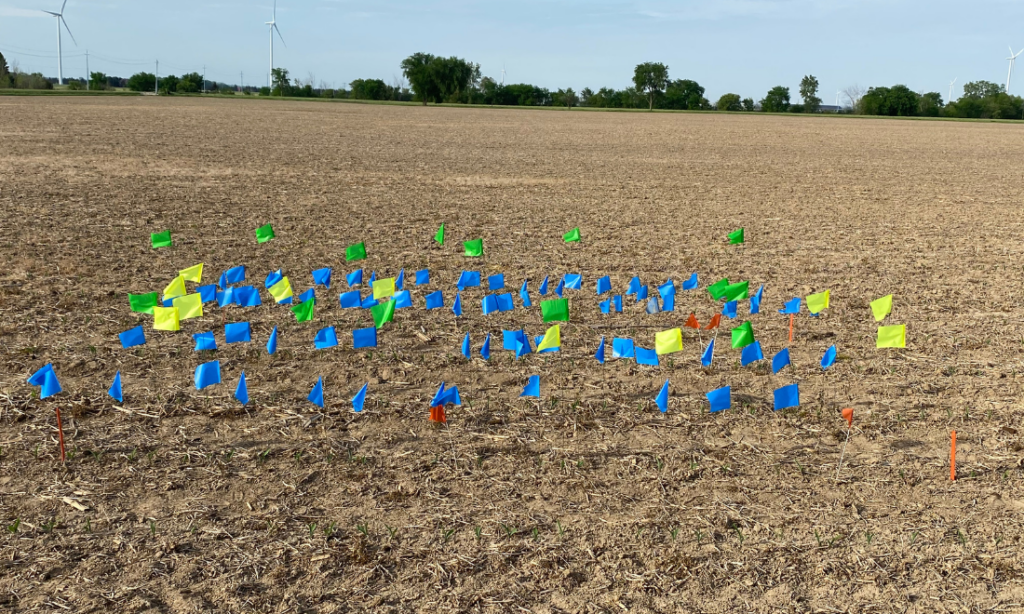
As the season progresses, pay particular attention to the flagged corn plot. See if the later emerged plants are weaker and smaller. Did they pollinate later? How was the ear size or cob fill? Does emergence timing make a difference in your crop?
With cooler springs, it is not uncommon to see corn seed that is planted and in the process of emerging display some challenges noted below that can cause a delay in emergence. These can be noted when setting flags out at emergence.
Visually, one might see emergence challenges such as corn leafing out underground or corkscrewing, the causes range from:
- cold soil temperatures- cold soils or large temperature fluctuations can damage the mesocotyl cells (stem-like part between the seed and the coleoptile), causing delayed emergence and corkscrewing
- soil crusting and/or compaction- heavy rain, wet conditions at planting, clay soils, compacted sidewalls can restrict the coleoptile emergence
- herbicide injury- certain herbicides can affect shoot development, especially under cool/wet conditions
- planting depth and seedbed conditions- planting too deep or uneven furrow closure leading to light penetration can cause premature leaf unfurling
- poor seed to soil contact- prevents normal emergence, contributing to leafing out underground
Later, these challenges can show up in the corn stand as stunted plants, poor plant populations and therefore lower yield potential.
There have been some questions as to when to switch hybrids for corn in areas dealing with wet soils. Decisions about switching hybrids will be based on individual risk tolerance and what hybrids are sitting in the shed. If you had late-maturity hybrids planned for April planting, adjusting to recommended heat units for your area is necessary to avoid potentially late-harvested corn at higher moisture levels. Moving to earlier than recommended for your area will depend on the CHU area, and for some, decisions will be made later in May towards the start of June.
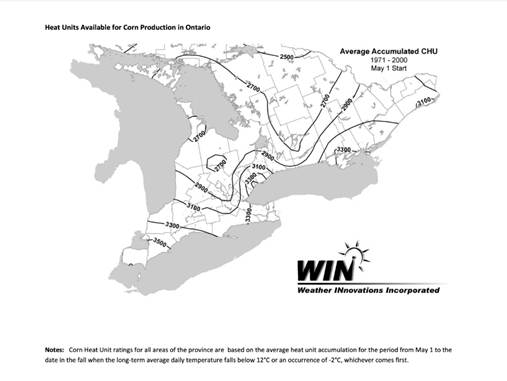
For further information and a table with recommended dates for considering a switch from full-season hybrids across various heat unit zones, visit Field Crop News.
Soybeans
Soybean planting is also ongoing on ground that is fit. Field Progress shares that soybean planting is 16 per cent complete across the province as of Wednesday, May 13, 2026.
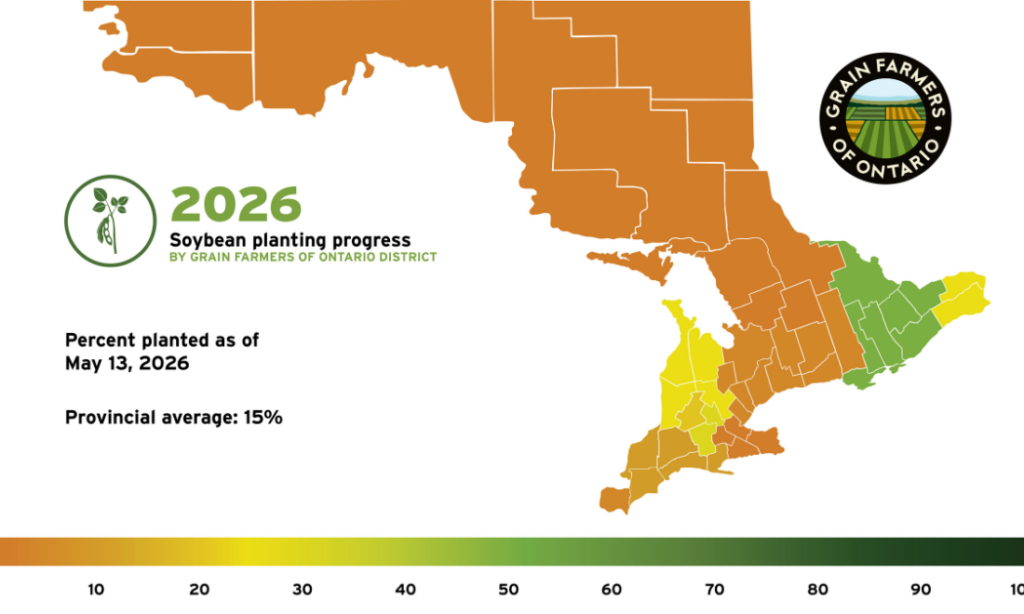
The ideal soybean planting depth is around 1.5 to 1.75 inches, with adequate soil moisture. If soil is drying out unevenly, seeds may need to be planted around 2- 2.25 inches if on lighter soils, but only if moisture is limited. Remember, soybean hypocotyl reach is limited and can only be extended by two-plus inches. If conditions like crusting occur, deep planted soybeans will not be able to push and extend the distance. Loose, dry soil may be the exception for the 2-inch-plus depth. Patience is key; there is still lots of time to plant soybeans, so ensure soil is fit. Warmth and lower amounts of rain look to be coming in the forecast.
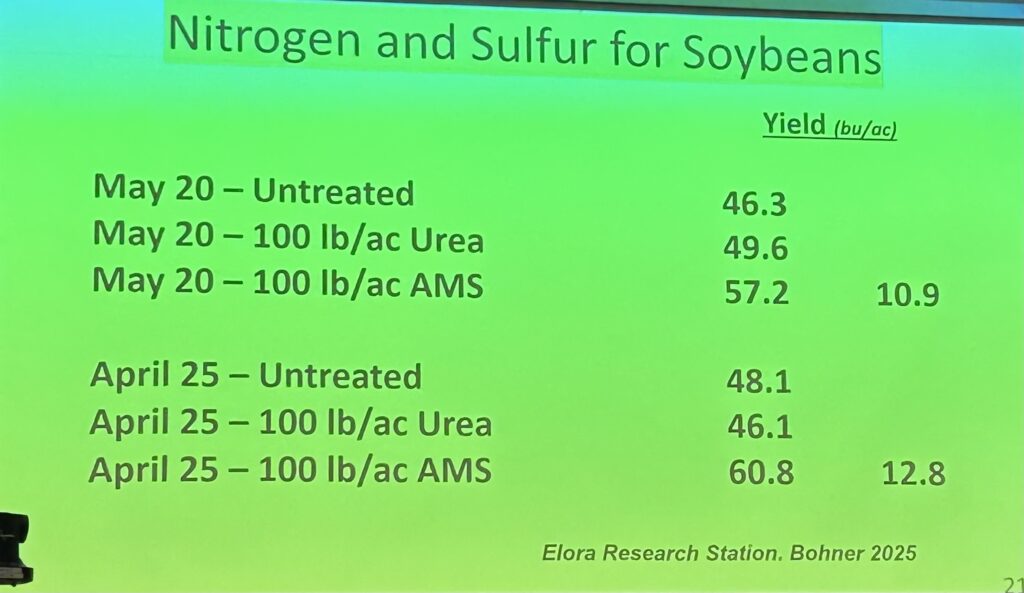
A note that sulphur fertilizer for soybeans, according to OMAFA, can be an important ingredient in fertilizer applications. However, application response can be very site specific. Lighter ground and/or fields that have SCN pressure can see a big response.
Cereals
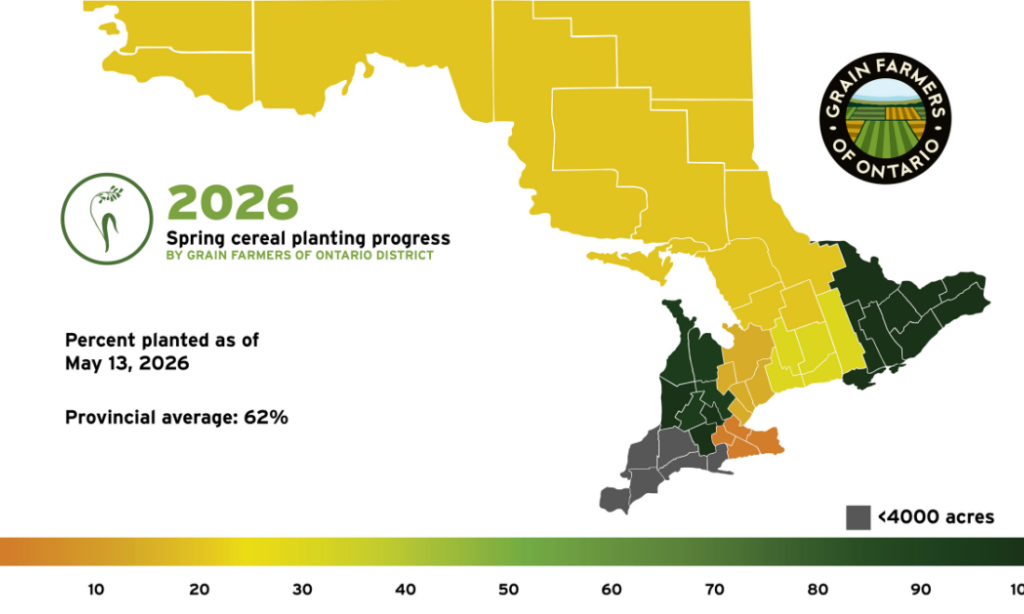
Spring cereal fields have been planted; there are still more acres to go in the ground in northern Ontario and other regions of the province as weather and time allow. In northern Ontario, there are still regions waiting for the snow to melt. Field Progress shares that spring cereal planting is 62 per cent complete across the province as of Wednesday, May 13, 2026. Emergence is slow with the ongoing cool days and nights.
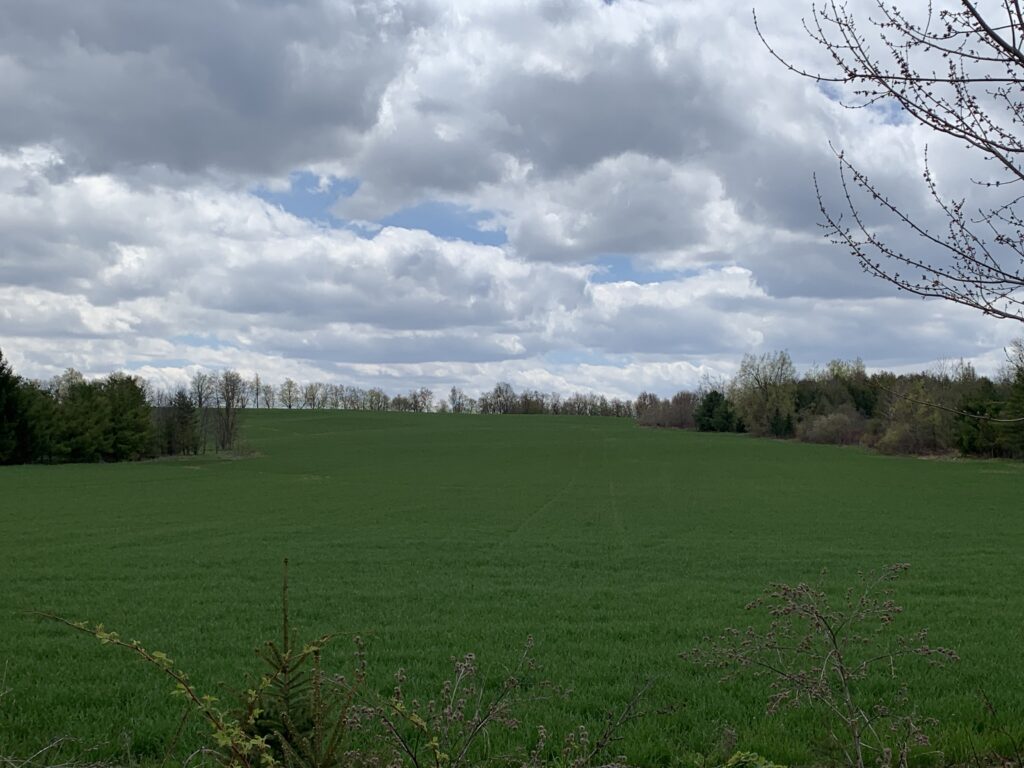
Winter wheat that has received a second pass of nitrogen looks spectacular in many cases. Herbicide, and in some cases, fungicide applications are occurring as weather allows. Many areas have been experiencing cool overnight temperatures which have limited spray days, as too cool of temperatures when mixing multiple products are applied can see an increase in crop injury. Some wheat in the deep southwest is at GS 39 (flag leaf fully emerged from the whorl, ligule just visible), while other wheat fields to the north and east are tillering and at the beginning to middle of stem elongation. Winter wheat in the northern areas of the province is reported to have come through the winter well. With this past week of cold weather and frost, it is assumed that the winter wheat fields were not far enough ahead in growth stage to be at risk from the cold.
Leaf rust has been identified in fields, at low levels. Fungicides are a great solution to control leaf rust. Keep an eye out for other diseases such as powdery mildew (especially on susceptible varieties) and septoria. Keep in mind that stripe rust could also show up. Overall, as the weather warms up, there is an increasing chance that more disease will develop. Cool temps limit the growth of disease in many cases, but as temperatures increase, be prepared to scout and work with your local agronomist to determine a plan should disease pressure become an issue.
The Crop Protection Hub is a great resource for what to apply to control various weeds, diseases and insects.
Physiological fleck has shown up in past years, when there have been many cloudy spring days, followed by sunny days and is could again show up this year, as warm, sunny days arrive.
Be safe!
As planting progresses, remember that safety is key. Many accidents and mistakes can occur when overtired.
Managing off-target pesticide movement
The sprayers are running; acres are being covered. Do you know how to mitigate drift? Join Dr. Jason Deveau (AKA Spray guy) as he shares valuable insights on off-target pesticide movement, strategies to limit movement, temperature inversions and more in the Grain Farmers of Ontario GrainTalk Webinar on drift management.
Crop Chats
Looking for something to listen to while planting? Check out OMAFA’s Crop Chats, supported by Grain Farmers of Ontario. Several videos are available at each link; Winning with no-till, Seeding equipment decisions, and more.
May 7, 2026
Spring has sprung across some areas of the province, with spring cereals, corn, and soybeans being planted where soil is fit.
Corn
It is important to note that it is still early in the spring season. Field Progress, Grain Farmers of Ontario’s weekly estimation of planting and harvest across the province by district, shares that corn planting is 11 per cent complete across the province as of Wednesday May 6, 2026.
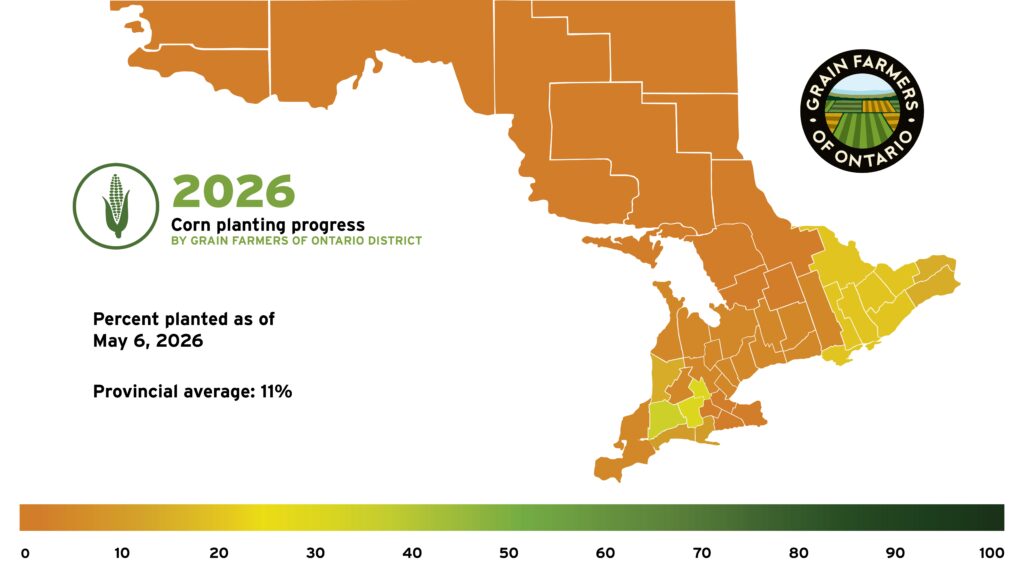
Planting has been occurring where soil conditions have allowed. Once things dry up, there will be a push to get corn planted. There has been some manure and fertilizer applications, along with some soil preparation in anticipation for planting.
As conditions dry up, ensure that fieldwork and planting aren’t being “rushed.” Ensure that ground conditions are fit for planting. Seedbeds that are too wet when planting occurs can cause emergence issues, root growth issues and, in turn, yield losses.
A key thing to remember when planting corn is weed management. Corn can lose one to 3.5 bu./acre per day when weeds are present due to competition for resources and structural changes of the plant. Targeting weeds at emergence and when they are small using multiple modes of action are important keys to management. The critical weed free period for corn overall is from emergence (VE) to the six-leaf stage (V4-V5) in order to have minimal yield losses from weed competition.
Similarly, weed control is crucial for soybeans, especially with IP soybeans; do not let weeds get too large before controlling. Plan to start clean and stay clean, so that yield is not impacted by competition from weeds. There is a high cost to not controlling weeds, more can be found on the cost in this Ontario Grain Farmer article that shares insights from Grain Farmers of Ontario funded research.
As warmer temperatures arrive, insects become more active. Be on the lookout for true armyworm and black cutworm, wireworms, and bean leaf beetle, and more. Good soil temperatures help plants emerge quickly, with less chance of insect feeding on seeds. The Pest Manager app is an excellent source of information on all pests. Grain Farmers of Ontario supports much of the research that is used in the app. It applies to pests, weeds, and diseases and is updated regularly based on current research data.
Discover effective strategies for managing resistance for insects, weeds and disease through proper Integrated Pest Management (IPM) on Manage Resistance Now.
As planting ramps up, remember to stay safe.
Soybeans
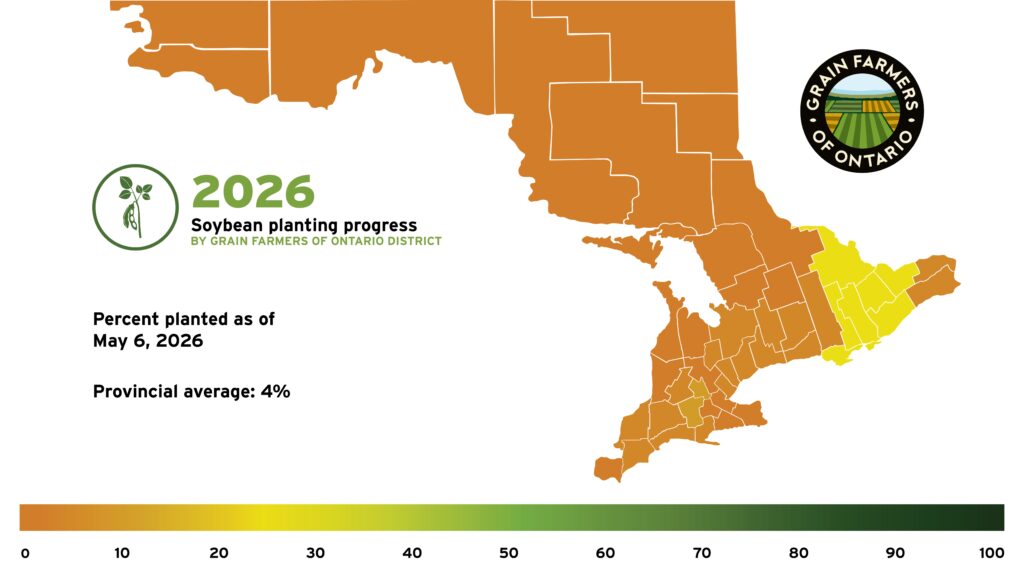
Field Progress reports that soybean planting is at four per cent complete across the province as of May 6, 2026. Similar thoughts to corn planting and making sure that the ground is fit are top priority as planting continues.
Weed control is crucial for soybeans, especially with IP soybeans; do not let weeds get too large before controlling. Plan to start clean and stay clean, so that yield is not impacted by competition from weeds.
Cereals
Some spring cereals have been planted. Field Progress shares that the province is 30 per cent complete as of May 6, 2026. Wet conditions have limited current planting progress. As soon as ground conditions become fit, there will be a push to plant. Remember to check seed sizing and adjust the rate as needed.
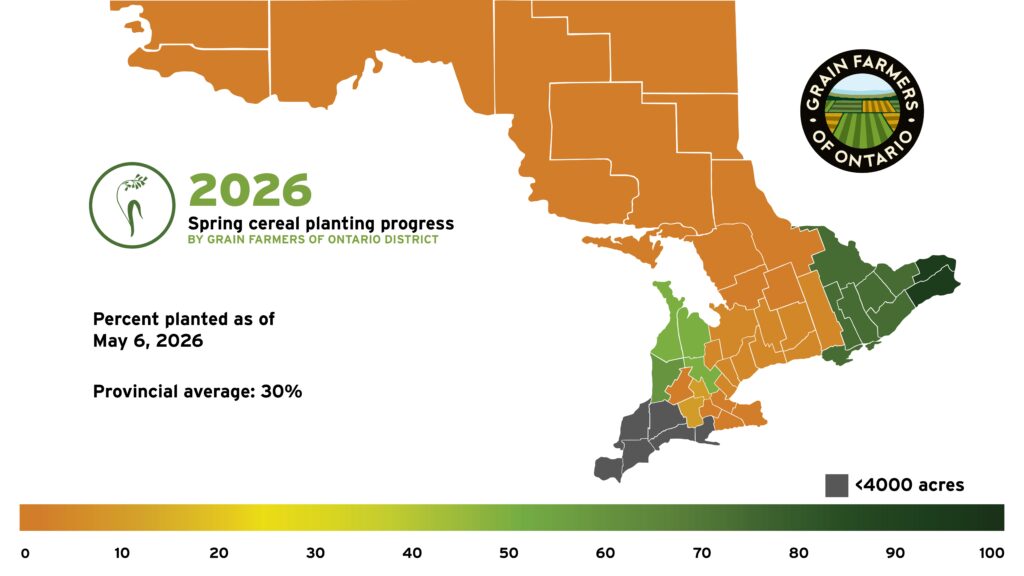
Some winter wheat fields have received their second pass of N, or in some cases, one pass of N for the year, along with a herbicide and T1 fungicide, as required. There are still ongoing challenges to get out in fields for timely N applications due to wet and windy weather.
There is a wide range in maturity of the winter wheat crop, with slightly warmer temperatures in the southwest and cooler temperatures elsewhere in the province, but overall, the past week or so has been quite cool and slowed crop development.
Leaf tip burn has been noted in some cases, from higher rates of Nitrogen and Sulphur that went on over the past couple of weeks. No concerns at this point, as it is cosmetic.
Wheat fields that are on heavier clays or poorer drained fields are seeing a bit more challenges for green up and growth.
Some winter wheat fields are seeing pressure from winter annual weeds, with very advanced weeds in size and maturity. In these situations, fall weed control would have been a great option to keep the winter annuals under control.
Waterhemp
A weed that many don’t realize is troublesome, waterhemp, has shown multiple forms of resistance across the province. This weed can germinate and emerge throughout the growing season and has high seed production. Waterhemp can be controlled by implementing a two-pass herbicide program using residual herbicides with multiple modes of effective action. Proper identification is key. Once identified, proper equipment cleaning before moving from contaminated fields is highly encouraged to reduce the spread.
Once harvest is complete, plant a cover crop. Cover crops will inhibit waterhemp emergence, growth and seed production. Grain Farmers of Ontario has created an Agronomy Alert on waterhemp, which includes identification, locations of resistance and how-to programs for control of waterhemp. More information on waterhemp biology, identification, and control.
Over the past several years Grain Farmers of Ontario has invested in several research projects that investigate managing waterhemp.
Avian Influenza
The Avian Influenza (AI) virus can survive for extended periods of time in the environment, particularly in cooler weather. Here are some important reminders, as spring progresses. It is important to realize that tilling and planting equipment will cover fields that may have been contaminated by wild birds. Water, wet soil and feces can become contaminated with AI and linger after the migrating flock has moved on. Soil and wild bird feces can stick to tires and undercarriages of vehicles, including field equipment and all-terrain vehicles (ATVs), and be easily spread to other locations.
Follow these guidelines to help mitigate the risk of spreading the virus:
- Wash vehicles between livestock and poultry farms, paying close attention to the vehicle tires and wheel wells.
- For footwear, remove obvious mud and organic matter first and then scrub boots, especially the bottom tread, with a brush and hose. Ensure adequate contact time and concentrations for commercial disinfectants – be sure to read and follow the label!
- Clean all equipment used on the farm that could become contaminated.
- Planting and tilling equipment should be kept away from poultry and livestock barns and from driveways servicing poultry and livestock premises. Avoid contaminating ground areas near barns housing animals.
- Avoid driving near barns that contain animals if possible. If not, drive slowly to minimize dust.
- Avoid parking by exhaust fans and air inlets unless required as part of loading or unloading.
- If there is a visitor logbook at the farm, sign it. If there is no logbook, keep your own records identifying where you have been and when.
- Leave a note in a mailbox or parcel drop box to let the farm owner or manager know you were there.
- Before getting into your vehicle after a farm call, check to ensure your footwear is clean of organic material.
April 30, 2026
Planting has begun on limited acres across the province so far this spring. Winter wheat continues to grow, but there have been some challenges in getting products applied.
Corn
As the potential for warmer weather approaches, the big question on many growers’ minds is: When should I begin planting?
A key to establishing the crop’s potential is planting it into a seedbed that can provide even and timely emergence. Most importantly, the soil needs to be fit (not too wet, not compacted or lumpy) before planting for ideal emergence. Planting into soil that is too wet can create sidewall compaction, limiting seedling root growth.
The ideal soil temperature for planting corn is 10 C or above to achieve uniform germination and reduce seedling stress, which can result in corkscrewing and leafing out under the surface. When placed in the soil, the seed will absorb about 30 per cent of its weight in water. The temperature does not affect water imbibition much. However, this differs from radicle (root) and coleoptile (shoot) growth, whose growth is correlated with soil temperature.
In cold soil conditions (below 10 C), seeds will readily absorb water but not initiate root or shoot growth, leading to seed rots and poor emergence. Recommendations are to begin planting when soil is near 10 C, or the forecast is favourable and trending warm. Some growers have experienced cold conditions after planting the last few years, and colder fields, such as no-till fields, experienced lower emergence populations due to cold stress, resulting in leafing out underground. Techniques to warm the soil or waiting until soils warm up will help with better stand establishment and uniformity. Being aware of soil fitness and temperature helps ensure plants will be off to a good start.
When the planter does get rolling, aim to maintain a planting depth of two inches into adequate moisture to ensure uniform germination.
Soybeans
As with corn, it is imperative to plant soybeans into fit soil. It is also crucial to know soybean seed germination. As soybean planting edges closer and farmers are finalizing planting plans, something to consider is the final plant stand goals, and what planting population is needed to achieve that. Seed germination is one part of the calculation, as are planting conditions and weather conditions after planting.
Due to drought conditions in several regions of Ontario, some soybean seed this spring may not germinate at the same rate as in previous years. It would be wise to know the germination rate before planting, so seeding rates can be adjusted. For example, if a 150,000 plant stand is desired, the planter will need to drop 187,500 if the germination rate is 80 per cent. Also, adjust the rate based on seedbed conditions, or if there are other concerns about emergence, such as crusting, etc.
Seed tagged with a Canada Certified No. 1 seed tag will have an 85 per cent germination rate or greater. Canada Certified No. 2 seed will have 75 per cent germination or greater.
Note: Some companies may have greater internal tolerances, which is used to determine which seed lots to sell. Of course, everyone wants to sell the best quality, but conditions in the previous year may affect germination rates in different seed lots. A seed germination test is the best way of knowing, so asking about your seed provider’s germination rate or getting a test done before planting will provide you with the knowledge needed to adjust seeding rates.
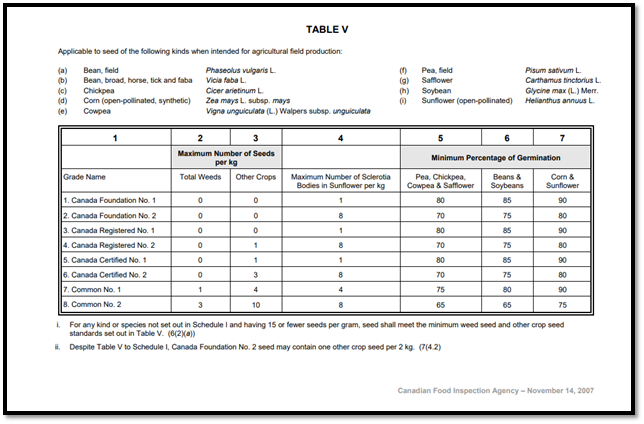
Schedule 1 to the Seeds Regulations Grade Table 5 for Soybeans and Corn https://csi-ics.com/sites/default/files/seed_regulations_grade_tables.pdf .
When planting does begin, aim for ideal soil conditions to get the crop off to the best start. Ideal planting depth is one to 1.5 inches, unless reaching soil moisture is critical later in the season, where 2.5 inches is possible. However, the deeper the seed is planted, the higher the chance that the soybean hypocotyl runs out of growth with the cotyledons not being able to reach the soil surface, causing poor emergence.
Cereals
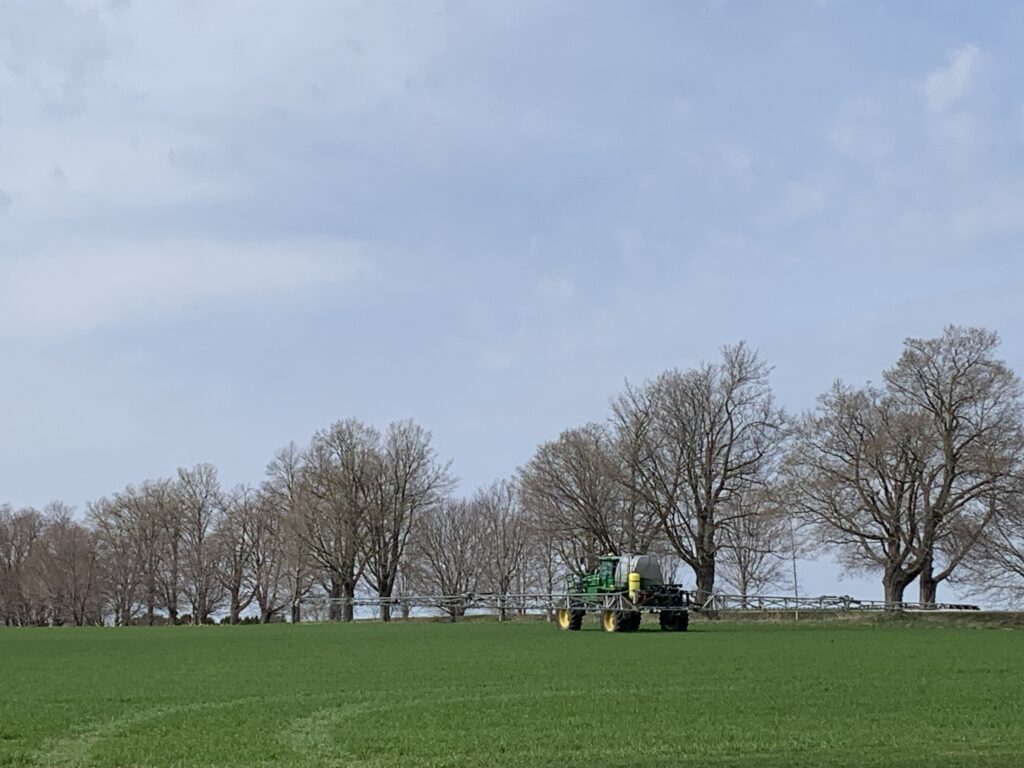
Winter wheat is rapidly advancing with the warm weather, staging at GS 25 to GS 32. For some, wheat is at or near the second application of nitrogen, along with a herbicide, a T1 fungicide, and, if warranted, a PGR (plant growth regulator).As wheat plants approach growth stage 30 (stem elongation), it is the last stage at which some herbicides can be used without risk of injury. By GS 30, the number of spikelets per head has been determined.
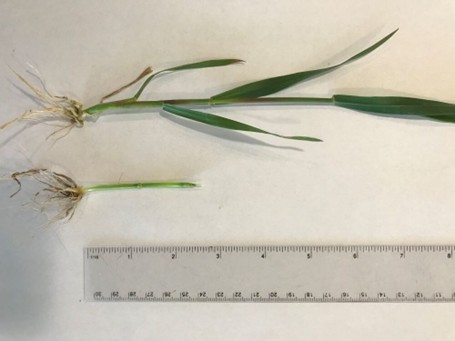
GS 31-37 can be very challenging stages to identify. Use a knife to split the main stem and count the number of nodes separated by the internode. GS 31 will have one node detectable, the first node detectable must be above an internode of at least one cm, while the second and so on nodes detectable must be above an internode of at least two cm.
While some winter wheat acres have received a nitrogen application, there have been challenges of getting nitrogen and other products applied due to wet soil conditions (which could cause compaction on waterlogged soils) or windy conditions.
Looking at the long-range forecast for parts of the province, temperatures are still on the cooler side, especially at night, dipping down in some areas to below 0 C. If application is occurring, especially if mixing multiple products in a tank mix, remember to watch temperatures (before, the day of, and after application, aiming for above 3 C the day before, the day of, and the day after) and read labels to ensure that you are using the appropriate tank mix partners.
Several years ago, there was a cool, late spring that brought about many questions on how to prioritize trips across the field. More can be found here in this Field Crop News article.
Soil sampling and 4Rs
Planting new ground or fields with unknown fertility levels? A best practice is to ensure that a soil sample has been completed in order to have a base line knowledge of fertility levels. Soil sampling allows nutrient applications to be made following the 4R principles: Right source, Right rate, Right time, and in the Right place.
April 22, 2026
Although an early spring was predicted by Ontario’s resident groundhog, it has been slow to arrive, with some areas of the province receiving snow this past weekend. We recently asked the OMAFA crop specialists what farmers should consider as spring approaches with respect to planting date and fertilizer.
Corn
Ben Rosser, corn specialist with OMAFA, said: “Given the year and fertilizer prices, having a recent soil test will help to make more informed fertility decisions.”
He said that for very low soil-test results, even expensive fertilizer can still provide a good return on investment. With non-responsive soil-test results, it may be possible to reduce or skip applications if you expect future years will have more favourable fertilizer-to-corn price ratios.
“Use the Ontario Corn Nitrogen Calculator to see how different fertilizer and corn price ratios affect nitrogen fertility recommendations. For example, at today’s price ratios (nitrogen being more expensive relative to corn), the most economic N recommendations might be about 10 per cent lower than what a 10-year average might have been before N fertilizer prices started to run up before 2022.”
In the field, he said: “Use test strips to evaluate N needs on the farm. Can rates be pulled back without any yield loss? Is there yield being left on the table in very high-yielding years? Collecting yield-response data is the only real way to know.”
“An easy, low-risk way would be to do some 30-lb. test strips (a strip 30 lb.-N/ac. more and 30 lb.-N/ac. less than grower practice, then check yields for all three rates in the fall). Also consider how much yield you expect. Doing a zero-N strip can provide insight into how many bushels you are getting from soil-N supply and how much yield you are trying to gain with N fertilizer. In some Thames Valley Soil and Crop Improvement Association trials, starter-only N (about 30-40 lb.-N/ac.) yields about 60 per cent of N-rich, but this can be highly variable across fields.”
He added: “We talk a lot about the importance of uniform emergence and growth in corn, and that starts at planting.”
“There has been more talk recently about the importance of tracking, or benchmarking, stands. Most growers know their seed drop, but what is the plant stand, and how many ear-bearing plants are still there at harvest? Those are good numbers to know and can help troubleshoot or identify areas to improve in future planting seasons.” The Ontario Corn Agronomy Network, a pilot program in 2026, is focused on helping farmers hone agronomic decisions and benchmark against other fields to identify potential improvements. Registration for 2027 will open early next year.
On planting date, Rosser said Dave Hooker, Horst Bohner and Seth Ritsma recently completed Grain Farmers of Ontario-funded planting-date trials for corn and soybeans. “While timely planting is always important for both crops, the data showed that economic responses for corn planting dates (corn yield minus drying costs and downgrades) are fairly flat for the first half of May and start to decline more quickly after about May 20.”
Rosser added: “Sometimes it seems that once the calendar switches to May 1, there is a feeling we are losing yield or income by the day we are not planted. But the data does not necessarily bear this out. There can also be season-long costs from pushing planting conditions: compaction, non-uniform emergence or uneven stands. Balance the calendar date with field conditions and the expected number of days needed to finish planting for season-long success.”
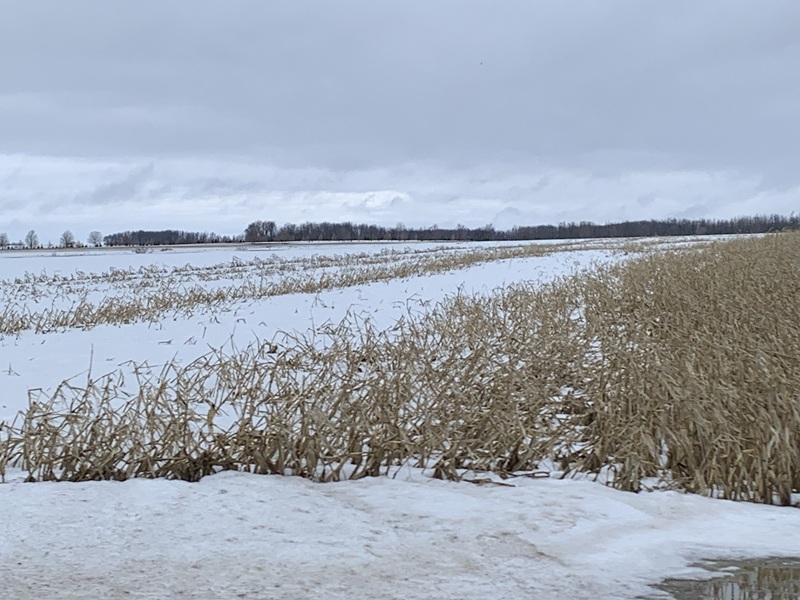
As spring approaches, some corn fields still need to be harvested from last fall, with standability challenges in some cases. Fields harvested this spring may create volunteer corn issues in the 2026 crop. Build a herbicide plan that considers that risk.
Soybeans
We also asked Horst Bohner, soybean specialist with OMAFA, to share his thoughts as planting approaches. He said planting date is “an important management tool to maximize yield potential. Generally, early planted soybeans (late April to early May) yield more than soybeans planted in late May. Early planting allows for more nodes per plant, and therefore more pods. June-planted soybeans yield the least.”
He added: “Soybean planting should be based on seedbed conditions, the weather forecast for the 48 hours after planting and, to some extent, the calendar. Since soybeans will be destroyed by a killing frost once they have emerged, ultra-early planting (before April 15) is problematic in Ontario. Plant stands are also a consideration when planting early.”
Bohner said that if weather delays planting, there is good news when it comes to soybeans. “Since the majority of yield is ‘made’ in July and August, late-planted fields can do very well if the remainder of the growing season is good. Since soybeans adapt (within reason) to the growing season because they are daylength-sensitive, it is not necessary to switch varieties unless planting is delayed until late June or July.”
“If farmers are considering switching, the main purpose of moving to an earlier maturity group is to ensure the beans can finish before a killing frost in the fall. Since late-planted fields result in shorter plants that do not branch as much, it’s a good idea to increase the seeding rate to maximize yield potential.”
Bohner said lower plant stands are common with early planting since soils are cooler. “It is critical to have a good seedbed. Soybeans should always be planted into fit soils, regardless of planting date. If significant rainfall is forecast, wait until conditions improve before planting. A cold rain immediately after seeding will affect emergence.”
“Yield response to planting date will vary depending on the growing season and the maturity group of the variety. The key to getting the highest yield possible when planting early is to select a variety that is full-season for a given area. Planting a short-season variety early does not consistently increase yields compared with a more normal planting window.”
Bohner also noted that the importance of soil fertility for high-yielding soybeans is sometimes overlooked. “High-yielding soybeans require large amounts of nutrients. If the soil test is ‘good,’ then the job is done. Additional fertilizer will not add to yield. But for many Ontario fields, soil tests for P and K are insufficient to maximize yields.”
Spring cereals
Joanna Follings, OMAFA cereals crop specialist shares her thoughts. “The earlier we can get spring cereals seeded, the better. Research has shown that frost seeding or seeding spring cereals early helps avoid those hot and dry growing conditions during the grain fill period. Spring cereals do well when temperatures are cool, especially during the initial growth stages. We often see an increase in tillering and can also avoid some of the early season diseases.
“Even in a year like 2020 where we saw snow in parts of the province in May, the early seeded cereal crop was small enough that the temporary cold temperatures had little impact on the small cereals. Once they get to the stem elongation phase and the growing point has started moving up the stem it is more prone to cold injury; however, we don’t often run into temperatures that are too cold for spring cereals.”
Follings adds, “If seeding of spring cereals is delayed, growers should bump up their seeding rates. When spring cereals are planted late, temperatures are often higher, and the growth and development of the crop is much quicker in higher temperatures. As a result, we see the crop will often have a lower yield potential. By bumping up the seeding rate, we can help compensate for the reduced tillering and potentially lower test weights due to warm temperatures during the grain fill period. Growers should also ensure the variety they are growing has a good disease package. Later planted fields tend to be more susceptible to diseases – specifically crown rust in oats and FHB in spring wheat.”
Winter wheat
There are some very lush wheat fields in the province, having been planted early, with good tillering. Fields that had two tillers in the fall are now seeing seven to eight tillers, with some fields in southwestern Ontario at growth stage 31 (stem elongation). The start of stem elongation is an important time for weed control, nitrogen applications and the start of the optimum window for most PGR applications. This is also the last stage when some herbicides can be used without risk of injury. Always read and follow labels, choosing the appropriate herbicide for plant stage.
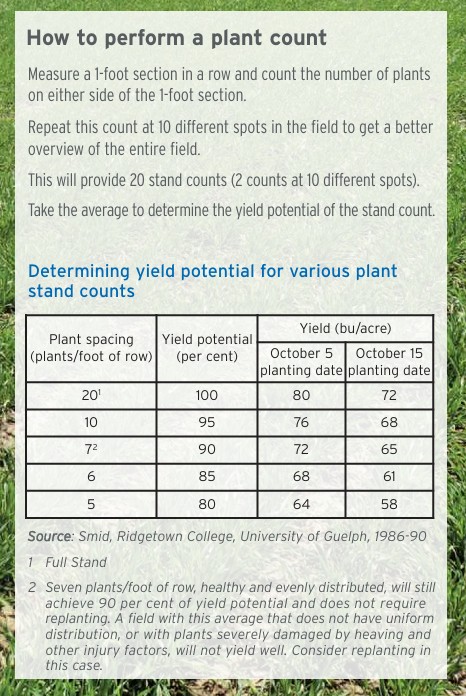
If fields are more delayed, but have an even plant stand, they still have a good yield potential. If you’re worried that plant stands are not where they should be with fields greening up, review this plant stand chart to estimate potential.
If it was planned that wheat was going to get two applications of Nitrogen (N), some of the winter wheat acreage has received the first application. Wet fields have hampered application across much of the province.
Sulphur (S) is a required nutrient for plant growth. With less sulphur being deposited from the atmosphere, crops have been showing more deficiencies over the years. If you are not using sulphur and need to show its value, one of the best ways is to do a split field or test strips. Typically, lower organic matter and sandy soils see a higher response, but crop response has been measured on all soil types. The recommendation from OMAFA for winter wheat is 10 lb./ac. of S. It is important to note that the higher the N rate, the higher the S rate should be. Ratios of 10:1 to 8:1 are a good guideline, but adjust based on local needs. Ontario research has shown variation in yield responses to S depending on the year; cool, damp springs have shown more of a yield response.
Grain Farmers of Ontario is currently investing in further sulphur rate research with John Lauzon at the University of Guelph.
Slugs
Slug feeding can cause damage during crop establishment and early growth, resulting in poor plant establishment and replanting in some situations, and potential yield loss. Learn more about slug identification, favourable conditions and control in this Grain Farmers of Ontario factsheet.
Mental health
As the spring rush approaches, please keep your mental health in mind and reach out for support if needed.
April 16, 2026
A cool, wet, and in some cases, snowy spring has so far delayed many field operations.
Wheat
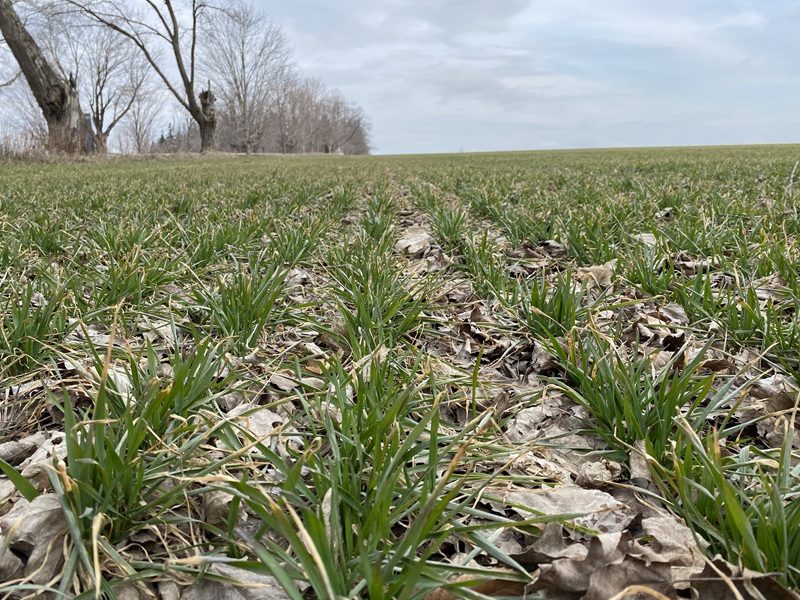
Scouting whether to keep or terminate a wheat field has been ongoing in various areas. Some fields are looking quite good, while others are struggling due to late planting, heavy rains after planting, and, in some cases, snow mould. A quick lesson on assessing wheat stands can be found here .
Fields planted early last fall tillered nicely before winter and are well established this spring. These fields do not necessarily need an early application, but can benefit from an N application as the season progresses. The best timing is before the plants start to stem elongate; however, keep in mind that application timing can be affected by when fields are dry enough to carry the equipment without causing field damage (rutting). It’s important to check the weather forecast and walk the fields to check the growth stage of the crop.
A delay in N application can result in the crop showing signs of deficiency. The yellowing of wheat due to a lack of N in the soil is a sign of crop stress. Early stress on the crop will cause fewer florets to develop, which means fewer kernels, and a lower yield.
It’s also important to note that a herbicide application needs to occur before stem elongation to prevent damage to the plant and head development. Any stress just before, and during, stem elongation can cause damage to the developing head and reduce yield potential. Scout early, and scout often for plant growth, weeds, and diseases.
Following your wheat crop along, and timing crop protection and nutrient applications is important for optimizing yield. The visual guide to winter wheat staging is a handy tool for identifying what growth stage your crop is at!
Insects
As we approach planting, insect pests should be monitored as they may affect crop stands. In some cases, the insect larvae can cause significant reductions in stands and early season plant vigour. High-risk fields are those that are being planted early, following hay or grass, fallow, or a grassy cover crop. If the spring continues cool and wet, it will be favourable to early season pests. Learn more here.
Weeds
We recently received some insight from Mike Cowbrough, OMAFA’s weeds specialist, about the weed spectrum in Ontario, and what growers should be aware of.
Cowbrough shared, “Both the number of herbicide-resistant weed species in Ontario and the number of herbicide groups to which those weeds are resistant continue to increase over time. This is almost inevitable, as intensive and repeated use of the same herbicide modes of action increases the likelihood that weed populations will evolve resistance.
“Additionally, the introduction of new weed species from other regions that already carry herbicide resistance, such as Palmer amaranth, is something we have seen recently in Ontario. In some cases, crops used as cover crops become problematic weeds themselves, for example, Italian ryegrass, which is widely used as a cover crop, turfgrass species or forage grass species, now has confirmed glyphosate-resistant (Group 9) populations in Ontario, making it much more difficult to control.”
Fields planted early last fall tillered nicely before winter and are well established this spring. These fields do not necessarily need an early application, but can benefit from an N application as the season progresses. The best timing is before the plants start to stem elongate; however, keep in mind that application timing can be affected by when fields are dry enough to carry the equipment without causing field damage (rutting). It’s important to check the weather forecast and walk the fields to check the growth stage of the crop.
A delay in N application can result in the crop showing signs of deficiency. The yellowing of wheat due to a lack of N in the soil is a sign of crop stress. Early stress on the crop will cause fewer florets to develop, which means fewer kernels and a lower yield.
It’s also important to note that some herbicide application need to occur before stem elongation to prevent damage to the plant and head development. Always read and follow herbicide labels. Any stress just before and during stem elongation can cause damage to the developing head and reduce yield potential. Scout early and scout often for plant growth, weeds, and diseases.
Following your wheat crop along and timing crop protection and nutrient applications is important for optimizing yield. The visual guide to winter wheat staging is a handy tool for identifying what growth stage your crop is at!
Mike was also asked if there are any trends of particular significance for Grain Farmers of Ontario and relayed the following:
1) The increased prevalence of group 14 resistant weeds – pigweed, waterhemp and common ragweed
2) Increase in prevalence of glyphosate resistant ryegrass
Weeds resistant to multiple herbicide modes of action are increasingly common, and this is especially concerning since there are not many options available to manage such species.
Multiple-herbicide-resistant waterhemp is the clearest example. In Ontario, waterhemp populations have evolved resistance to five herbicide groups (2, 5, 9, 14 and 27), and herbicide-resistant waterhemp has been confirmed in 19 counties from Southern Ontario to Northern Regions. Multiple resistance is also very common in other key species relevant to growers and their rotations, including common ragweed, green and redroot pigweed, and Canada fleabane.
Palmer amaranth is not yet widely established in Ontario, but it is widespread in field and vegetable crops in the United States and is associated with severe yield losses. Our recent work has detected Palmer amaranth populations in Lambton and Stormont, Dundas and Glengarry in 2025. This species is extremely competitive and is known globally to have evolved resistance to nine different herbicide groups, with populations documented that are resistant to up to six herbicide modes of action simultaneously.”
Stay alert and scout fields for problem weeds and manage them effectively this spring. If there is a weed that is hard to identify or has not reacted to herbicide applications as you think it should, ask your local agronomist for a second opinion. If there are still concerns, weed resistance testing is available in Ontario. A resistant weeds dashboard is also available to better identify which weeds may be more challenging to control regionally across the province.
Crop Protection Hub
The Crop Protection Hub is a wonderful resource for management strategies for weeds, disease and insects. It also provides Ontario farmers with up-to date information about registered products and Integrated Pest Management approaches to crop protection. Explore the hub here.
Avian Influenza
Biosecurity when travelling from field to field is important to keep in mind, as avian influenza is often present in the area each spring. Ensuring you don’t step in bird droppings, staying away from poultry barns, and thoroughly cleaning your boots and field implements when moving from field to field are always good practices. More information on biosecurity tips can be viewed here.