
Are spray drones getting ahead of themselves?
This novel technology is advancing much faster than our understanding of its applicability and efficacy
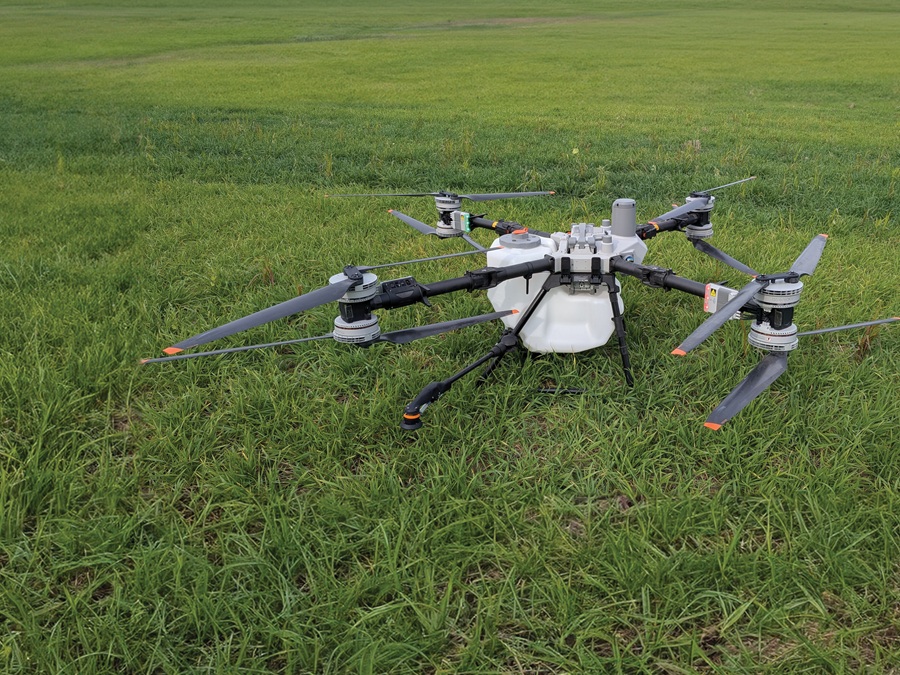
As the enthusiasm for spray drones grows, this expert raises some fundamental questions about using them.

With proper use, drones could offer a revolutionary technological advantage in spray applications. But what’s the right way to use a drone? One expert says it’s still too early to say.
Jason Deveau, application technology specialist with the Ontario Ministry of Agriculture, Food and Agribusiness, says drone technology is advancing so quickly that it’s far outpacing our understanding of how such novel platforms affect spray application performance.
As the enthusiasm for spray drones grows, Deveau cautions crop growers that there is still much to learn.
“Patience has run out for many,” he says. “It shouldn’t be dismissed how much fun drones are, and on paper, how much they promise is like a siren song. But in practice, it’s easier to blow it than to get it right. Science and testing take time. That can be hard to swallow when it looks like our (U.S.) neighbours have an advantage and we don’t. But is it really all it’s cracked up to be?”
RAPID DEVELOPMENT
Developments from drone manufacturing giant DJI highlight just how far spray drone technology has come over the last 10 years. Speaking at the 2026 Southwest Agricultural Conference, Deveau pointed to the company’s 2015 release of a rotary quadcopter with 10-litre tank capacity, hydraulic nozzles, and an operational speed of “well under 25 kilometres per hour.”
That seemed like a big deal at the time. Then in 2021, DJI reached the 25 km per hour goalpost. The next year saw the introduction of the DJI T40, which featured a 40-litre tank and rotary atomizer nozzles. The most recent model, the T100, was released with a 100-litre capacity, rotary atomizers, and a maximum speed of 72 km per hour.
“That’s how fast this is changing,” Deveau says. Interest in the agricultural applications of drone technology has generated interest “the likes of which we haven’t seen in a long time” from people outside agriculture, he says, let alone among farmers themselves.
According to Deveau, the drone market is experiencing “a gold rush” of investment, including from those offering custom application services but who have little or no experience in agricultural uses, or even pesticide application.
Even farmers and others who do indeed have input application experience are themselves dependent on what Deveau calls “information from colourful brochures,” not real-world data.
“There’s no training program per se. You have 50 grand, and enough money to throw it on a trailer? You can be a custom operator. No matter if you’ve never worked in agriculture before,” Deveau says. “Where are the checks and balances? That lack of understanding is why education and this base research is so important. What are the limitations of this equipment? The problem is not necessarily the drones. The drones can do what the drones can do. The problem is often how people are planning to use them.”
DROPLET DYNAMICS
How droplets act when applied from drone systems is key to understanding of efficiency.
Like watercraft, planes and helicopters leave a “wake” as they fly over the field. Spray droplets follow that wake, falling over the target area.
By contrast, drones produce a continuous downwash of air directly below-and-behind. That downwash makes swath width hard to predict, as the drone itself is acting like a single, air-assisted hollow cone nozzle. This is less of a problem in orchards or similar speciality crops where product would otherwise be applied with an air blast sprayer. But it makes for complicated operation in row crops where a uniform threshold dose is critical.
“Ostensibly, there’s too much [product] directly under the drone, and then it just tapers off on each end. Unless there’s a light wind. And then, who knows?” Deveau says. That means operators must assume their actual coverage is a given percentage less than peak coverage, calculate an over-under dose for the product being applied, and accept that there will still be a lot of variability in the application.
“And we hope that you’re spraying in a bit of a side wind, to blend the variability a little bit. Conventional aerial applicators have known this forever. It’s the best we can do with this narrow swath,” Deveau says.
This marks the sixth year Deveau and his colleagues have been gathering real-world data on sprayer drone performance, much of which involved experimentation with DJI’s 40-litre capacity T50. Experiments are being conducted with fungicides, with visual results being increasingly easy to notice thanks to the proliferation of tar spot through southern Ontario.
Results include the need to tighten swaths to achieve consistent coverage (drones naturally have a much higher coefficient variation than other application equipment), that coverage increases with water volume, and that greater canopy depth is inversely related to coverage, even with significant downwash activity.
“We were initially very hopeful we were going to blow that spray in there and do a great job. It does, but unfortunately the downwash is a consequence of flight. It’s not really a variable people are trying to control. In fact, they want to fly as fast as possible to get it done, which minimizes that downwash. But if you were interested in slowing down and drilling it in, you would push it into the canopy a bit further – but you wouldn’t have the patience to do it,” says Deveau.
Although fungicide application by drone is not currently permitted in Canada, some research has reported satisfactory results. But in many such cases, effectiveness was impossible to verify due to a lack of check strips, harvest data, or even aerial photographs.
“There are lots of unsubstantiated claims of efficacy. And I think we’re going to see more and more of that,” he says. “For many, flying the treatment area and coming back empty afterwards is evidence enough”.
Swath width also widens and collapses mid-flight, based on topography, altitude, wind, and other factors, further confirming the need for tighter flight paths. Operating at higher speeds and at higher altitudes was found to widen swath width, but heighten drift risk. Flying into a head wind increases apparent wind speed, and swath width. With a tailwind, swath width collapses to a point. This means flying back and forth across a field, alternating between head and tailwinds, increases the risk of lengthy coverage gaps.
“Some of this may sound intuitive to you, but you do have to do the work so you can point to it,” Deveau says.
Unanticipated findings were also many. Drone-deployed droplets were found to vector down and backwards – a result of the drone canting forward while in motion – providing little coverage on the part of the plant the drone is flying towards. Coverage on the reverse side was, conversely, extensive.
“Imagine dropping a rock into water and creating the ripples. Similarly, when spray-laden downwash hits the ground, the spray moves laterally,” Deveau says. “When we added the collectors with the greatest degree of coverage (facing up, facing the flight path and facing the drone’s retreat) we found the swaths were mathematically wider than if we had just sampled in two dimensions.”
“And in a rare shock, we actually did get some under leaf coverage…right at the edge of the swath, where the air slows down, rubbing the air around it, where the spray hits the ground and that turbulence causes it to roll. For one shining moment, it carries the finest drops straight up. Perhaps not useful, but an interesting observation.”
LOOKING AHEAD
Crucially, all of the aforementioned findings were garnered from spraying fungicides. But in late 2025, Deveau and his colleagues found herbicide – and specifically, glyphosate – was a different beast.
Using both a DJI T50 and the larger DJI T100, as well as all the same parameters trialling fungicide applications, researchers found glyphosate covered 32 per cent and 40 per cent more surface area than the intended treatment area, respectively.
And for some reason, while data indicated higher operational speeds did increase the T50 swath width, higher speeds had no correlation with the T100 swath width.
Another intriguing one-off finding, says Deveau, was an instance where the T100 appeared to achieve “true forward flight”, similar to that of a helicopter, indicating that “maybe at a certain speed I can no longer say it’s different than a helicopter.”
Other researchers trialing drone efficacy have also found the droplets emitted by rotary atomizers might be a category smaller than what operators might see detailed on the controller.
“None of these companies have ever said they’re compliant with any ISO. They’ll tell you the microns they’re producing but you don’t know whose standard that is,” he says.
Deveau’s general point for farmers and custom operators is that drones are a rapidly changing tool with significant potential, but the wild west environment they’re being fielded in today should make us cautious. While Canadian regulators have yet to approve common agricultural inputs for use in drone systems, he also reiterates Canadian farmers may not be at a disadvantage currently.
“With the release of this new generation of high-speed rotary drones, we are approaching a situation where a drone might be able to complete with the productivity of a ground rig. Now I’m not saying it will be consistent…but hypothetically it’s knocking on the door. They’re getting bigger, they’re getting faster, and while this might close some gaps, it opens others,” Deveau says. “The point is, it’s changing and its changing fast. What a drone is, what you might want to do with it, what you shouldn’t do with it – we’re all still figuring this out. A drone is very easy to use wrong.” •