
Rethinking the rules
From fertilizer economics to maturity group selection, fresh data is refining best practices for soybean production
New Ontario trials are refining fertilizer rates, maturity group selection and sulphur use—highlighting where small management shifts can protect yield and improve returns.
From optimizing fertilizers to cropping practices, there are many long-held standards for growing soybeans. But recent research trials are challenging some of these long-held conventions.
At the 2026 Southwest Agricultural Conference in Ridgetown earlier this year, Adrian Correndo, an assistant professor at the University of Guelph, and Horst Bohner, soybean specialist with the Ontario Ministry of Agriculture, Food and Agribusiness (OMAFA), provided their own ‘secrets’ for growing soybeans. Among their observations were updates to phosphate (P) and potash (K) recommendations, excitement over double-cropping soybeans, and insights on sulphur applications.
Correndo presented data from research trials on P and K levels in soybeans from more than 28 trials across Ontario (Table 1). The goal was to determine whether OMAFA recommendations still apply, and to create a dashboard available for growers before the planting season. A beta version was planned for feedback in February.
“We’re still building the database, and we have a lot of data,” said Correndo, stressing that results from the research are preliminary. “We’re also compiling all the historical data and trying to make it available.”
His research addressed P and K levels according to Soil Test (STP and STK) values and compared them to Critical Soil Test Values (CSTV). In phosphate, 15 ppm was the recommendation for P with a range of 10 to 20 ppm labelled “acceptable”.
“The average response of soil below 15 ppm is 10 bushels per acre (bu./ac),” said Correndo, adding that the range of yield loss is between three and 15 bu./ac, which is a reasonable response in soils below 15 ppm. “We may have cases where you have 30 bu./ac (response). But if we go above 15 ppm, you see that the response is an average of around 5 bu./ac.”
Table 1 – Revisiting P&K recommendations
| P2O5 (lbs/ac) | K2O (lbs/ac) | |
| T1 | 0 | 200 |
| T2 | 22 | 200 |
| T3 | 53 | 200 |
| T4 | 85 | 200 |
| T5 | 116 | 200 |
| T6 | 116 | 0 |
| T7 | 116 | 22 |
| T8 | 116 | 66 |
| T9 | 116 | 133 |
| T10 | 0 | 0 |
Source: Adrian Correndo University of Guelph
MORE NOT ALWAYS LESS
Relating that to application rates, Correndo used a graph that employed a ratio of pounds of soybeans and pounds of P2O5 while comparing them to soil test levels of P (STP) above and below 15 ppm. He found the optimum ratio was five (lbs of soybeans to lbs of P2O5). Using current pricing – which he said is a bit high compared to historical figures – that ratio would show up at 50 to 60 lbs of P2O5/ac.
According to the Most Economic Rate of P (MERP) from all the trials, that application rate still looks reasonable, with an Olsen-P rate of five ppm at 0 to 15 centimetres (six inches) depth.
“Overall, the recommendations wouldn’t change much, depending on price,” said Correndo. “They may change about 10 pounds or so – not a drastic thing. What’s driving most of the recommendations is not the price of fertilizer, it’s the soil test.”
He used the same logic for researching potash. To achieve 95 per cent of relative yield, the critical value is around 90 ppm with a range of 80 to 100, which is similar to the current recommendations.
“If we do the same summary below 100 ppm, the average response is within three to 13 bu. per ac with an average of five bushels,” said Correndo. “But if we go above the critical value, the average re-sponse is around two bushels, or one-and-a-half, within a range of zero to five.”
With the MERK, the research data indicated that in a lot of cases, between 60 and 120 lbs of K2O/ac, there was no economic response. But whenever there is a response, he added, it looks like the recommendation may be a bit short, meaning more research and data are required.
One question from the audience asked how crop removal rates might affect application recommendations. Correndo responded that this research only reflected changes to the recommendations.
DOUBLE CROPPING SURPRISE
Horst Bohner has never been a fan of double-cropping soybeans, mostly due to his location near Stratford and the uncertainty of planting dates. Growers in various regions have tried it, as has Bohner since 2021. He said he’s failed every year except in 2025.
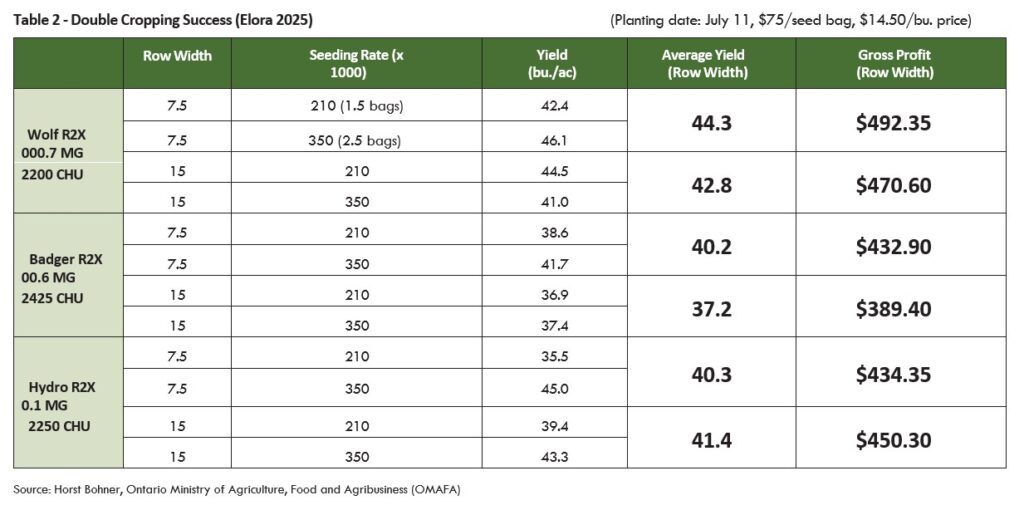
“And I have some really interesting results and I’m getting a little excited about double cropping, even in the short-season areas,” he said. To illustrate his point, he displayed a picture of one field at the Elora Research Station with “regular-planted soybeans ready for harvest on Oct. 1, compared to a nearby double-crop field that was green and vibrant. “But October 9th was when we had the first frost of any significance, and we had really short-day beans – Wolf 2200 heat units, 000s. Between the first and ninth of October, they came along really nicely.”
Bohner tried different maturity groups to what he considered to be an adaptive variety for Elora, and the one he planted was a 0.7 maturity group, and they finished. The plots were helped by a relatively late end to the collection of crop heat units on Oct. 24; in 2024, it was Oct. 16, and the long-term, 10-year average is Oct. 1.
What he took from the 2025 results, however, was the need for short-day soybeans – up to three maturity groups less than adapted at Elora. That’s where Bohner suggested growers would have the most success.
“It’s not what we’ll necessarily finish with in terms of what you can get away with, but this is based on 10 years of performance trials,” he said, noting the Maturity Group map for soybeans has been updated. “What we learned in terms of the double cropping results is that even though we have more heat units in terms of the soybean recommended variety, we actually lowered the number because those are the varieties that are yielding the best.”
The figures from the 2025 test plots at the Elora Research Station indicated double-cropping is possible, albeit under ideal conditions and with the necessary adjustments in maturity group (Table 2). Row widths had less of an impact; however, seeding rate was key. Bohner determined the traditional numbers – 250,000 seeds per acre – aren’t sufficient for a location like Elora and should be increased to 263,000.
“This is the real learning curve for people in the shorter heat unit areas,” he noted. “If you’re going to try this, don’t use an adapted variety – don’t use a variety that’s even one maturity group less. The only thing you have to work on is finishing that variety, and the only hope you’ve got is a super short-day bean.”
THE S EFFECT
For years, sulphur has been the “major micronutrient”, often challenged by the absence of a reliable soil test. But Bohner discussed trial results from 2025 and a seven-year study on spring broadcast of nitrogen (21 lbs/ac actual) and sulphur (24 lbs/ac actual) from 2019 to 2025.
In total, they have 49 site years, some from Pioneer Hi-Bred and Maizex Seeds, as well as OMAFA, University of Guelph and Ontario Soil and Crop Improvement Association (OSCIA). On its own, the data from nitrogen were disappointing, and the average response to 100 lbs/ ac of ammonium sulphate was 3 bu./ac.
What Bohner found exciting was that 22 per cent of the trials were significant and taking an average yield response from those, there was a 10.3 bu./ac, gain, meaning fields short on sulphur could benefit greatly. Sandy, low-organic matter fields, early-planted with heavy crop residue, no sulphur applied the previous year and soil test below 5 mg/L CaCl extractable sulphur indicated a benefit. Yet the surprising secret was the presence of soybean cyst nematode (SCN).
“Where there’s significant SCN, we’re seeing a better response to sulphur,” he said. “There is some scientific evidence now that SCN has a real impact on the amount of available sulphur and even more importantly, that if you have a lot of SCN, the bean needs more sulphur. There may be a reason why there’s a correlation to SCN.” •