Dual-edged technology helping wheat growers
A smartphone app can monitor for FHB and estimate head counts
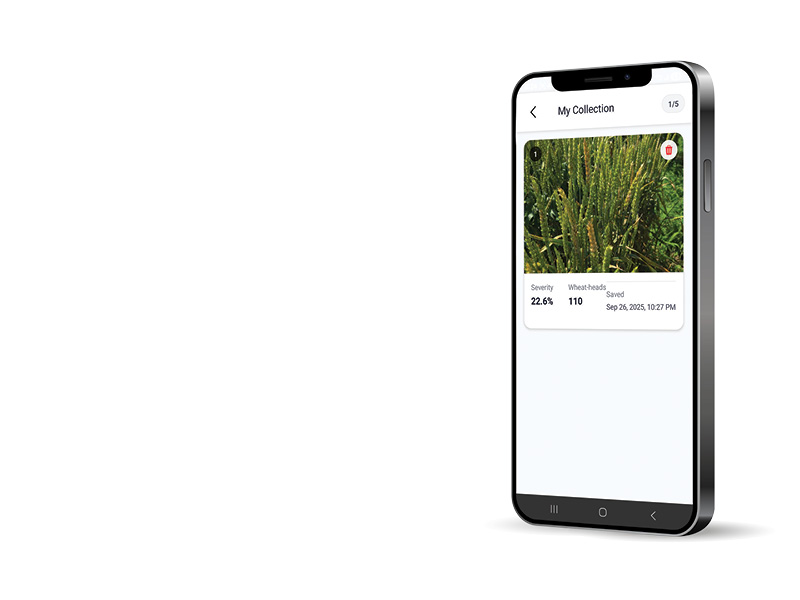
The WheatScanR app is a new technological tool to help researchers and wheat growers monitor Fusarium head blight (FHB) and estimate wheat head counts for yield predictions.

In 1996, Fusarium head blight (FHB) decimated more than 90 per cent of the Ontario wheat crop, at a loss of more than $120 million. With improved genetics, timely fungicide applications, and retuning harvest methods, the effects of FHB have been reduced, yet it remains a considerable threat.
Now, 30 years later, plant breeders and growers stand to benefit from a new app conceived and built by a University of Guelph PhD candidate. WheatScanR is available on iOS and Android platforms, free of charge. Developed primarily to help researchers screen varieties and assess the extent of FHB in wheat cultivars, it can also help growers monitor their fields for the disease and perform head counts for yield estimates.
Riley McConachie is the developer of the WheatScanR and began work on the platform while immersed in his master’s degree. He started in the Undergraduate Student Experiential Learning (USEL) program and has continued with his post-graduate studies. The app was born out of painstaking labour from many test plots, inoculating thousands of wheat heads, then estimating levels of infection by physically examining the heads.
THE ACTUAL PROCESS
With the WheatScanR, McConachie used an open-source software to segment images of the heads. Wheat-head detection and segmentation combine shapes and colours, providing an accurate image of what’s present. A spectral index is used to determine the extent of bleaching from FHB. Green colouring indicates a disease-free head.
The app removes much of the variability from human estimates of FHB, which were previously assumed to be 100 per cent accurate, though even experienced researchers find distinguishing 60 to 70 per cent infection a challenge. The app is capable of capturing millions of pixels in an image, which eliminates variability, adding to its accuracy in predicting FHB in a field.
“Some of our testing has shown that it’s within a five per cent severity estimation; if you say the plot is 10 per cent infected, it’s plus or minus five per cent from that number,” says McConachie.
“That might seem like a little bit, but studies have shown that with person-to-person (counts), there’s about a 10 per cent sway. The app’s accuracy is a bit more consistent.”
That’s a huge advantage for researchers and plant breeders, particularly in assessing Fusarium resistance in breeding lines. In a breeding program, the focus is on germplasm improvement by introducing new traits and selecting for them amongst thousands of breeding lines.
“As plant breeders or geneticists, we make populations and discover where those genes are,” says Helen Booker, an associate professor at the University of Guelph, adding that it’s a slow, deliberate process. “We are using a population derived from a cross of FHB-resistant Canadian spring wheat and elite winter wheat lines to map genetic regions in a winter wheat background that condition resistance.”
To further aid in plant breeding, part of McConachie’s work uses the app to estimate incidence and disease severity, helping breeders and researchers measure a trait’s fusarium resistance, as merit criteria for registration testing. It’s providing more objective data and greater transparency around FHB resistance, along with resistance to deoxynivalenol (DON) accumulation in the grain.
“As part of his master’s work using these single head images, he was able to use a spectral index to estimate disease within the head,” says Booker, one of McConachie’s supervisors, along with John Sulik. “He’s upping that to the plot level in his PhD, because in the field, we’re looking at hundreds or thousands of individuals.”
RAISING THE BAR
Adding value to the app is its availability to growers, who can perform their own head counts to help with yield estimates. Where the FHB image captures have a limited window (shortly after flowering), growers can use the app after heading and before maturity, as long as the heads are visible. Growers will also be able to make better-informed decisions using the FHB assessment for in-season adjustments, like combining infected fields first or increasing fan speeds to blow out infected kernels. It would also be a benefit for longer-term management practices, assessing wheat stands one year and carrying those lessons to the next.
Joanna Follings, cereals specialist with the Ontario Ministry of Agriculture, Food and Agribusiness (OMAFA), had help from McConachie with the 2025 Yield Enhancement Network (YEN) initiative. The trends they’ve noticed with YEN show high-yielding producers have more than 800 heads/m2.
“Those producers had an average of 143 bu./ac., and this would give them an idea of whether they’re hitting that target to achieve high yields,” says Follings.
“It could be more valuable in helping them with decisions the following year, comparing fields and head counts, and looking at the differences between the management strategies they use, particularly planting dates.”
Planting date is one aspect that has a significant influence on head counts, where planting within an optimum window can help reach that target of 800 heads/m2. Growers can also address other management strategies, including nitrogen rates.
“It’s not a tool that’s going to give you all the answers, but it’ll provide you with insights of what worked well this season and maybe what you can improve on,” adds Follings.
McConachie stresses the head count and yield estimates are not guarantees on what a grower will harvest. The final numbers still depend on possible infections in a field, lodging or random weather events. In using the app to assess FHB, he notes it’s a little more challenging given the bleaching effect of the disease: once the crop reaches maturity, a bleached head looks the same as a mature head.
But another advantage is the app’s cost-and time-efficiency; a grower can get FHB estimates in minutes rather than spending an hour or two scouting a field.
NEXT STEPS
With ongoing use, WheatScanR will be updated as new methodologies and features are added. There is a limit on the number of pictures that can be saved within the app, but it’s still a powerful indication of what’s possible and what’s coming in the future. •