Farming through change
From slower markets to global volatility, Keith Black looks back on 12 years of leadership
Conventional wisdom often warns against thinking too much about the past because there’s no changing it. Yet there’s a difference between living in it and fondly reflecting on where a person’s come from and what they’ve accomplished.

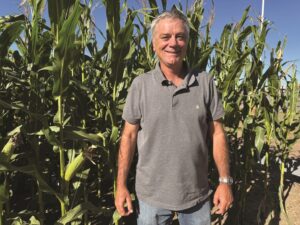
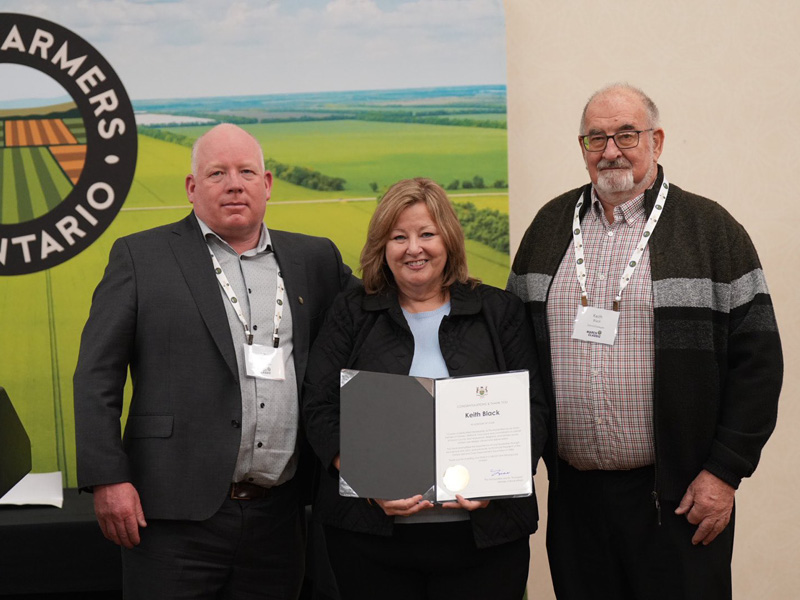
Keith Black understands that. Stepping down earlier this year as director of Grain Farmers of Ontario’s District 8 (Huron), he assesses his 12 years of service, marking many of the changes that have taken place as part of the third generation on his farm.
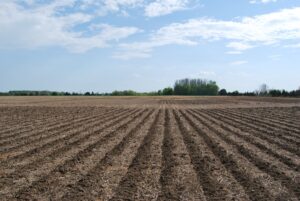
Black is primarily a cash-cropper with roughly 250 acres in North Huron, southwest of Belgrave, rotating soybeans, wheat and corn grown on 175 acres. The remaining 75 are rougher ground on which his son-in-law pastures cattle. That was a switch from the days when Black pastured his own grass cattle, which he’d purchase in the spring and feed them through to the following winter.
THERE FROM THE START
In addition to his service as a director, Black’s time with boards and organizations predates the Grain Farmers of Ontario. He was a director with the Ontario Soybean Growers the year before the amalgamation with the Ontario Corn Producers Association and the Ontario Wheat Producers’ Marketing Board. He was also a long-time member of the Huron County Grain Farmers.
“Huron County was a bit different because we had a soybean board, a wheat board and a corn board, but we always met jointly,” says Black. “We kept separate books, but our meetings were joint, so we were ‘semi-organized’ before the Grain Farmers of Ontario organization.”
When asked about some of the more significant changes he’s witnessed, Black points to the technologies now available to growers and levels of uncertainty and volatility that are ongoing realities. In terms of the advances, he acknowledges that farming has always embraced the drive to expand operations. In his local region, supply management has driven a lot of the expansion, with advances in technology leading the way. Although he avoids saying it’s right or wrong, he believes it has helped create more competition.
Where the pace of change is a more imposing concern for Black is in the barriers facing younger producers. In his estimation, it’s far more difficult now than 30 years ago, partly because costs are so inflated today, but that’s only part of the equation. “When we started farming, we basically started with nothing,” he says, noting it required some custom work and off-farm jobs to garner wages coming in to the farm. “We managed to pay our bills. But now, with the price of land, the price of machinery, that off-farm income isn’t big enough to do that, and that was just with buying a farm.”
The only way Black believes someone starting from scratch can make it – without any connection to the farm – is with rented ground and possibly a partnership with someone. Or they might have to work for another grower and buy or lease land, or do custom work. Starting literally from the ground-up or even buying a farm with good used machinery, it can be overwhelming, not to mention difficult to cash-flow.
On top of that is the uncertainty with global conditions and the impacts on trade caused by tariffs and policies from other countries, as well as conflicts in Ukraine and the Middle East. Black maintains that reactions to these and other influences occur with greater immediacy than in the past.
“Back in the 1990s, the 80s and even in the 70s, we had markets that reacted to weather or other factors, but they reacted slowly and incrementally,” he adds. “Now, we have markets that are reacting, and you can see a 50-cent swing in a day, and it can be up 50 cents one day and down 50 cents the next, so that’s a dollar swing. The world was still volatile back then, but we didn’t react to world news the way we do now.”
DOMESTIC ISSUES
As if conditions abroad weren’t combining to challenge growers both older and younger here in Ontario, there’s a delicate balancing act when advocating for growers in dealings with government. Black’s been a part of the agri-food industry long enough to understand the value of an assertive approach, but he often questions some of the decisions made by provincial and federal governments.
“There are all kinds of opportunities we should be researching,” says Black, referring to the proposed soy protein isolate processing plant for Huron Commodities at Benmiller as one example (it’s having trouble garnering funding to see its construction).
“We’re viewed as an exporting nation, and that seems to be where the federal government wants to lead us, rather than starting up our own industries and doing our own processing and exporting value-added products. The role should be to lead, but I don’t think we’re doing that.”
It’s not as though there aren’t positives with building premium export opportunities, including connections Grain Farmers of Ontario has helped foster with Mexico and soft red wheat, and exporting soybeans. But neither of those came quickly, says Black; they took time and effort, and continued diligence to maintain them.
From Grain Farmers of Ontario’s standpoint, he adds, there have been ongoing and open discussions with government, although he distinguishes provincial and federal levels. The latter relations seem to be a little tougher. But it’s all the more reason to continue pressing. “We had a few issues that might not have been solved the way we wanted, but we took the years to solve them and we’ll continue on,” says Black, referring to his time as a director. “You can’t give up because if you do, you won’t get anywhere.”
As he reflects on the past 12 years in particular, the most rewarding things about being a director have been the friends he’s made across the province, including farmers, fellow directors and government and industry representatives. •