
From gaucho to grain farmer, government and back
Santiago del Solar on a decade of change in Argentina
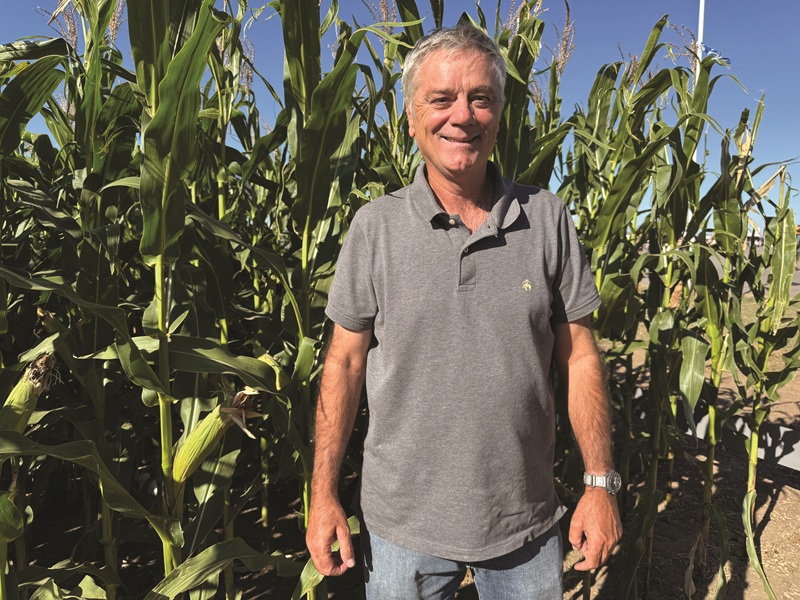
An Argentinian farmer remains hopeful that farmers in his country can thrive with a more stable policy environment.

The business pavilion at Expoagro is buzzing with activity. Held each March in San Nicolás, Argentina, the outdoor exhibition is the place to be. Farmers move between stands, some stopping at the CREA booth for coffee and conversation. The energy is good. Under President Javier Milei, Argentina’s grain sector has reason for new optimism.
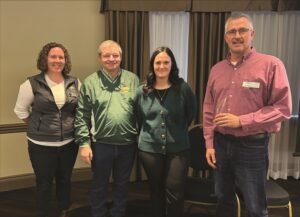
Santiago del Solar walks into the pavilion, looks around slowly, and makes his way across the room. He does not get far before he is intercepted — someone shakes his hand, another claps him on the back. A farmer friend he has not seen in a while gives him a quick embrace. He returns each greeting warmly and unhurriedly before settling in for the interview.
It is not hard to understand why Del Solar commands the room. Now in his early 60s, he comes from six generations of farming in Buenos Aires province. He has been an active member of his local farmer network, CREA, for decades, and served on its national board for six years. He also served in government for two years and two months. He is modest but outspoken—kind but firm. More importantly, he is knowledgeable about both farming practices and public policy. He is the kind of farmer other farmers listen to.
A FARM TRANSFORMED
Ontario Grain Farmer readers may remember Del Solar from a profile published in 2014. At the time, he co-owned a 4,700-acre farm with his brothers and managed nearly 25,000 acres across Buenos Aires province. While his family had, for generations, been skilled cowboys — gauchos in Argentine culture — they had abandoned cattle in the early 1990s in favour of no-till crop production.
At the time, Del Solar was sharply critical of government interference in agriculture. Export taxes, known as retenciones, which siphoned a percentage of farmers’ revenue at the border, had long been a feature of Argentine economic policy. But the interventions went further. Programs like the dólar soja — a temporary preferential exchange rate designed to pressure farmers into selling stored grain quickly — were less about supporting farmers than managing the government’s desperate need for foreign currency. For producers trying to plan ahead, the instability was exhausting. Despite his frustrations, Del Solar remained both technically progressive and optimistic.
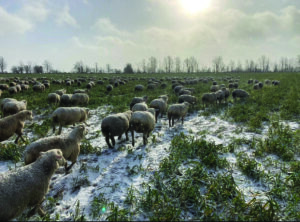
The first thing that would surprise anyone familiar with the 2014 profile would be the return of cattle. Del Solar still grows corn, wheat, barley, soybeans, and sunflower across several family properties in the Buenos Aires region. But his farm spans closer to 30,000 acres now, and the livestock are back. He runs about 3,000 head of beef cattle through a full production cycle, including a feedlot, and milks 2,500 dairy cows on Lely robotic milking systems, something of a rarity in Argentine dairy operations.
The decision to diversify was partly agronomic — some of his land is better suited to pasture than crops — and partly a matter of family investment. Beef cattle prices have roughly doubled in five years. The move has paid off.
INSIDE THE MACHINE
In late 2017, Del Solar received a call from Argentina’s incoming agriculture minister. The newly elected Macri government had come to power on a promise to open markets, reduce export taxes, and reintegrate Argentina into the global economy. The minister wanted Del Solar to serve as his right-hand man, advising him on how policy changes might affect farmers.
Before saying yes, Del Solar consulted his brothers and his cousin, who agreed to take over day-to-day farm operations in his absence. It was not a decision he made lightly. He had spent decades building the operation. Walking away from it, even temporarily, meant stepping back from everything he knew. His brothers encouraged him to do it. Perhaps he could effect change from inside government.
Del Solar was proud to work under Macri, who understood farming and made time for the agricultural file. But the fiscal pressures of governing Argentina were relentless. Grain is Argentina’s primary source of U.S. dollars. When the government is desperate for hard currency to service its debt or stabilize the peso, it turns to grain export taxes because that is where the dollars are.
Once in Buenos Aires, Del Solar found a government willing to support agriculture — and a finance ministry equally willing to tax it.
“The finance minister is always happy in Argentina,” he said. “They need money. They need dollars. They need export taxes.”
“And that was a kind of struggle every day,” he added. “Trying to stop the finance minister from raising taxes.”
The breaking point came over a single weekend in August 2018, when a currency crisis forced the government to impose export taxes across all sectors of the economy, not just agriculture. Del Solar was devastated. He had not gone to work in government just to do what it had always done. Conflicted, he spent the weekend calling trusted farmer friends before markets opened Monday morning. Several urged him to stay in his post.
“I spoke with my wife, my son. I asked them what to do,” Del Solar said. “‘Stay,’ they said. So I stayed.”
Some of his farmer friends felt he should have resigned in protest, but he had made a commitment. “I paid the price,” he said, referring to the reputational cost. “I didn’t like that.”
He is philosophical about it now, though, noting that a tax applied universally across all sectors was at least structurally different from the usual arrangement.
“When it’s only for farmers, it’s only for farmers, and nobody gets it — like right now,” he said.
Government taught him something else he could not have learned in the field, something he has since passed on to his farmer friends. Large corporations carry much more power at the policy table than farmers do. They push and lobby for the change they want. And they are heard.
“Big companies know how to do that. And sometimes they don’t show themselves,” he said, meaning their approach is not always transparent.
He saw this most directly in the push to commercially approve HB4, a genetically modified drought-tolerant wheat, during his time in office. The pressure from the crushing industry and seed companies was immense, he said. But Del Solar held firm in support of farmers, arguing the export market risk was too great.
BACK ON THE FARM
What Del Solar learned during his time in office helps shape decisions on the farm today. Government in Argentina, he said, is always in crisis or on the edge of one. Finance ministers react out of fear, and they react fast — sometimes over a single weekend. So he farms defensively now, hedging against the policy shocks he knows will come, staying involved in advocacy through CREA and Sociedad Rural, and trying to shape the outside environment he could not change from inside.
The governments that followed Macri restored grain export taxes. The current Milei government, elected in late 2023 on a platform of radical economic liberalization, has reduced the soybean export tax. The tax was lowered from 33 to 26 per cent, and then cut again to 24 per cent in December 2025. Just two weeks ago, Milei announced a schedule to reduce it further by 0.25 to 0.5 percentage points per month beginning in January 2027, conditional on his coalition winning the next election. Del Solar acknowledges Milei has delivered genuine reform in mining and energy, where a large investment incentive program has attracted significant foreign capital. Agriculture, he said, has not received the same treatment.
“He’s a libertarian, but not with farming — with other industries, with mining, energy,” he said. “You can’t be a part-time libertarian.”
The same tax burden suppresses fertilizer use. Argentine farmers cannot justify the agronomic investment when export levies cut so deeply into returns. The result is a widening gap between what Argentine soils are capable of producing and what they actually produce.
Yet he is not without hope. Argentina has the land, the knowledge, and the people. What they need, he said, is simple — a policy environment that is stable long enough to let them work.
“More than three days, please,” he said with a chuckle. “At least one week. It could change everything.” •