
Beyond simple soil chemistry
Looking below the surface could change how growers assess fertility decisions
A better understanding of soil complexity could help farmers improve yields, reduce input dependence, and keep more value on the farm.

Soil is complex. Agronomists and farmers say it often, but do production decisions always reflect that reality?
Not as much as they could, according to NaturAll Solutions Inc., an agricultural consulting firm based in Shakespeare. Its team argues that reframing production decisions to better account for soil complexity could improve yields and save money at the same time.
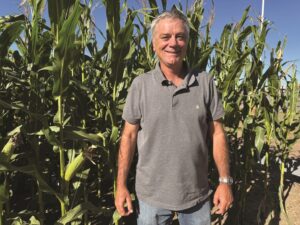
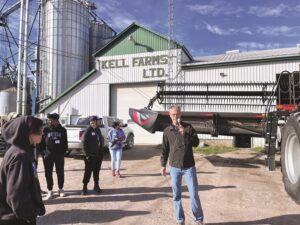
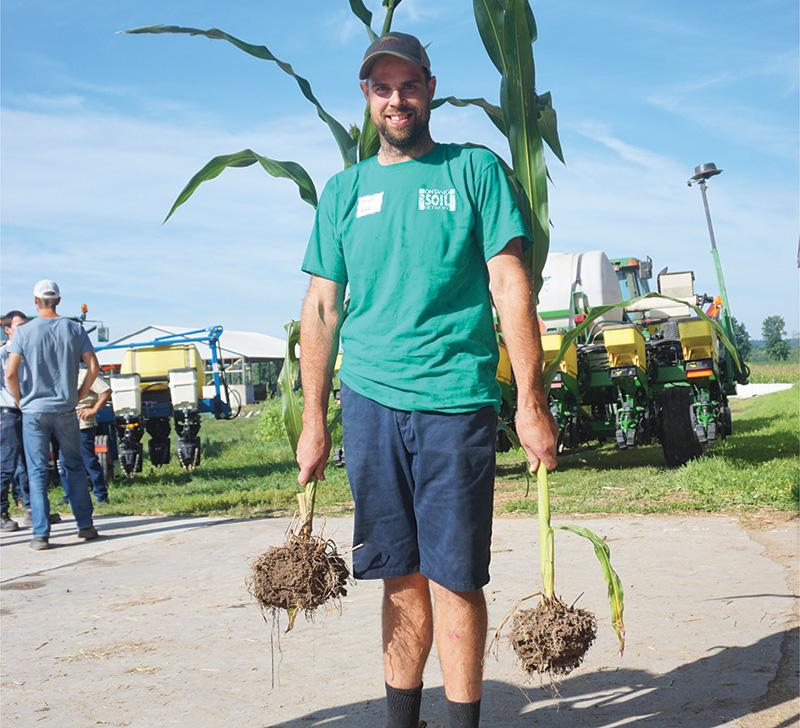
The argument was made during an Ontario Soil Network event held August 26 near Hamilton at the farm of Gordon Alblas. The event allowed growers to discuss factors affecting nutrient availability, planter setup, and other production considerations.
Representatives from NaturAll covered how growers can assess and understand what soil is holding, including minerals critical to soil function, and what supporting soil biology looks like in practice. Alblas and other neighbouring farmers also discussed their use of biological compost extracts. A broader theme emerged throughout the day: how can farmers keep more money on the farm and out of agricultural retailers’ hands?
THE SOIL-GEOLOGY CONNECTION
John Slack, a geologist by trade who previously operated an organic sheep farm, was the first to speak. Now an agromineral specialist with NaturAll, Slack identified soils’ interaction with the geology from which they formed as a key way to understand how soils function.
“Geology used to be an important part of agronomy education. Before an agronomist went into the actual specifics of growing a crop and the relationship between the plant and the soil, they had to study geology. I’d say in the 1950s and 1960s, that part of agronomy education ended. I always thought we were leaving out a major understanding of our soils by not studying them,” says Slack.
“What we know today in geoscience is that the relationship between geology and life, the biosphere, is interconnected.”
Slack says the underlying geological properties of a given area influence the composition of the soil above it. Much of Ontario’s farmland, for example, has soils formed from high beds of calcium carbonate, meaning they are naturally high in trace elements. Trace elements and other physical characteristics of soil matter because they can affect the chemical and biological properties required for plant growth, including the availability of nitrogen.
A better understanding of underlying geology also helps inform understanding of root systems. Pointing to century-old research conducted by John Weaver, a botanist and prairie ecologist who studied wild grasses and grass crops at the University of Nebraska, Slack argues that the composition of the subsoil and parent material is underrated in its influence on root development and nutrient extraction. Analyzing deep soil layers can paint a clearer picture of what nutrients may be available in a given area, better informing management decisions.
Standard soil testing, he says, “evaluates relationships and patterns at the level of chemistry. If we aren’t thinking about soil complexity, we will never achieve optimal efficiency.”
A “BEAUTIFULLY COMPLEX” SYSTEM
Several attendees shared examples of complexity they have observed in the field. Host farmer Gordon Alblas pointed to reduced nitrogen rate trials in his 2026 corn crop, where plant and cob development did not follow a linear response based on nitrogen rate.
Spencer Zehr, a farmer and co-founder of NaturAll, says such results indicate how much nutrition already exists in the soil. In his consultancy work, Zehr says he tries to “work on the assumption there is abundance” in soil, rather than adopting a scarcity mindset.
“Nitrogen isn’t just a fertilizer, it’s a cycle. Healthy biology is what turns nitrogen into a reliable, season-long nutrient supply,” he says.
With this in mind, Zehr says growers should look for ways to add carbon, oxygen, silica, and micronutrients to support enzymatic activity. Feeding the carbon cycle and improving soil structure with living roots and residues is one way to achieve gains, he says. Understanding the importance of trace elements and micronutrients is another.
Silica, for example, is critical to plant metabolism. Molybdenum relates directly to nitrogen use efficiency and nitrogen fixation. Boron is critical for pollen viability, pollen tube growth, flower retention, seed set, root growth, and hormonal regulation. Zehr says his experience shows molybdenum and boron are consistently neglected in Ontario, often to the point of critical deficiency, resulting in “constipated plants” where nutrient flow does not reach its full potential.
Another strategy for improving the natural function of soils is avoiding fertilizer overapplication.
“Adding nitrogen can suppress biological fixation. It’s kind of like labour — when you have too many workers, the organisms say, ‘OK, we’re done.’ We have to figure out a system that’s going to work with the natural system in our soil,” Zehr says.
The end goal is for soils to “regulate themselves,” reducing dependence on expensive inputs.
“The soil and plants are a heck of a lot smarter than we are. Nature has the blueprints to do it. We’ve simplified complex systems to simple chemistry. It’s shooting ourselves in the foot and wondering why it hurts to walk.”
Zehr also encourages farmers to sharpen their observation skills and pay closer attention to how plants respond to management practices, rather than relying on linear assumptions between inputs and expected results.
“Observation is so critical for farmers. They spend so much money paying agronomists like us to do tissue tests and soil samples, and then we give them recommendations. But what we’ve seen is that not many are taking these analyses, going out into the field, and watching how plants express themselves,” he says.
“My dad always said growing up on the farm that plants are an amazing thing to work with because they’re the one thing in life that won’t lie to you. When you do the right thing, plants will respond positively. We have all this analytical data now, but we can simplify so much of it with observation.” •