
Putting farm robotics to the test
Event highlights challenges, potential, and networking opportunities
The AIVA network is testing farm technologies in real-world conditions to help farmers make informed investments.

A growing community of farmers, researchers, facilitators, and innovators are partnering to validate new agricultural technologies on farms across the country. The intention – to eliminate the need for individual producers to prove agricultural technologies work, thereby making adoption easier for all.
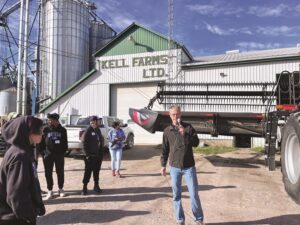
Many representatives of this growing community met near Bothwell at Haggerty Creek Ltd., On August 18, for a day of in-field demonstrations of different agricultural technologies. Many of those on display were involved in the Agriculture Innovation, Validation and Adoption (AIVA) network – an initiative created by Farm Credit Canada, EMILI Innovation Farms, and Wabash Heartland Innovation Network.
Speaking at the field event, Carl Havixbeck, farmer network success manager for AIVA, says the organization’s mandate is rooted in “validation, adoption, and co-learning.” In practice, validation means getting technologies market ready, so farmers can adopt with confidence that the technology in question works as described in their unique field conditions.
Co-learning refers to the organization’s focus on making all findings public, and holding events to demonstrate the effectiveness of the technologies being assessed. At the time of the Haggerty Creek field event, 133 technologies from companies around the world are in the AIVA assessment queue.
The network’s core effort, says Havixbeck, is to figure out “what’s the tech that’s going to help you be better at what you do?” and argues the necessity of doing so is growing as the development of artificial intelligence means the ag-tech landscape is going to get “very noisy very quickly.”
One of the farmers working with AIVA is Chuck Baresich, of Haggerty Creek Ltd. and Haggerty Creek AgRobotics. Long interested in the potential of agricultural robotics and other technologies, Baresich has many takeaways for tech developers. One of those is “please no more machine screws,” and to “use real bolts,” the context of the statement being tech developers must understand how tough field conditions are on hardware.
“What farmers want to see is they don’t want to see breakdowns. They don’t want to see something that has a bad wiring connection or has a battery that only lasts an hour. It has to work in field conditions.”
He also encouraged developers to really consider if they have a solution looking for a problem, and whether a farmer will actually “write a cheque.”
“I don’t want to discourage inventors and entrepreneurs. When I say ‘you have a solution looking for a problem,’ I don’t mean that in a demeaning way. What I mean is we need to flesh that out together as a group,” says Baresich. “It takes time. The unfortunate thing with agriculture is it takes more time than other industries.”
SOME OF THE TECHNOLOGIES BEING SHOWCASED INCLUDED:
- Oz, autonomous weeding
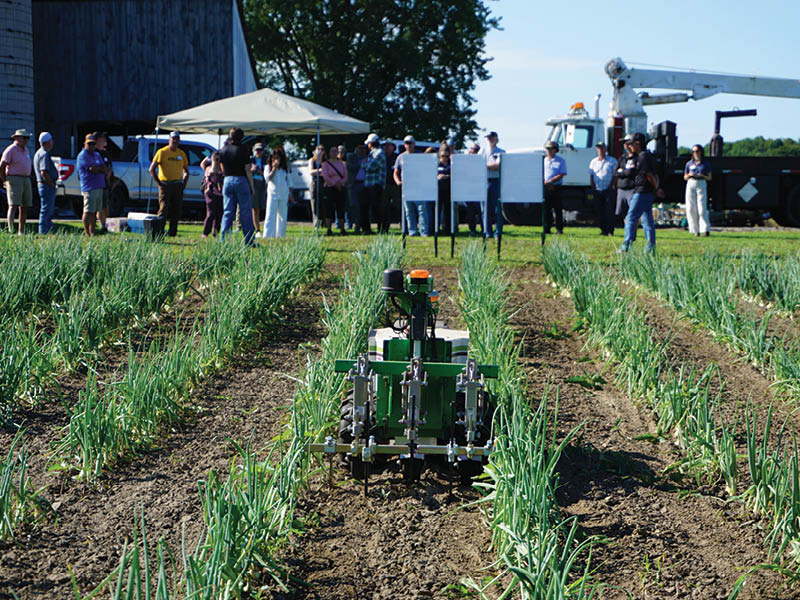
The Oz robot from France’s Naïo Technologies is an autonomous weeding platform for higher-value row crops. At Haggerty Creek, it was being demonstrated in a series of small onion plots.
Capable of covering two acres per day, the developers say the platform is not designed to replace large weeding machines. Its success in the onion plots was mixed, as it was very effective at tilling weeds between rows, but struggled to control anything growing in closer proximity to the crop. It was also observed a narrower toolbar was needed to fit between the rows as the onion stalks grew.
- DJI T50, pesticide application
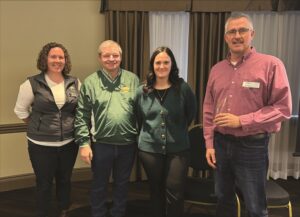
The Pesticide Regulatory Directorate’s recent permitting of pesticide application via drones has opened significant possibilities for input application. Standing in front of a DJI T50 drone, Angela Fawcette (pictured at right) regulatory project manager for Corteva, reviewed some of the application challenges still being hashed-out by drone applicators. This includes the water volumes required for adequate coverage, and swath width.
“Keep that water volume up. 50 litres per hectare at a minimum,” says Fawcett, also cautioning against flying the drone too quickly while applying liquid products. Elsewhere, the company is assessing the utility of drones in other use cases, such as over uneven terrain, or in utility corridors.
- Subterra Green, soil analysis
A technology initially developed to scan for human remains prior to archaeological excavation, S4 Mobile Laboratories’ Subterra Green is a spectroscopic probe used to detect soil organic carbon and other soil characteristics, such as water content and bulk density. It can go up to 90 centimetres down, and take readings at any point in the soil profile.
Technical sales manager Russell Pier (left) says the move to carbon analysis came at a time when carbon markets were beginning to be a popular topic of conversation in the United States. The idea is to supplement, or partially replace, the need for more labour-intensive and time-consuming soil core sampling. At Haggerty Creek, he and his colleague Morgan Revels (right) completed a 171-probe analysis to a depth of 60 centimetres.
“Precision is the name of the game. It’s calculating a lot of data,” says Pier.
- CredoSense, crop health diagnostic
Early-warning disease prevention is the purpose behind crop diagnostic tool CredoSense. The system combines a weather station with soil and leaf moisture sensors to detect plant stress before disease signs become visible.
Abdul Halim (not pictured) chief executive officer, says the machine gathers environmental data continuously, generating warnings when conditions are favourable for disease development. Someone can then visit the location and assess crop leaves with a handheld scanner. The idea is to expand the window for fungicide application, and ideally, reduce the amount of product required, either by reducing the rate or improving timing so a single application is all that’s needed. The effective monitoring range of each weather station is five kilometres or less.
Many other technologies were also on display, serving as discussion prompts for event attendees. For his part, Baresich shared some of the observations he has made since Haggerty Creek began investing in precision and autonomous systems.
While current application technology is “very advanced” and has occurred almost without notice, Baresich says ther next step is “removing the driver from the cab” – but only where it makes sense to do so.
“On a fertilizer application that can cover 700 acres a day, removing the driver from that machine doesn’t make a lot of sense because your labour is your lowest cost. What we’re looking at in the robotics space is generally in the smaller, lighter or higher value crops. Some examples of that are some of the robots we have here (today), and the robotic lawnmower bouncing around behind us,” he says.
That autonomous lawnmower – relatively inconspicuous by comparison to the larger machines scattered around the Haggerty Creek yard – served as a particularly important demonstration of what Baresich identified as the potential use case for robotics and autonomous systems in agriculture.
“The reality is, when I come home from work at night, it is a significant relief to come home and the lawn is already cut. It’s something I don’t have to do. And it might sound silly, but that is actually what the allure of robotics is all about. What is that little task that I no longer have to do? We have four acres of lawn and at full tilt on my riding lawnmower takes me 3.5 hours. And so yes, that little robot cannot cut that in 3.5 hours. It takes it 2.5 days. But who cares? It doesn’t matter.”
He also encourages farmers to analyze their thought processes when it comes to the problems technology can solve, and reiterates his belief in the potential for autonomous systems to succeed as the community around them grows.
“As farmers, we have so much generational knowledge and ingrained knowledge, sometimes we can’t define our problems very well. The problems come out as ‘my costs are too high,’ or ‘I don’t have enough labour to weed my onions’ or ‘the herbicide isn’t working to kill the palmer amaranth.’ That’s kind of how the problems get expressed, when the reality is there’s probably a process question, or applications question, that needs to get answered,” says Baresich.
“One of the things this journey has showed me is the network of people interested in this space is very, very large. I think we’re going to do lots of things with this.” •