
How a UK farmer grows 235-bushel winter wheat
Lincolnshire farmer Mark Stubbs produces bin-busting yields by driving soil organic matter

Yield gains in winter wheat can be achieved by experimenting on the farm and treating wheat with as much care as more lucrative crops such as corn and soybeans.

Tight row spacing, high plant populations, and continued investment in the soil have helped Mark Stubbs win the UK’s Yield Enhancement Network (YEN) not once, but twice. His most recent winning harvest was a record-breaking 235 bu./ac.
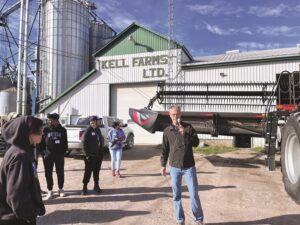
Stubbs, who farms in Lincolnshire, shared his growing strategy and the unique conditions that help make top yields possible to attendees of the 2026 Southwest Agriculture Conference (SWAC) in Ridgetown. Though his local conditions differ from what Canadian wheat growers face, he argues it’s still possible to achieve yield gains by experimenting on the farm and treating wheat with as much care as comparatively more lucrative crops.
NARROW ROWS, HEAVY POPULATION
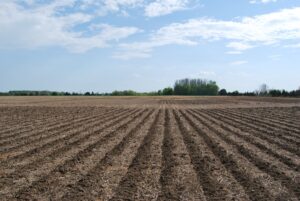
Stubbs approaches winter wheat by lightly discing the top few inches of soil, then drilling seed in 12.5-centimetre (5-inch) spaced rows, at 500 plants per square metre. Direct drilling without seedbed preparation, says Stubbs, “does not work well at all” in his clay-loam conditions.
In the case of Stubbs’ most recent YEN-winning crop, seeding occurred in mid-November. This is done to support better control of black grass, a challenging, yield-robbing weed, through the end of its late-October germination period.
“Our soil temperature was five degree Celsius in November. My crop was up out of the ground in five days,” says Stubbs.
“The reason we plant 500 plants per square metre is because I find I can get good tillering early on. Maybe five or six tillers on the plant,” he says.
But when it comes to winter, he says those tillers will die back and only two or three tillers survive.
“It’s only one in every five years where we get a season with excellent tillering. I go to 500 plants, aiming to have 1,000 heads at harvest.”
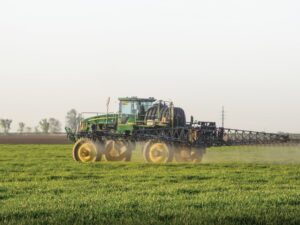
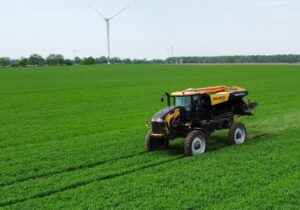
Stubbs also uses banded liquid nitrogen applied via a sprayer dribble bar. To avoid scorching as much as possible, application is generally done on what he calls “miserable” days, or overnight, when temperatures are comparatively low.
Sulphur is added to the liquid nitrogen as well, as Stubbs finds it makes the ammonium nitrate more nutritionally efficient for the plant, thus also helping to prevent volatilization. Passes are made at the end of February, and again just before flag leaf.
“I have to be careful because I don’t want to scorch that flag leaf. It’s weather dependent. I’ve got to wait for that flag leaf to emerge. If we get miserable weather, I know I’m safe. If it looks like it’s going to be a warm spell, I’ll go just before that flag leaf emerges,” he says.
“My final [application] is just as the ear is starting to emerge. The final one is trying to feed everything into the head.”
MANURE AND COVER CROPS
Manure and cover crops are also critical elements of the cropping regime.
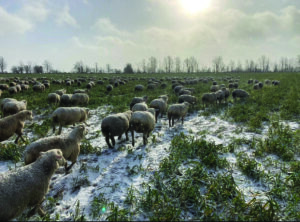
Stubbs says he began incorporating cover crops two decades ago in an effort to build soil organic matter. While effective, the impact was slow. The subsequent addition of manure from broiler chickens was a game changer.
While adding significantly to his field’s organic matter, he finds the poultry manure also helps unlock existing soil fertility for his crop, while encouraging “all the good insects to eat the bad ones,” removing the need for insecticide treatments. Stubbs adds that the price point for manure, versus relying totally on conventional fertilizer, makes good business sense in his case.
The unique soil profile of Stubbs’ home area is another critical factor in supporting high wheat yields. Combined with cover crops and manure, organic matter levels have jumped from one to 10 per cent.
“We have a unique area. We call it the ‘Lincolnshire wolds.’ This area here is a chalk base with a clay loam over it. So, we’re only working with six inches of soil,” he says.
That means it’s very viable, drains really well, and when it’s dry, we have underground aquifers which come up through the ground, and can get to our plants,” says Stubbs. “With the chalk being soft, it’s not like what you have in Canada, where sometimes you have a bed of limestone. That works completely differently to how the chalk works and how the water moves through it.”
Stubbs has found that by mixing manures and cover crops together, he’s able to get a really good breakdown. “With only working the top six inches of soil, I get the organic matter up. So, I’m now running at ten per cent organic matter, which I’ve done in ten years,” he says.
RECOMMENDATIONS
Stubbs recognizes his system cannot be universally applied. However, he did provide SWAC attendees with ideas on how they could experiment with some of his methods, given their local conditions.
“It all depends on the areas where you are. If you’re in a warm, droughty area of Canada and you’re on 10-inch spacing, there’s not a lot I would change about that,” he says.
But for those in a fertile part of Canada who are drilling at ten-inch spacing, he recommends drilling a five-acre field to perform a field trial on your farm. “There’s nothing more you can learn about yourself than from a farm trial,” says Stubbs.
He also encourages experimentation with fertilizer rates, plant populations, and varieties.
“Row spacing is important. Plants per square metre is important, and getting that soil up to a really good level is very important as well. Because if you don’t get your soil correct, it’s not going to work for you.”
The economics of wheat is also something Stubbs recognizes. While per-bushel dollar returns for wheat may not be comparable to corn and soybeans, Stubbs thinks figuring out how to consistently drive wheat yields could help remedy the comparatively poor business case.
“I think in some of your fertile areas, if you treat your wheat the same as you treat your corn, and give it the same respect, I think you could get yields within 50 bushels of what you’re getting for corn.” •