
Are drains also habitat?
Water management professionals support rethinking incentives for improved agricultural drains
Two-stage designs, Species at Risk pressures, and questions about cost-sharing are prompting fresh debate about how municipal drains serve farmers, communities, and ecosystems.

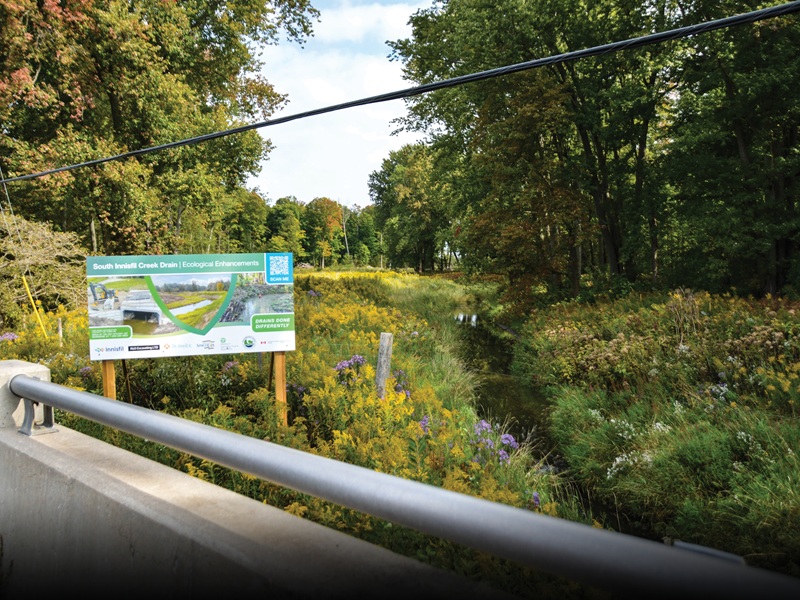
Southern Ontario’s drainage network is characterized largely by straight, trapezoid-shaped drains. The design has been in use since European colonists began clearing land in the area for agriculture.
While necessary to move water off farm fields, these drains have also become important habitats for Ontario flora and fauna, including many Species at Risk. But two veteran drainage experts argue that creativity in policy could make many Ontario drains even better habitats, while simultaneously performing their core water-moving function for farmers.
Critically, however, they also say farmers should not have to bear the full costs of drain improvement.
DIFFERENT DESIGNS
Ian Smith, a fluvial geomorphologist, highlights Species at Risk legislation as a potential sore spot for farmers, as the legislation can conflict with drain maintenance.
In cases such as Fort Erie’s Beaver Creek, for example, portions of the creek were identified as critical for the reproductive cycle of a key fish species. Clearing the drain the typical way — by dredging it with an excavator or dragline, and trimming all bank vegetation — would have ensured water could be moved quickly. But this process would make conditions untenable for the endangered fish, causing friction with the Endangered Species Act. Indeed, Smith compares clearing drains by conventional means to “a nuclear weapon hitting the stream.”
Beaver Creek was, thus, a conundrum — one Smith was hired to solve. What followed was a long process of consultation between himself, local government, ecologists, drainage engineers, and the local agricultural community on the best way to ensure the drain remains effective at moving water while also protecting the biodiversity present. It was decided that a two-stage ditch, characterized by a central flat bottom or V-shaped channel within a wider trapezoid-shaped channel and featuring reed and stone beds, could effectively accomplish both tasks. Compared with the standard, standalone V-shaped or trapezoidal drain design, the wider two-stage drain also created conditions for greater animal and plant life beyond the Species at Risk originally identified. Two-stage ditches are, of course, more expensive to construct compared to standard V-shaped drains. While farmers have traditionally borne the cost of drain maintenance, a result of them benefitting from the drain moving water away from their land, Smith thinks biodiversity restoration goals and Species at Risk legislation make the question of who benefits more complex.
In part for this reason, he believes Ontario’s Drainage Act, originally established in 1835, should be revised.
“The costs of drainage are borne almost entirely by the farming community. If we’re going to start calling drains habitat — and they are habitat — it’s not just the farmers that benefit, it’s humanity in general,” says Smith.
“It’s 2026, and the Drainage Act may need a good look given the body of knowledge we have beyond farming science.”
“Let’s not tar and feather the Act, let’s act wholesomely and say, ‘We understand humanity is part of the natural ecosystem.’ Not every farm should be turned back into a forest. We need the coexistence of food production and habitat. There should be a mechanism in the government, the legislation, that acknowledges the coexistence of competing interests for those resources.”
WHAT IS ONTARIO’S DRAINAGE ACT?
Ontario’s Drainage Act has its origins in the Ditches and Watercourses Act, dating from 1835. This act was repealed in 1963. Sid Vander Veen, former drainage co-ordinator with the Ontario Ministry of Agriculture, Food and Agribusiness, says municipal drains, which were constructed under the Drainage Act (occasionally also known as the Municipal Drainage Act), were first developed in 1859. According to the Ontario Federation of Agriculture, current drainage legislation covers the regulation, maintenance, and repair of approximately 45,000 kilometres of municipal drains. Approximately 1.75 million hectares of cropland are serviced by these drains.
By and large, the cost of constructing and maintaining drains is borne by the landowners and road authorities being serviced by the drain. The province maintains a cost-share program for agricultural landowners, covering one-third the cost of drain construction and maintenance.
LANDOWNER SUPPORT
For Sid Vander Veen, currently with the Land Improvement Contractors of Ontario, and retired drainage coordinator for the Ontario Ministry of Agriculture, Food and Agribusiness, incorporating more nature-friendly designs into drain construction and maintenance has long been a topic of discussion. He does not, however, consider it necessary to change the Drainage Act to do so.
“There’s nothing in the Drainage Act that says drains need to be straight and trapezoidal. There’s ability to do other things, but it all comes back to willingness, politics, the property owner, and cost. Those are big hurdles,” says Vander Veen.
“Is it a problem with the Act? I don’t think so. But there is the ability to levy costs from property owners, and the province provides a one-third cost grant to property owners on agriculture-assessed lands.”
Vander Veen adds that while the province does provide a grant covering one-third the cost of drain construction, there is no specific incentive for more environmentally beneficial project designs. Cost savings for inclusions such as buffer strips, riparian areas, and two-stage ditches are only available through some Conservation Authorities, willing local governments, or other external organizations. In their absence, the full cost is borne by the property owner.
“I still would prefer to see an incentive to encourage some of these practices, but it doesn’t exist right now,” says Vander Veen. “Conservation Authorities do stream rehabilitation projects, where they spend money to rehabilitate streams to make them pristine. Better for habitat, water quality, they do all these things. You can accomplish the exact same thing under the Drainage Act, and have the further benefit of having it codified with a municipal bylaw.”
Vander Veen says drains are incredibly important for rural agriculture in Ontario. In his mind, a perfect drain provides drainage for farmers, but that’s also habitat.
“What’s the harm? There is no harm. Can we do things better? Yes, we can,” he says. •