
Decoding weed pressure in corn
Peter Sikkema shares insights from decades of research on weed competition, resistance, and the economics of control
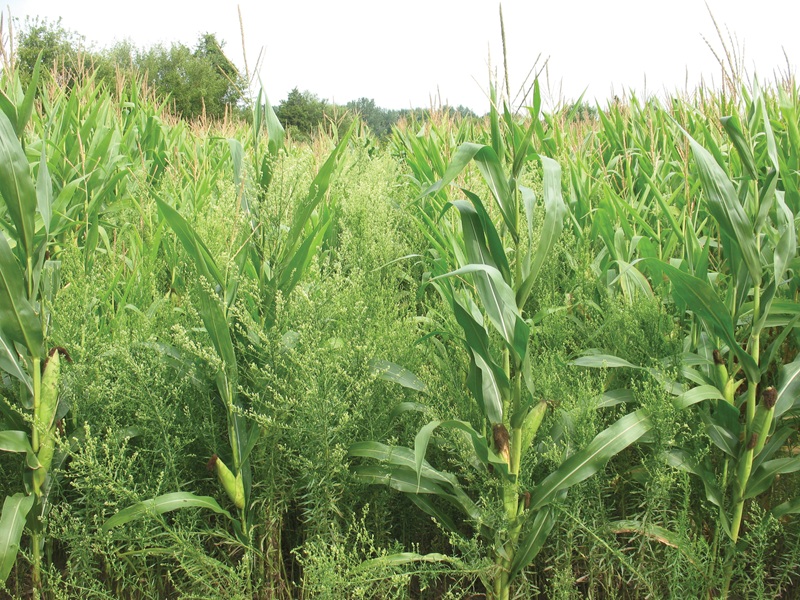
Long-term trials show corn yield loss from weeds can swing dramatically, even in the same field. Understanding weed biology, species pressure, and emergence timing is key to managing the risk.

For more than 30 years, Peter Sikkema dedicated his field work to the science behind weeds and their effects on crop production. It took more than monitoring research plots or memorizing herbicide labels and modes of action — it required a sense of vision, an understanding of the changing biology of weeds, and their evolving tolerances and resistances.
Although Sikkema retired from his position as field crop weed management professor at the University of Guelph’s Ridgetown campus last year, he is still called upon to provide his expertise and understanding of weed science. He was invited to give a session at the 2026 Southwest Agricultural Conference in January titled “Weed Whisperer,” where he was emphatic about the need for a higher level of management in dealing with weeds, many of which have developed resistance to multiple modes of action.
To start, Sikkema shared data from work he conducted with Susan Weaver at Agriculture and Agri-Food Canada’s (AAFC) Harrow research station. The primary message from their work was that corn yield loss from weed interference is unpredictable and varies from field to field and year to year. Over a 10-year period, 59 trials were completed on the same 40 acres at the University of Guelph’s Ridgetown campus.
“What was really interesting to me was that on the exact same campus, in seven per cent of the experiments, corn yield loss due to weed interference was less than 10 per cent,” said Sikkema. In 46 per cent of the experiments, he said the corn yield loss was between 10 and 50 per cent, and in 44 per cent of the experiments, the yield loss was between 50 and 90 per cent. In three per cent, the yield loss was greater than 90 per cent.
The same soil, the same 40 acres and the weed seed bank hadn’t changed appreciably in 10 years.
Based on the available data, Sikkema concluded that corn yield loss from weed interference is variable, unpredictable, and influenced by:
- weather
- weed density
- seeding date
- tillage practices
- relative time of weed and crop emergence
- soil texture and nutrient status
- weed species composition
“A really important one is the relative time of weed and crop emergence,” said Sikkema. “If those weeds come up at the same time as the crop, they have a much greater impact on corn yield than if the weeds come up a week or two after the corn. Since yield loss is variable and unpredictable, farmers should invest in a good insurance policy or a robust two-pass weed management program.”
SPECIES-SPECIFIC
The next observation was corn yield loss by species, based on another project of Susan Weaver’s testing seven annual grasses — crabgrass, yellow foxtail, witch grass, barnyard grass, green foxtail, fall panicum, and giant foxtail. Weaver also tested seven broadleaf weeds, including black nightshade, lady’s thumb, velvetleaf, common ragweed, redroot pigweed, lamb’s quarters, and giant ragweed.
“Broadleaf weeds cause a greater yield loss in corn than annual grasses,” noted Sikkema. “Lamb’s quarters and giant ragweed caused a 3.5-fold greater corn yield loss than black nightshade at the exact same density (10 weeds per square metre).”
For most producers, the impact of broadleaf weeds may not be a surprise, but factoring in the density had a sobering effect. With lamb’s quarters, an increase from one plant per square metre to 25 caused a 4.7-fold increase in yield loss (from 12 per cent to 56 per cent). Triazine-resistant biotypes caused a four per cent decrease in corn yield due to a “fitness penalty” and may be easier to control with an alternative herbicide. Of the glyphosate-resistant weed species, waterhemp had the lowest yield loss (19 per cent) compared to Canada fleabane (54 per cent) and giant ragweed (72 per cent).
“Waterhemp is a heliotype that responds to high light intensity and corn just outgrows waterhemp,” said Sikkema. “Canada fleabane grows above the crop, and the same with giant ragweed. In summary, annual broadleaf weeds result in greater corn yield loss than annual grasses.”
MONEY TALKS
Another timely observation from Sikkema’s presentation was his revenue-and-cost comparisons. When he arrived at Ridgetown in 1993, the general thought was that if you had perfect weed control on your farm, you spent too much money on herbicide.
“Thirty-three years later, I’ve completely changed that: your goal should be 100 per cent control and zero weed seed return to the soil,” he said. “The focus should be on new weed species that have a high propensity to evolve resistance and focus on those species that have the greatest impact on corn yield.”
A weed control program should be planned field-by-field, and Sikke-ma started with Weed Spectrum #1 – green foxtail and barnyard grass, lamb’s quarters, redroot pigweed, common ragweed, wild mustard and wild buckwheat. Both Acruon and Primextra provide 95 per cent control of those weeds, yet Acuron costs $36.06 per acre (2025 suggested retail price) while Primextra costs $17.48, saving $13.58 per acre.
With Weed Spectrum #2 (replacing wild mustard and wild buckwheat with velvetleaf and multiple-herbicide-resistant waterhemp), the use of Pri-mextra’s low rate would cost a grower more. The herbicide only provides 25 per cent control of velvetleaf and has no activity on herbicide-resistant waterhemp. With this weed spectrum, Acuron, despite its $36.06 per acre price, provides 95 per cent control of the substituted weed species.
When presented as a reflection of total farm income, the results are startling. Assuming a grower plants 1,000 acres of Enlist corn, one 500-acre field has Weed Spectrum #1 and the other 500 has Weed Spectrum #2. Citing the Ontario Ministry of Agriculture, Food and Agribusiness (OMAFA) five-year average yield of 168 bu/ac and a price of $6.56 per bushel, gross revenue would be $1,102 per acre (see Table 1).
But factoring the cost of Acuron versus Primextra and their effect on the two weed spectra, plus the cost of application ($12 per acre), the total weed management cost would be $29.48 per acre for Primextra and
$48.06 for Acuron ($36.06 + $12). If a grower splits the use of the two based on field-specific weed spectra, it’s a difference of $61,000 in total farm income (Table 1).
| Total Farm Income | |||
| Primextra | Acuron | Field Specific | |
| Weed Spectrum #1 | 500 acres | 500 acres | 500 acres |
| Partial Returns | $1,073/ac | $1,055/ac | $1,073/ac |
| Sub-total | $537,628 | $527,338 | $537,628 |
| Weed Spectrum #2 | 500 acres | 500 acres | 500 acres |
| Partial Returns | $932/ac | $1,055/ac | $1,055/ac |
| Sub-total | $465,831 | $527,338 | $527,338 |
| Farm Total | $1.002 million | $1.055 million | $1.063 million |
Source: Dr. Peter Sikkema, 2026 Southwest Agricultural Conference
NEW OPTION AVAILABLE SOON
Sikkema previewed the arrival of diflufenican, a Group 12 herbicide and a new mode of action in corn. It’s the active ingredient in Convintro Corn and Convintro Corn 12 (diflufenican/isoxaflutole + S-metolachlor) and is expected to be available in Canada in 2026. The good news is it will provide control of a limited spectrum of weeds, including complementary activity on Amaranthus (waterhemp, redroot, green pigweed, and Palmer amaranth) species. However, he emphasized it is not a stand-alone herbicide, but it should control emerged weeds up to five centimetres in height. •