
Managing Bt-resistant corn rootworm: Reset and don’t repeat
Agronomic information from Ontario's crop specialists

Ontario Ministry of Agriculture and Agri-Food
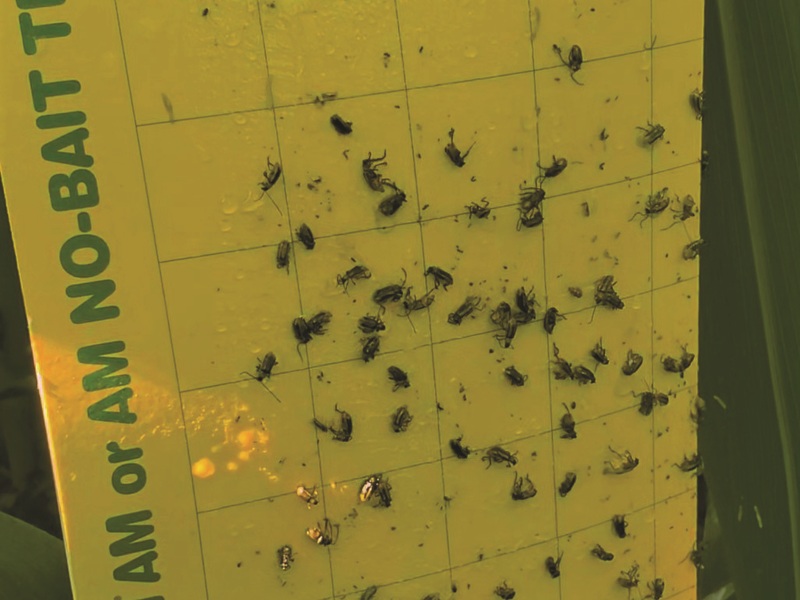
Monitoring for adult CRW populations using sticky traps can help assess the risk of root injury to the following corn crop.
Corn rootworm populations in 2025 were among the highest in decades, driven by hot, dry conditions and increasing continuous corn acreage. Similar pressure is expected in 2026, especially in areas with a high percentage of continuous corn.
Heavy reliance on below-ground Bt corn rootworm hybrids, especially in continuous corn, has led to widespread resistance in parts of southern Ontario. Simply switching to RNAi hybrids in fields with Bt-resistant populations will not solve the problem and could also accelerate resistance to RNAi.
Effective management requires resetting populations and rotating tools to reduce selection pressure. This includes:
- Rotate out of corn at least every four years — hit the reset button
Corn rootworm larvae need corn roots to survive. Larvae emerge in May or June from eggs laid by adults the previous summer. Rotating out of corn and controlling volunteer corn causes populations to crash, effectively resetting risk.
- Monitor adult populations with traps — knowledge is power
Monitor sticky traps weekly each year in July and August to assess risk:
- ≥2 beetles/trap/day indicates a higher risk of root injury for the following corn crop.
- High counts in Bt-CRW fields may signal resistance.
Free traps are available through the CRW Trap Network.
- Rotate management tools annually — don’t repeat the same tool back to back
Avoid relying on the same control each year:
- Year 1 corn: Low risk; use above-ground trait hybrids only.
- Year 2 corn: Use above-ground trait hybrids. If trap thresholds were exceeded, add a soil-applied insecticide.
- Year 3 corn: High risk; use Bt corn rootworm hybrids, with or without RNAi, if trap thresholds were reached. Do not use Bt or Bt-plus-RNAi hybrids in consecutive years.
- Year 4: Rotate out of corn.
- Scout and report injury — watch for signs of resistance
Report any unexpected injury on Bt or Bt-plus-RNAi hybrids to your seed provider and Tracey Baute at OMAFA for further resistance testing. Monitor for:
- Root pruning, lodging, or “goosenecking” caused by larval feeding.
- Leaf feeding or silk clipping caused by adults feeding.
Consistent crop rotation, monitoring, and alternating management tools are essential to slow the development of resistance and maintain the tools that remain for rootworm control.
More information is available on the Canadian Corn Pest Coalition website: www.cornpest.ca.