Saving farmland needs allies, planning expertise
Highlights from the 2026 Ontario Farmland Forum
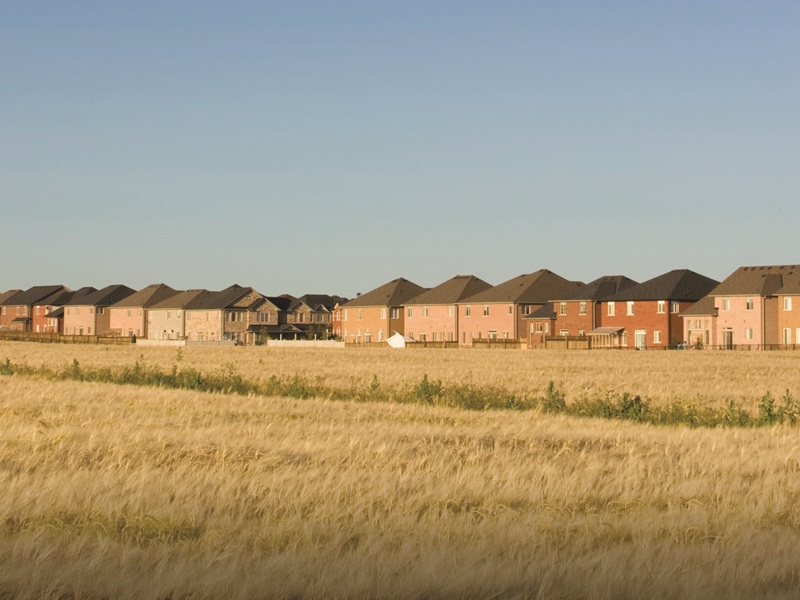
Farmers can play a larger role in protecting Ontario farmland by building broad coalitions, understanding the planning process, and engaging decision-makers before development proposals reach the approval stage.
Build coalitions, get involved, and know how to engage local government – just three of many take-away messages for attendees of the 2026 Farmland Trust Forum, held in Elora on March 19.
Hosted annually by the Ontario Farmland Trust, the forum is an event where farmers, policymakers, municipal planners, conservation professionals, and others meet to discuss development, planning, and other challenges and opportunities facing Ontario’s agricultural community. With the current provincial government continuing to pursue significant increases in housing and industrial development, the mood at this year’s forum was one of palpable concern. Forum speakers, however, shared perspective to turn concern and frustration into positive action.
BUILDING SUPPORT BEYOND THE FARM GATE
The day began with a keynote presentation from Rene Van Acker, president of the University of Guelph, in which he stressed the role of building coalitions in preserving farmland and food production.
Drawing on expertise once communicated by Preston Manning – the politician behind what became the federal Reform and later Canadian Alliance party – Van Acker asked attendees to consider what groups they could bring into the broader tent of people concerned about farmland loss. He highlighted how efforts to build support must reflect different worldviews, and the fact that perceptions of food and farming can vary significantly even within agriculture.
“I’m going to posit that farmland protection is a popular movement. And if it’s a popular movement, which waves of interest in the populace will we, will you, ride to support that movement?” says Van Acker.
“The agri-food sector is a massive sector. And we often like to associate very directly food with farming. I think we do that intuitively because we understand the popular value in doing that…Farming is big business. In Ontario, the food sector is even bigger business. Farming and food together is massive business. It’s arguably the largest economic sector in this province. So that’s also important for us in terms of what might be those waves one wants to ride around farmland.”
Van Acker also cautioned against some past strategies used to generate change for farmers – specifically, the Farmers Feed Cities campaign.
Though the Farmers Feed Cities campaign did have positive benefits when it came to policy in Ontario, he says it was more of a “visceral” reaction sourced from frustration brought on by tough economic times. Rather than coalition building, it was “going to the choir.” Today with regards to farmland protection, the farming community needs to look for partners who are, for example, concerned about the role of food in national defence, or the potential positive impact farming can have on climate change. Terms like “citiots,” and thinking the agriculture community should “farm-splain” to those outside the sector must be terms and habits of the past.
“Perception is important. Perception drives so much,” Van Acker says.
UNDERSTANDING HOW PLANNING DECISIONS ARE MADE
Following the keynote were sessions detailing how planning happens at the local level, and how the agriculture community can influence the planning process by understanding how it works.
Pamela Duesling, farmer and director of community planning and development for the town of Pelham, stressed the importance of municipal plans, calling them “the bible” of local development policy.
“They are that overarching land use document for specific communities, and they describe local policies, and how land and communities should be developed. It’s prepared by input from the community and helps to ensure future planning and development will meet specific needs of that municipality,” says Duesling. Municipal plans are thus where those concerned about farmland should look to garner an understanding of how a community aims to grow, and try to influence during the planning process as early as possible.
Building on Duesling’s breakdown of how communities assess, plan, and enact development policy was registered professional planner Claire Basinski. For Basinski, people need to understand planners are friends, not foes, but building relationships with planning professionals is essential to influencing how development happens. In practice, that means emphasizing engagement and cooperation, not just advocating for specific policies or actions.
“In order to effectively engage the system, we need to know the system,” Basinski says.
Overall, she points to four actions critical to effective engagement: understand how the development system works; ask questions to ensure you understand what development plans are trying to accomplish; understand what engagement tools are available; and give serious consideration to how you communicate your position.
“The world of engagement has broadened and narrowed all at the same time. We’ve opened up our opportunity for engagement through online engagement and more tools due to COVID. We also are focusing that much more on accessibility of information and opportunity, as well as equity and diversity of options,” Basinski says, referring to options for engagement specifically. “But we have to be clear about the degree of influence of these tactics. We also have to be very thoughtful about what’s going to be the most appropriate tactic for the most appropriate audience.
“Let’s say you’re invited to an open house. You may want to think a bit on how much the open house has on the overall process, relative to how you want to impact the process and outcomes. It’s not that it doesn’t. It does. But would a one-on-one meeting with your friend and contact be a bit more effective to communicating your needs and interests…Think about the efficacy of tactics, to help you decide where your efforts are going to be most effective.”
INFLUENCING GROWTH BEFORE IT’S APPROVED
The challenges of managing the current provincial government’s drive for development was commented on by many forum speakers and panelists. In a later interview, for example, Basinski said assuming the province is “going to do what they say” helps community planners better mitigate potential damage. She adds in some cases it’s clear the government does not know the details of how its policies will work on the ground, and “they don’t want to admit that.”
The province aside, poor decision making at the community level remains an endemic challenge. Crispin Colvin, director for Middlesex Federation of Agriculture and past municipal councillor, points to the tendency for small communities to develop housing zones requiring significant utility and other services.
“We’re our own worst enemies. Our small municipalities such as Ilderton, my own community of Dorchester and Thorndale, continue to grow. We become bedroom communities to London. And the problem with that is we are putting in housing. Housing costs money in servicing, infrastructure – it doesn’t make the municipality money,” Colvin says. “We need to convince cities to stay within their boundaries, and build up.”
Colvin also encourages other farmers to run for their local community council, in an effort to bring much needed agricultural perspectives to planning environments.
“We don’t get farmers on council…When you make a mistake in planning, you can’t have a do-over,” he says, later adding “we have to change our mindset, so when it comes to local or provincial planning, we have to look at it in a whole different light instead of just looking for a nice piece of flat, clear ground that’s easy to develop.”
Jennifer Pfenning, president National Farmers Union, provided some of the starkest commentary of the forum, highlighting what she considers to be a total absence of thought given to agriculture and food in planning at multiple levels of governance.
“I spent four years on my municipal council. One of the things that I recognized was that we have master plans, we have emergency preparedness plans, we have a master plan for arts and culture. We have sports master plans. We have no food plan. Almost no municipality in the country has a food plan. None of the regions. None of the provinces, and not even the country,” Pfenning says.
“We all eat, and we have no plan. Municipalities need to create food plans. They need to create food plans that include protecting the farmland within their boundaries. They need to create a food and farmland protection plan that dovetails with the region’s plan, so counties and regions have plans dovetail to lower-tier municipalities. Then those regions need to dovetail into a provincial plan, and that provincial plan needs to connect with a national plan…Those plans, that’s what I want to see every level of government do. And it starts, I think, with municipalities.” •