Can grain be grown without synthetic inputs?
This Serbian farm is testing it
LoginEKO is testing whether grain can be grown at commercial scale with lower input costs, but the model depends heavily on local conditions, machinery, and capital.
Samo Login sold his talking cat app for nearly US$1 billion, then invested the proceeds in a theory. The Slovenian entrepreneur wanted to know whether non-GM grain and legumes could be grown at commercial scale without synthetic inputs or manure. He had not set out to become a farmer.
After selling Outfit7, he went looking for the most under-invested, highest-impact problem he could find and landed on food production. His reasoning centred on nitrogen and phosphorus pollution from agriculture, not carbon emissions. To answer his question, he bought an 8,100-acre farm in Serbia and hired Djura Karagić, a local agronomist, to turn that theory into practice.
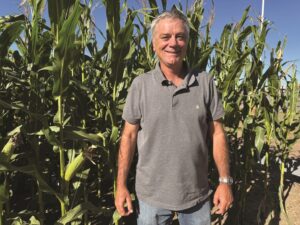
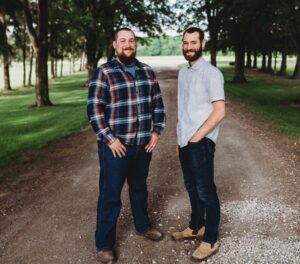
Karagić did not arrive as a believer. He came from conventional research, where he led the forage crops department at Serbia’s National Research Institute in Novi Sad. By his own account, he joined LoginEKO with scepticism, the way most of his colleagues would have.
The neighbours were certain he would fail, and, for the first two seasons, they were right. Borrowed techniques that were successful in other climates and contexts did not translate well in heavy clay soil under increasingly erratic rainfall. Weeds, at one point, grew taller than the farm’s tractors, he said. Karagić called this period the “YouTube agriculture” phase. To make the theory work, he would need to develop a plan as unique as the environment. He did not have to do it alone.
Karagić works alongside the LoginEKO team, which is made up of agronomists, field managers, machinery operators, and data and software colleagues, all of whom played an essential role in developing, testing, and improving the system. He also relied on guidance from researchers at Wageningen University & Research and Oxford University, who helped assess, validate, and independently evaluate the sustainability of the model.
Most of what the LoginEKO team knows now is the result of mistakes made in those early seasons. Today, new ideas are tested first on small experimental plots, then verified on several larger fields across two locations. Crops are only scaled up when results hold. LoginEKO has trialled more than 50 crops this way, landing on five or six that fit the rotation.
Wheat provides the clearest example of how much trial and error went into the process. Karagić said they tried nearly everything to raise protein content, including cover crops and green manure peas, before concluding that, in a semi-arid climate, a green manure crop simply cost them a season of commercial grain without delivering enough nitrogen to justify it.
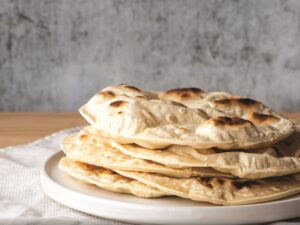
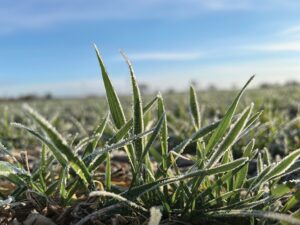
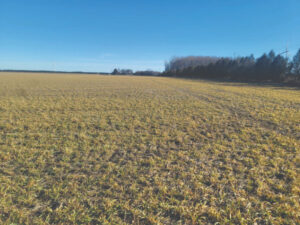
The breakthrough came from a variety screening trial. They tested 27 wheat varieties and identified two capable of reaching 15 per cent protein in good conditions. In practice, they are now consistently hitting 13.5 per cent — enough to clear the 12 per cent threshold to be sold as bread wheat instead of feed. The same trial-and-scale approach has been used to shape the legume side of the rotation. Field peas, the backbone of the farm’s nitrogen supply, are well suited to this climate because they mature early enough to avoid the worst of the summer drought.
Chickpeas, a new crop for this part of Serbia, are being tested using the same approach. Karagić is trialling four seeding dates and using a U.K.-sourced bacterial inoculant to build a second, more modest nitrogen source alongside the peas.
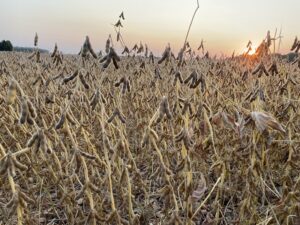
Yield results are mixed. Field peas average 37 to 39 bu./ac. Chickpeas, still in the on-farm trial phase, are targeting about 30 bu./acs but are not there yet.
The rotation itself runs in five-year cycles, which vary in terms of crops included. A typical version starts with winter peas to fix nitrogen, moves into a cereal — wheat or oats — works in chickpeas, then winter-hardy flax, and closes with sunflower, a deep-rooted crop that scavenges whatever nitrogen is left in the soil before the cycle starts over with peas again.
Login said the decision to grow crops without synthetic fertilizer or manure was driven by economics and logistics. Trucking in enough manure for the entire operation is not feasible, he said.
MANAGING WEEDS, DISEASE AND INSECT PRESSURE
LoginEKO manages weeds the same way it manages fertility: without inputs. Timely seeding gives the crop a head start, and a fleet of mechanical tools — inter-row cultivators, tine harrows, and a brush cutter used only as a last resort — does the rest. Karagić said the goal is not zero weeds. Some weed pressure, he argued, is fine for biodiversity and soil biology. The crop just needs to stay ahead of it during a defined window early in the season.
They had used cover crops to manage weed pressure, but those have mostly been dropped. In Serbia’s dry climate, there is no guarantee the crops will germinate, and a failed cover crop is a wasted input that gives weeds a head start.
Disease and insect pressure get less input substitution than weeds do. Management relies more on climate and biology.
The region’s dry conditions cut disease pressure but leave the farm more exposed to pests, particularly aphids and cotton bollworm. For bollworm, they use a biological treatment based on Bacillus thuringiensis. Aphids are managed largely by encouraging natural predators such as ladybugs. Disease is also part of why the farm still plows a portion of its fields each year. Heavy surface residue left by no-till can harbour soil-borne pathogen inoculum.
MACHINERY DOES THE HEAVY LIFTING
The farm has two advantages that make the experiment worth trying at all: location and investment capital.
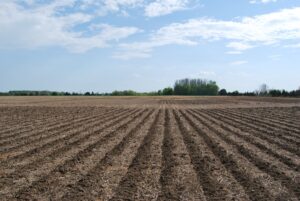
The plain in northern Serbia where LoginEKO is situated was once known as Yugoslavia’s breadbasket. It is flat, heavy clay country with some of the highest natural soil fertility in the region. Karagić said some LoginEKO fields sit near six per cent organic matter, while neighbouring farms are around 2.5 per cent.
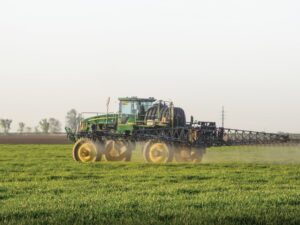
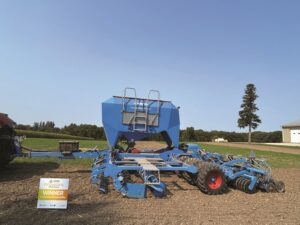
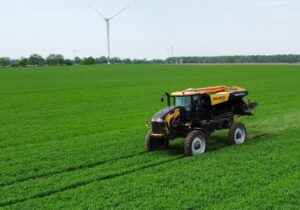
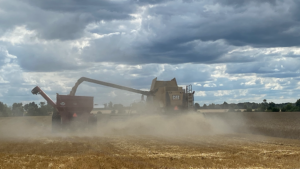
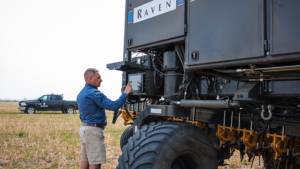
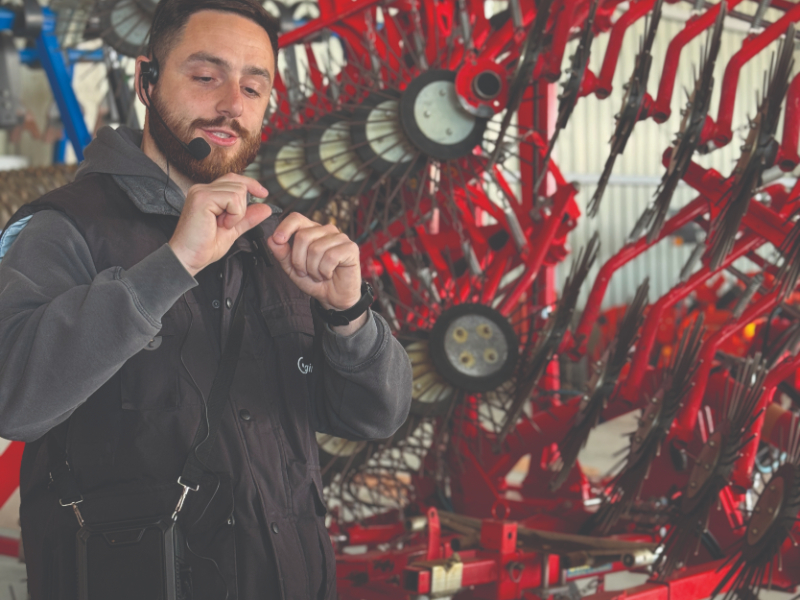
The second advantage is capital. Making the complex rotation work has required eight combines, 29 tractors, and a hangar full of specialized weed-control equipment: camera-guided cultivators that correct for crop rows that drifted during seeding, disc harrows, subsoilers, multiple seed drills matched to different crops, and a mill built into the combine harvester that destroys weed seed viability during harvest.
The fleet is intentionally large. With no herbicides to fall back on, effective weed management can only be achieved in narrow windows, which means more machinery standing ready for when soil and weather line up. Getting everything done in those narrow windows requires organization. This is where Login comes in.
Login developed management software from scratch that tracks every field operation, yield map, soil sample, weather report, drone image, telemetry dataset, and scouting report. The software and the data it collects are open source, adding traceability that lets consumers scan a product and trace its ingredient back to the field where it was grown. All of it, including the software, is offered to other farmers for free. Login has said proving the model works matters more to him than owning it.
“I believe more farmers would choose more sustainable methods because that’s what makes the business function over the long term,” he said. “But they just don’t have that option.”
In total, Login has invested about €83 million ($133 million) in the operation. He said the core farming operation, minus software development and research spending, is close to breaking even. This does not consider land costs but does include labour.
The bigger question remains: Can grain and legumes be grown at commercial scale without synthetic inputs or manure? At this point, the findings are not clear. Login knows the rotation they have chosen would not survive a move of even a few hundred kilometres, let alone across an ocean. Different rainfall, disease pressure, and soil chemistry would demand a different sequence, rebuilt from scratch. But it is a start.
LoginEKO is a member of the Global Network of Lighthouse Farms, established by Wageningen University & Research. The network recognizes 14 global farms as living examples of the future of sustainable farming. •