
Drones can increase cover cropping options
Drone operators discuss the successes and challenges of applying cover crops and fertilizer by drone
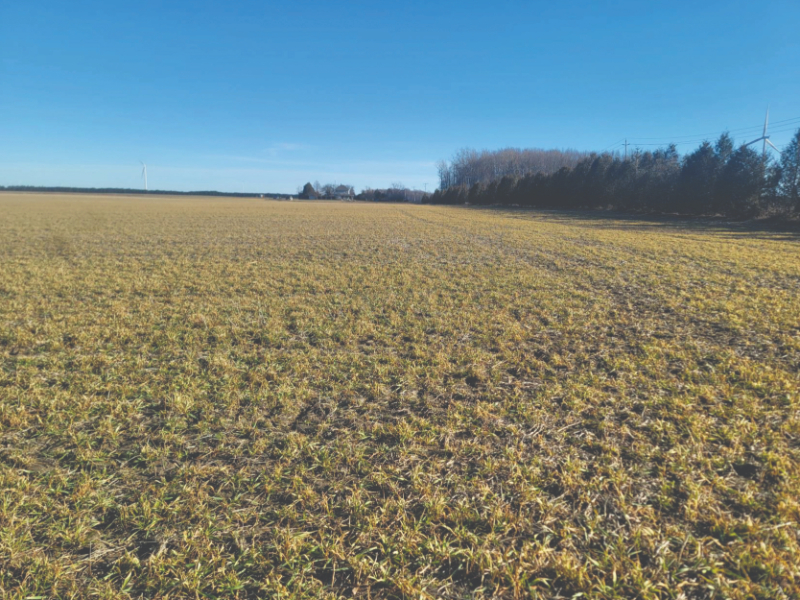
Drone operators say success still depends on planning around herbicide carryover, residue management, weather, calibration, and active monitoring, but the technology offers another tool for building soil health and expanding cover crop options.

As Canada’s agricultural community waits for the federal government to permit pesticide application by drone, existing operators say the aerial platforms continue to offer a unique and effective way to expand cover cropping options.
While some technical kinks still need to be worked out, proponents argue drone technology should prompt farmers to rethink what is possible for soil health.
DRONE KNOWLEDGE EXCHANGE
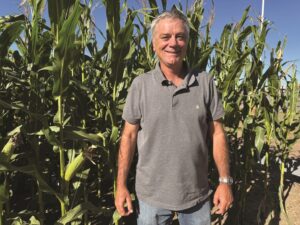
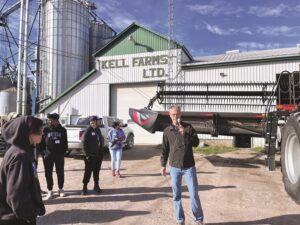
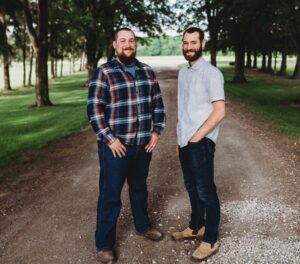
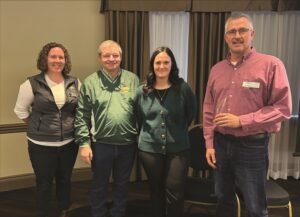
During a June 23 community meeting at Drone Spray Canada’s Blenheim headquarters, Adrian Rivard, the company’s president and a local farmer, encouraged attendees to keep experimenting with cover crop application, and to share their knowledge with each other. The purpose of the meeting was to do just that, with some 30 to 40 people — most of whom had at least some experience operating drones for agricultural purposes — discussing their experiences with cover cropping and dry fertilizer application.
Rivard began the discussion with a question: Why use cover crops? The answer was, of course, to build soil health by breaking up compaction, driving carbon sequestration, supporting microbial communities, and more.
As with any discussion about cover crops, he reiterated the importance of planning ahead for residue management, as well as the potential impacts of herbicide carryover when establishing cover crop stands.
For Rivard, the latter point reflects a key capability drones provide: the ability to distribute cover crops at virtually any point in the growing season.
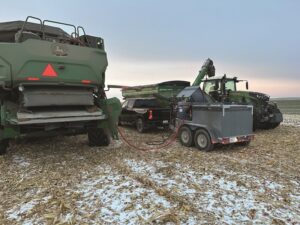
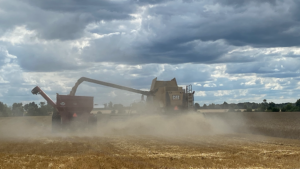
“We can broadcast straight into standing crops,” says Rivard. On his own farm, he adds, they have also had success seeding cover crops while harvesting, with residue from the combine providing effective seed cover.
CASE STUDIES
Rivard highlighted several approaches with which he and his Drone Spray Canada colleagues have had success.
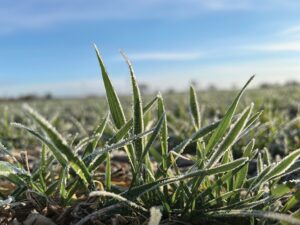
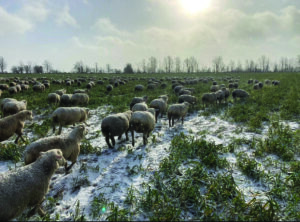
Clover into winter wheat at 10 pounds per acre, timing anywhere between February and April.
While early frost seeding is the conventional approach, Rivard says they have observed later seeding to be quite effective, even well into April, as spring mud and rain provide better immediate seed-to-soil contact. For this reason, he encourages operators and customers to be patient, rather than rushing to apply seed under adverse conditions where poor coverage is a greater risk.
“We’ve had years where you can hardly keep the drone straight in the air, and people want me to go out and spread seed,” says Rivard.
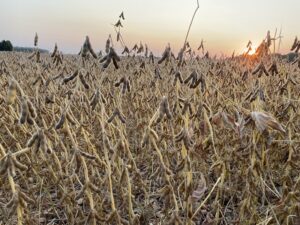
Oats into soybeans at 50 pounds per acre, timing application between leaf yellowing and brown stem.
Rivard says this approach has helped give the oats enough time to create a good mat on the soil surface, while leaving the farmer confident they will not have to manage spring growth. At least that is the hope, Rivard says, as mild winters in Ontario’s “banana belt” can sometimes allow oats to overwinter successfully.
“Success is still all about the rains. If you have a bone-dry fall, nothing is going to germinate,” he says.
Rye into corn, at 50 pounds per acre, timing application around mid-August.
In this example, Rivard and other attendees cautioned against applying rye too early if there is a threat of herbicide carryover. While the rye can have a slow start, a good catch is likely to show vigorous growth in spring.
OTHER USES
Rivard and his team have tried drone seeding cash crops, such as winter wheat, into soybeans. Success has been much more mixed, but he still encourages others to continue experimenting, and to “not give up on it.”
On his own farm, Rivard also uses drones to variable-rate urea — a capability made possible in conjunction with DJI SmartFarm mapping software — although he finds more expensive pay-to-play services more effective.
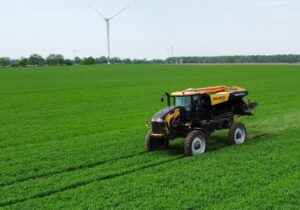
Responding to questions about seeding multi-species covers, Rivard says they have not had trouble, but they opt for tighter flight patterns to ensure even distribution. For context, he says 21 feet (6.4 metres) is their go-to “magic” swath width. Other tried-and-true settings for cover crop application include spinner disc speeds between 600 and 800 rotations per minute, and a flight height between 15 and 30 feet (4.5 and nine metres).
Speaking in his capacity as a custom operator, Rivard says he also likes to “fly as fast as possible.”
“I’m getting paid by the acre. There’s no drift with seeds.”
TECHNICAL CONSIDERATIONS
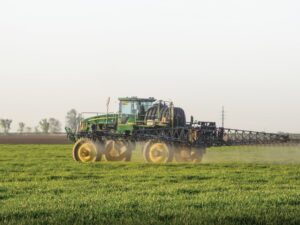
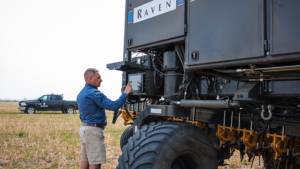
These technical preferences apply specifically to the DJI agricultural drones operated and sold by Drone Spray Canada. Ranging from the more compact T25P model to the large T100, the technical capabilities of each model can vary, with Rivard and his colleagues reiterating the importance of active observation by the drone operator.
Tyler Hatton, part of Drone Spray Canada’s sales team, cites an instance where a customer crashed his drone twice on the same day after not accounting for a lack of object avoidance capability on return-from-base flights in an older DJI model. Assuming object avoidance was on all the time, and subsequently walking away after refilling, resulted in costly repairs.
“Always keep your eyes on the controller,” says Hatton.
Odd things can still happen even if all the bells and whistles appear to be operating normally. Other attendees noted cases where their drones, returning to base with low batteries, opted for a direct path through a bush lot rather than flying around obstacles. Rivard himself also pointed to a recent software update that appeared to introduce unexpected gremlins into the machine. Calibration is also important, including doing the math to make sure cover crops or other products are coming out of the drone at the intended rate.
The meeting concluded with a general understanding that drone effectiveness in the field requires technical capability, human observation, and creativity.
“We want to engage more of the community,” says Rivard. “We want people to explore new stuff.” •