Robots, research help farmers rethink nitrogen management
Early on-farm trial results suggest some growers may be able to reduce nitrogen applications while maintaining yields and improving returns
Researchers and farmers shared lessons from nitrogen-reduction trials, including promising profit results and challenges with new technology.

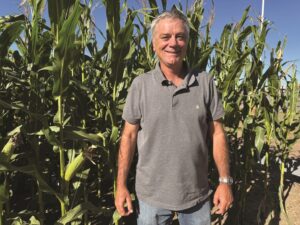
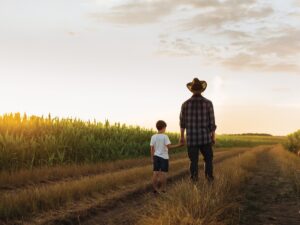
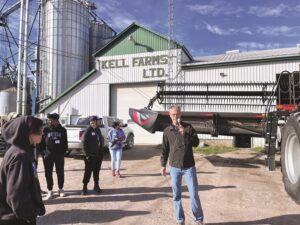
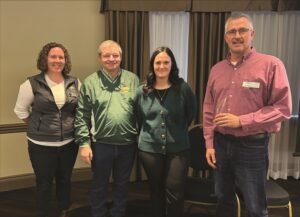
Farmers and agronomists gathered near Walkerton in June to learn how local producer Gerard Grubb is trying to optimize nitrogen use through comparative corn trials, and potentially, small robotic applicators developed by ag-tech company Upside Robotics.
Sponsored by the Ontario Soil Network, the Ecological Farmers Association of Ontario, and Farmers for Climate Solutions, the event was an opportunity to hear what the organizations, and Upside Robotics, have found in past nitrogen-reduction field trials. The takeaway message appears to be that Ontario growers, through their own on-farm experimentation, may have a good chance of improving profitability by reducing how much nitrogen they use.
A HISTORY OF RESEARCH
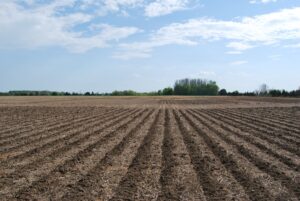
Grubb employs a strip-till system to manage what he describes as good gravel-loam soil. Frost-seeded cover crops are an important part of his rotation, as are biosolids. Also, a repeat participant in the Yield Enhancement Network (YEN) program, Grubb has long strived to improve production through on-farm research. Indeed, he says every field he operates “has had some form of research on it.”
In 2026, that research includes partnerships with Upside Robotics and Farmers for Climate Solutions, a farmer-led organization developing and advocating for policies that better support the adoption of low-emission, high-resilience approaches in agriculture. With Upside Robotics, Grubb is one of 31 farmers across the province trialling small, autonomous liquid nitrogen microdosing applicators.
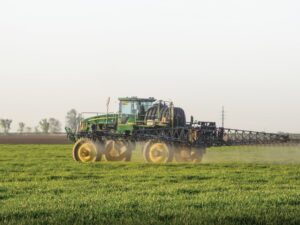
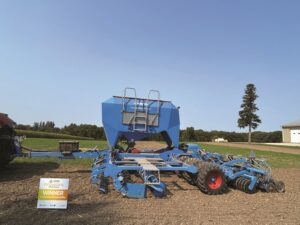
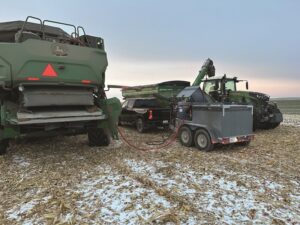
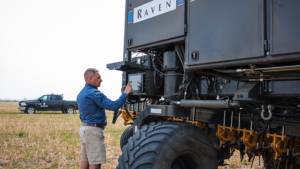
Tanya Franklin, Upside Robotics’ vice-president of agronomy and strategic partnerships, describes the design as “a Roomba for your corn field,” with the implement travelling the length of every other corn row to dispense liquid UAN across the entire growing season. Critically, she says, that includes the post-VT development stage when the crop is prohibitively tall for conventional application systems but still requires about 40 per cent of its nitrogen needs.
A second project involves Farmers for Climate Solutions’ Profit Warranty to Optimize Nitrogen Rates, a program designed to lower the financial risk of split nitrogen applications while reducing the total amount of nitrogen applied.
Participants in the program sign up to plant a corn test plot with just 30 pounds of nitrogen up front, and another reduced rate post-planting. Zero-nitrogen control plots are also encouraged to help bracket yield changes from the reduced rate and the conventional rate applied to the rest of the field. Participants are provided with a $1,000 honorarium, up to $500 in agronomist service support, and, as the name Profit Warranty suggests, a warranty in case they incur profit losses compared with their standard production approach.
For Grubb, the Profit Warranty program offered a good opportunity to “really see how much nitrogen we can operate with.” Two test cases have been planted in 2026: one with 30 pounds of starter fertilizer followed by just 30 pounds of sidedress fertility, and a second with 30 pounds of starter and 60 pounds of sidedress fertility.
While separate from the Upside Robotics project, yield and profitability results from reduced-nitrogen test plots could later inform the use of autonomous application equipment.
ABOUT UPSIDE ROBOTICS
By Owen Roberts
Upside Robotics designs autonomous solar-powered field robots, about the size of a large cooler, that deliver nutrients precisely, continuously, and efficiently. The robots operate autonomously between the rows – no operator is required, and no interference occurs with normal farm operations.
The robots apply fertilizer on an as-needed basis, with sensors on the robots assessing individual plants’ real-time requirements.
Every field collects data that builds a precise picture of what each acre actually needs, rather than what the average field might need. Instead of a single blanket nitrogen application at the start of the season, Upside’s robots make up to 20 targeted applications from crop emergence through to near-harvest.
“Our systems operate directly in the field and adapt in real time to soil, crop, and weather conditions,” says company co-founder Sam Dugan.
“We focus on practical deployment by building technology that integrates into existing farm workflows and delivers measurable results without adding complexity. Every robot is designed to run frequently, learn continuously and scale across real agricultural operations.”
The People’s Choice
In April, Upside Robotics won one of two People’s Choice awards at the Grand River Agricultural Society’s fifth SPARK symposium, held in Elora. This event, which drew 130 attendees, strives to connect agricultural and environmental technology companies with potential investors, and provide a platform showcasing innovative agricultural businesses, as well as business opportunities in agriculture.
In the People’s Choice category, Upside Robotics was voted “The company that attendees would invest in.”
New Generation
This year marked the launch of Upside Robotics’ second-generation base station and fifth-generation robot, improved through experience. Dugan says the changes entailed double the engineering effort of all previous generations combined, with a focus on serviceability, reliability and durability.
This year’s systems can apply up to four different nutrient blends simultaneously, adding micro and macro nutrients alongside nitrogen, based on real-time crop deficiencies.
TEETHING PROBLEMS
2024 was the inaugural year for Upside Robotics field trials, says Franklin, with seven Ontario farmers working with the company. That number grew to 11 farmers in 2025, and 31, including Grubb, in 2026.
The effectiveness of the company’s autonomous application platforms has been mixed to date. Early problems with the material quality of fertilizer holding tanks caused corrosion issues in critical electronic components, for example, leading to significant downtime in 2024. Large antennas required to maintain connectivity in tall standing corn have also proven challenging, as they were prone to snapping off after contact with corn stalks. Some connectivity challenges were recurring. In Grubb’s field this year, specifically, improved programming was needed to help the implement traverse an oddly sloped field.
The amount of unexpected downtime in previous years and in other fields meant some acres did not receive the full amount of intended nitrogen. Franklin says this brought an unexpected revelation, however, as those same acres still appeared to perform well. Even in places where zero nitrogen was applied, yields were still above 200 bushels per acre.
“Last year, even though we had inopportune placement and problematic timing, we were still able to prove with multiple split applications across the season we could still significantly cut nitrogen rates without harming yield,” Franklin says.
She adds some research has linked lower nitrogen application rates with healthier and more active soil biology, and that this might be the reason good yields are still possible with much lower rates of nitrogen.
“Nitrogen is not the limiting factor … But that can only be achieved with multiple applications. Sometimes the limiting factor is the equipment itself.”
HIGHER PROFITABILITY
While data from Grubb’s profit warranty project will not be available until after harvest this year, Lorraine Vandermyden, resource and demonstration co-ordinator with the Ontario Soil Network, says the data gathered from the seven farmers participating in 2025 was encouraging.
Two of the seven participants experienced significant drought in 2025, which contributed to yield reductions in low-nitrogen test plots of about five bu./ac., and $10 to $12 lower profit per acre.
A third participant had already been driving down their nitrogen rates, and experienced significant bushel and profit losses in a further reduced plot.
The other four participants, however, saw yield losses of just one or two bushels per acre and corresponding profit increases of $13, $15, $22, and $23 per acre.
“The story is there might be more nitrogen coming from the soil than originally thought,” says Vandermyden. For Grubb’s 2026 crop, she thinks his historical use of biosolids will be a factor to watch.
“Looking at all the stories that come from the (2025) data, you have to do this on your own farm, taking into account the weather, your soil type, your cover crop stand from last year, and all those things in order to draw conclusions from the data.”
Corn growers interested in participating in the Profit Warranty program can apply through the Farmers for Climate Solutions website.
“Looking at all the stories that come from the (2025) data, you have to do this on your own farm, taking into account the weather, and your soil type, and your cover crop stand from last year, and all those things in order to draw conclusions from the data.”
Corn growers interested in participating in the profit warranty program can apply through the Farmers for Climate Solutions website. •