Building markets through relationships
Japanese and Taiwanese buyers visit Ontario to see how soybeans make their way from the farm to global food processors
Strong buyer relationships and firsthand market insights help Ontario soybean growers protect premium markets and respond to evolving customer needs.

For Ontario soybean farmers, Japan and Taiwan are more than points on a map. They are key markets for the province’s food-grade and non-GMO soybeans, where buyers look for consistency, quality, and reliable supply.
When buyers from these markets come to Ontario, the trip is about more than seeing a farm. It is an opportunity to build relationships, understand customer needs, and show what goes into producing the soybeans they buy.
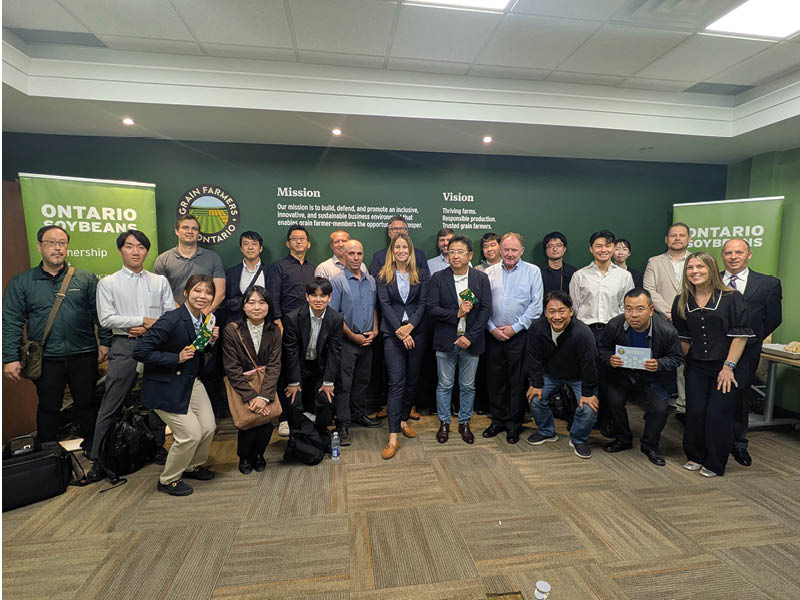
That was the focus of two incoming missions from Japan and Taiwan in September, coordinated by Soy Canada with support from Grain Farmers of Ontario and other industry partners.
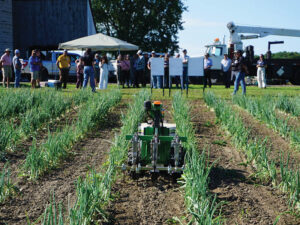
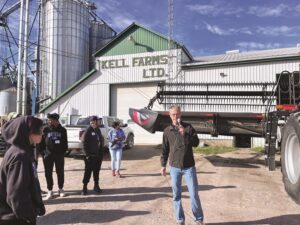
The delegations visited farms, exporters, processors, and research facilities and took part in seminars and business-to-business meetings. The goal was to give buyers a better understanding of the people and systems behind Canadian soybeans.
“These visits showcase Ontario’s strengths in soybean production, research, processing, identity preservation, and transportation,” says Demian Gallego, Soy Canada’s market development manager. “They also give exporters direct access to established and prospective customers, supporting long-term relationships, future contracts, and continued investment throughout the provincial soybean value chain.”
BUILDING RELATIONSHIPS
The incoming missions are part of an ongoing relationship between Soy Canada, the organization’s members, and customers in Japan and Taiwan.
Members of Soy Canada, including Grain Farmers of Ontario representatives, regularly travel to these international markets to meet with buyers and learn more about their needs. The incoming missions also give those same customers a chance to see soybean production and the entire Canadian value chain firsthand.
“These visits included many customers that we met with during our outbound missions to Taiwan and Japan earlier this year,” says Dana Dickerson, director of market development and sustainability with Grain Farmers of Ontario.
The difference with these incoming missions is the opportunity to meet with buyers here in Canada and bring several parts of the value chain together. “Some of the customers on these missions have visited Canada before, but for a number of them it’s their first time learning about our production on the ground,” says Dickerson.
According to Gallego, Soy Canada’s market development manager, that firsthand experience is an important part of the process.
“The missions connect Japanese and Taiwanese buyers directly with Canadian growers, exporters, processors, and researchers,” he says. “Through farm visits, facility tours, seminars, and B2B meetings, buyers can better understand Canada’s food-grade, non-GMO, and identity-preserved soybean production, quality, traceability, and sustainability.”
Gallego also notes that by giving Canadian growers the opportunity to demonstrate production practices firsthand, the missions help protect and expand premium markets for Ontario’s food-grade and identity-preserved soybeans.
GLOBAL CUSTOMERS
Both Japan and Taiwan have well-established soy-food industries, making them important markets for building and strengthening relationships with buyers.
Japanese consumers use soybeans in products such as tofu, miso, natto, soy milk, and soy sauce. Taiwan also has significant demand for soy food products, particularly tofu and soy milk, and imports soybeans for animal feed. Dickerson explains that, for Ontario farmers, these markets matter because they create demand for specialty soybeans such as identity-preserved (IP) and non-GMO soybeans, which can earn premiums over commodity production. “These missions help maintain and grow demand for specialty soybeans in two of Ontario’s most valuable export markets,” says Dickerson, noting that by strengthening relationships with food manufacturers and importers who pay premiums for quality, trade missions like these can help support the demand that drives specialty soybean premiums for Ontario growers.
Soy Canada estimates that premiums for specialty soybeans destined for these food grade markets can range from approximately $3 to $9 per bushel.
The markets are also significant in terms of volume. Japan is the second-largest buyer of food-grade soybeans behind China.
According to Soy Canada, exports increased in 2025, with Canada shipping approximately 384,000 tonnes to Japan, valued at $422 million, and approximately 69,000 tonnes to Taiwan, valued at $71.6 million.
Dickerson believes the growing interest in Canadian soybeans is being driven by the reliability of the Canadian supply.
“Food manufacturers in both Japan and Taiwan place a high value on supply security, consistency, and long-term reliability,” she explains. “In an increasingly uncertain global trade environment, Canada’s reputation as a stable supplier of high-quality food-grade soybeans has become an important competitive advantage.”
HEARING DIRECTLY FROM BUYERS
While buyers learned more about how Ontario soybeans are produced, the incoming missions also gave growers, exporters, and industry representatives an opportunity to hear directly from customers about what they need and value in Canadian soybeans.
Canadian participants learned that characteristics such as protein content, seed size, colour, and processing performance can be important to food manufacturers. Traceability and sustainability are also becoming increasingly important. Dickerson notes that those conversations can influence more than marketing. They can help inform research and breeding decisions to support the entire Canadian soybean industry.
“The meetings and discussions also extend into soybean breeding, with researchers and international customers discussing the characteristics that will be needed in future varieties,” explains Dickerson. “For Ontario’s soybean industry, the challenge is balancing those customer requirements with other priorities, including yield, disease resistance, and cost of production.”
For Lillian Wu of Shinn Cherng Co., a Taiwanese food ingredient importer that sources Canadian food-grade soybeans for wholesalers and food manufacturers, seeing the supply chain firsthand is an important part of building relationships. “I look forward to understanding how soybeans are grown on Canadian farms, how the processing system works, and how they travel to our Taiwanese market,” says Wu, noting that food safety and consistency are key considerations for her customers.
“We have high standards for food safety, and as a supplier of food ingredient soybeans to our customers, it’s important for us to know who we’re working with, and how the ingredients are being produced for our market,” she says.
Wu also points out that Canadian soybeans are valued for their consistency, explaining that “we value the quality, especially the stability of quality of Canadian soybeans.”
For Canadian exporters, understanding what buyers value is an important part of maintaining relationships with customers in Taiwan and continuing to build demand for Ontario’s specialty soybeans.
BRINGING THE INFORMATION HOME
For Soy Canada, Grain Farmers of Ontario, and other Canadian industry participants, the value of the trade missions goes beyond immediate business connections.
The missions also provide market intelligence that can guide the future direction and priorities of participating organizations and the broader industry.
“These missions help us deliver on our strategic plan objective to grow Ontario soybean exports,” says Dickerson. “Just as importantly, they provide valuable market intelligence. We learn how customers are using Ontario soybeans, how consumer preferences are changing, and which quality and sustainability attributes matter most to buyers.”
While Soy Canada coordinates the national missions, bringing together growers, exporters, researchers, government representatives, and provincial partners, Grain Farmers of Ontario contributes Ontario-specific expertise. “Soy Canada is the national lead and primary touchpoint with international customers, and they act as the mission captain,” says Dickerson. “Grain Farmers of Ontario is a member of Soy Canada, and we support the mission by providing regional and specialist insights, involving our farmer-directors and helping to co-ordinate local logistics and demonstrations. It is a very collaborative process.”
For Ontario farmers, the benefit of this work may not always be immediately visible, since international markets are built through many individual relationships over time. But according to Dickerson, there is still no substitute for seeing agriculture firsthand.
“Customers can read about our production standards, quality assurance systems, and sustainability practices, but visiting farms, grain handling facilities, and research centres allows them to see those commitments in action,” she notes.
Gallego says the goal is to leave buyers with confidence in the Canadian soybean industry. “We want visitors to leave confident that Canada is a reliable, innovative, and long-term soybean supplier,” he says. “Most importantly, we hope they develop stronger relationships with Canadian growers and exporters and see that our industry is prepared to listen, adapt, and meet their evolving needs.”
For Ontario soybean growers, that is ultimately what these missions are about: keeping important markets connected to the farms that supply them. •