
The terrible two
Snow mould and stripe (yellow) rust are a double disease challenge
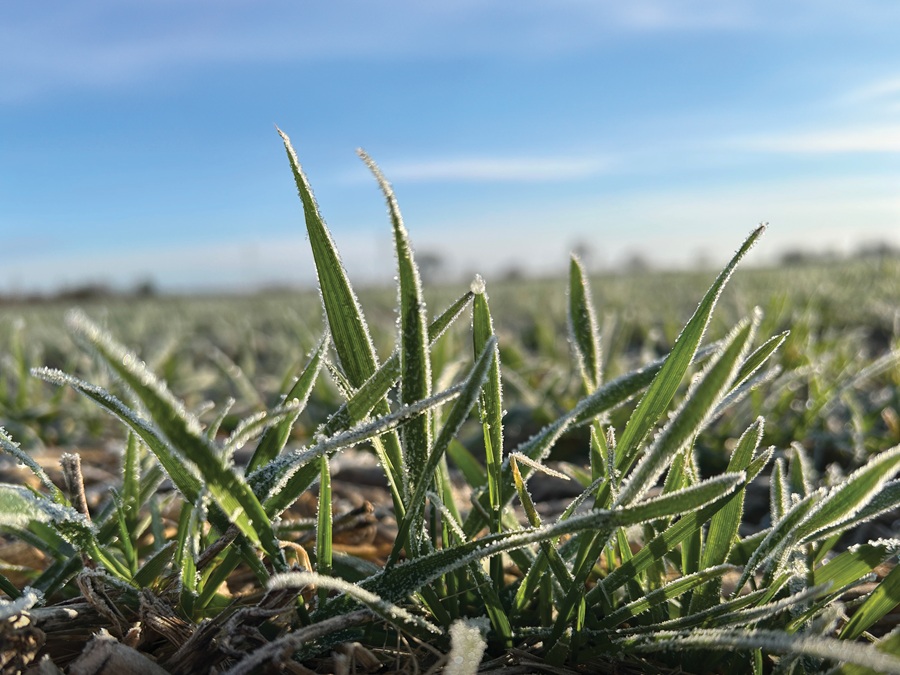
Winter has been long, cold, and snowy. As spring arrives, how will you respond to protect your winter wheat crop?

Snow mould and stripe (yellow) rust are caused by different fungal pathogens, but they share several characteristics, and chief among them is the ability to seriously impact winter wheat yields.
Marty Vermey, senior agronomist with Grain Farmers of Ontario, says that with both diseases, understanding the effect of preceding conditions and active scouting are very important. And so is the best variety selection for key diseases for your area.
STRIPE RUST CAN BE DEVASTATING
Stripe rust can devastate wheat production when infection is severe. Stripe rust symptoms first appear as small chlorotic lesions on leaves, followed by yellow to light orange pustules that each contain thousands of spores. The pustules occur in a random pattern and they can be confused with those that cause other rust diseases such as leaf rust.
Stripe rust thrives in cooler conditions, between 10 and 18 C, and likes intermittent rain or dew events. Growth slows at about 15 C, but there is now evidence that at least one population in the U.S. has adapted to warmer temperatures.
In terms of its severity in Ontario this year, the crystal ball is still a bit cloudy. But Ontario Ministry of Agriculture, Food and Agribusiness (OMAFA) Cereals Specialist Joanna Follings has her antennae up.
“We are monitoring throughout this winter the reports of stripe rust appearing in the southern U.S. and we’re tracking weather systems that may carry spores north,” she says.
Stripe rust does not typically overwinter in Ontario, but it can do so under specific conditions: high levels of disease pressure in the previous year, good fall with lush growth, mild-to-moderate winter temperatures and early and persistent snow cover – like the kind we had in fall 2025 and fall 2024. Many areas of Ontario received significant snowfall prior to the ground freezing.
“This may be conducive to overwintering of stripe rust in some areas, particularly in fields where disease pressure was high in 2025,” Follings says. “These fields should be scouted beginning in early spring once the crop has greened up, particularly if fungicide use is not a standard practice.” Vermey adds that volunteer wheat is a risk factor, and snow cover protects stripe rust that infects volunteer wheat in the “This is why we had stripe rust in the Mitchell area last year,” he says, “and then it spread.”
Follings, Vermey and OMAFA Extension Plant Pathologist Albert Tenuta concur that the best defense against stripe rust is a combination of variety selection, scouting, and timely fungicide applications.
“Keep in mind that if you see it, you may have to take immediate action as it can explode very quickly,” Tenuta says. “You may need to apply an earlier fungicide application than normal, earlier than T3.”
VARIETIES DIFFER
Large differences in susceptibility to both stripe rust and snow mould exist in Ontario winter wheat varieties, so check the Ontario Cereal Crops Committee performance trials for specific variety ratings (GoCrops.ca). But only look at the 2025 trials.
Follings says if a variety has a rating of six or higher, the variety is susceptible and will benefit from a fungicide application if disease is present. If a variety is rated three to five, then it’s classified as moderately resistant and should be scouted regularly during the growing season. If stripe or leaf rust are present and on the upper leaves of the canopy, consider a fungicide application, particularly if the wheat is before or just at flag leaf.
Varieties with a rating less than two are resistant against stripe and leaf rust, but should continue to be monitored.
“As we saw in previous stripe rust years, some growers got caught with a severe disease infestation 10 days before the T3 fungicide application timing and had significant yield losses as a result,” Follings says. “So, if a field is more than seven to ten days away from a T3 fungicide application and the variety is susceptible to stripe rust, a fungicide should be applied as soon as possible.”
However, she advises that if stripe rust incidence and severity is low, a tolerant variety is being grown and a T3 fungicide application is less than a week away, a fungicide application can wait until T3.
In terms of fungicide choice, if winter wheat is beyond the swollen ‘head in boot’ stage, a fungicide containing strobilurin should not be applied (see detailed information on fungicide selection at the OMAFA Crop Protection Hub). Grain Farmers of Ontario is also developing a technical fact sheet on stripe rust, to be released this spring.
SNOW MOULD: A TOUGHER FOE
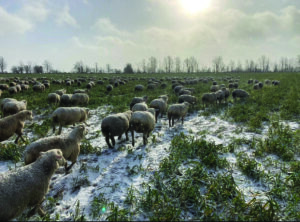
Snow mould encompasses several fungal pathogens that can damage or kill cereal crops after prolonged snow cover. Snow provides insulation for these species, allowing them to grow throughout the winter.
The most-common moulds (snow moulds) are pink snow mold, Typhula rot (called gray or speckled snow mould) and Sclerotinia snow mold. This fungal group is difficult to manage because so few management options exist, and because these species are hardy and persistent.
In fact, snow mould can survive in the soil for such long periods of time that crop rotation has no effect as a management tool. Early nitrogen applications will also not help plants overcome snow mould.
“It’s a very difficult disease to manage because there’s not much that can be done in the spring after the damage is done,” Vermey says. “It may be severe for some farmers. Your stands could be so thin that you decide to replant.”
As with stripe rust, it’s difficult to say what 2026 holds for snow mould severity, but Ontario farmers should anticipate problems. Tenuta notes that while temperatures have been extremely cold (which can slow the growth of snow mould), the snow cover in some areas may be enough to insulate the pathogen and allow it to grow, however slowly.
“The earlier the snow and longer snowpack persists, the greater potential for favourable conditions,” he says. “A break such as some areas had in late December-early January was good, but the heavy snows in January are concerning.”
Farmers in areas with early snow cover should scout fields early in the spring, as soon as the snow has melted.
Follings urges producers to prioritize scouting fields that were planted early and had significant top growth prior to snow coverage. She underlines the importance of conducting a number of stand counts and plant health assessments throughout the entire field to get a broader perspective on the status quo.
“Continue to monitor fields with this disease after snow melt because damp and cool weather is conducive to continued growth.” She says. Follings notes that in fields with severe infection, the growing point of wheat plants can be damaged, which will ultimately kill the plants. But if the growing point is intact, yield impact should be minimal. In scouting, Tenuta says signs of infection are a white, felty or sometimes slimy fungal mat on plants and bleaching or other unusual colouring in the leaves (plants not greening up like they are in other parts of the field). These signs fade as the spring sunlight gets stronger and the snow disappears. Damage is highly variable, ranging from a few dead leaves to the entire plant. The disease is generally located sporadically in the field, with patches of dead plants or thinned areas being common.
Tenuta says to look especially closely at places in the fields that get more snow cover than others such as low-lying areas and fence rows, or where you had lush growth going into the fall.
“Compare your stand density to what you expect,” he says. “Small patches may recover. Those minor thin spots will often green up, rebound and tiller.”
However, he notes that if 15-20 per cent of the field is infected, those plants may not rebound fully, so you will need to consider replanting an area or do a total field replant.
Early nitrogen applications will not help plants overcome the disease. The best strategy is to plant resistant or tolerant varieties within your optimum planting range to avoid too much top growth in the fall. Seed treatments and foliar fungicides have shown inconsistent efficacy, but they can provide some suppression.
As with stripe rust, growers should check the Ontario Cereal Crops Committee performance trials for specific snow mould variety ratings and stick to the most up-to-date (2025) data. •