
They go with the flow
Grain-carrying vessels gear up for a new shipping season
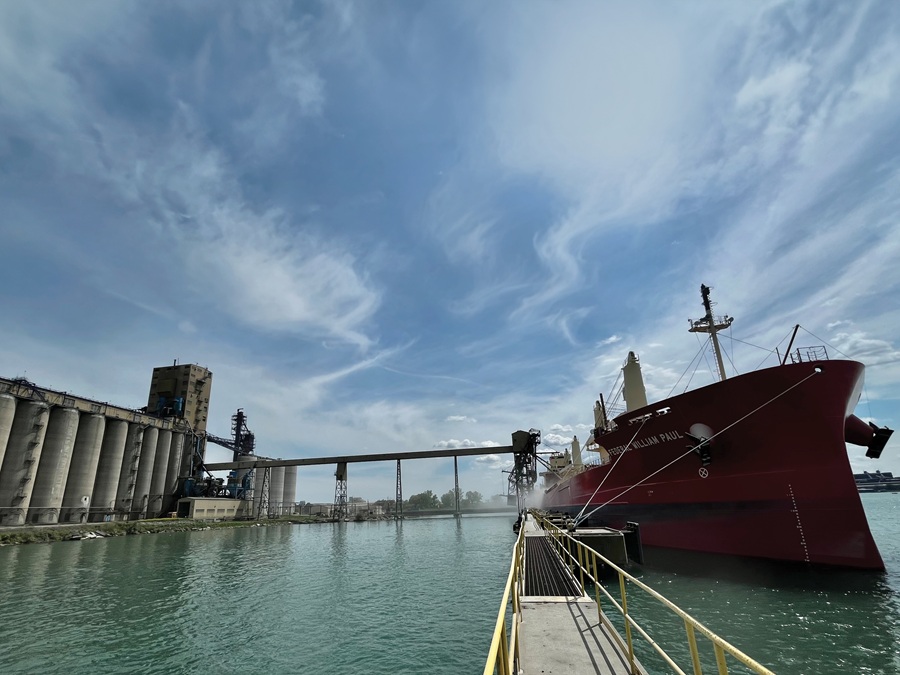
Inland navigation and the logistics of moving and loading ships in the Detroit River system requires precision management, efficiency, and effectiveness.

With the spring thaw, Ontario grain once again starts making its way to overseas customers by ship. It’s a seasonal rite for marine transportation, one which you’d think would be nearly automatic by now. But it turns out that managing the logistics of moving and loading grain-carrying vessels is no simple task.
Take, for example, the Detroit River and western Lake Erie’s Pelee Passage, a highly valued route in the North American commodity trade. From shore, ships appear to glide effortlessly along the busy, narrow waterway, after being loaded with grain dockside in Windsor.
But from weather to scheduling, to ship design, getting grain commodities flowing into ships’ holds and then down the river is neither quick nor straightforward, with ample opportunities for logistical snarls.
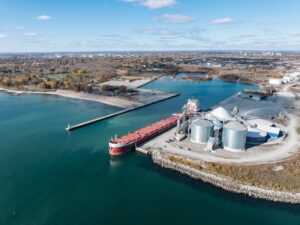
ADM’s Windsor facility, which district grain officials and producers toured earlier this winter, is a vital regional hub for grain transportation. It comprises a grain terminal and crush plant for extracting and blending soybean and canola oils from eastern and western Canada. Those products, as well as soybean meal and other raw commodities, are exported mostly by ship to customers worldwide. In total, up to 80 vessels visit ADM Windsor in any given year.
Last year, ADM expanded its grain terminal at the Port of Windsor, significantly increasing its export capacity to global markets and its support of agricultural production from southwestern Ontario farmers.
The expansion included new grain dryers, a new roadway and kiosk system to load soybean and canola meal, additional meal space at the ADM crush plant and new silos and conveyance to efficiently load export meal and grain.
“This expansion offers multiple beneficial effects on the local economy, including increasing demand for locally grown products, supporting and growing the regional transportation industry, and contributing to increased use of marine logistics,” Kevin Wright, general manager of ADM Great Lakes Region says.
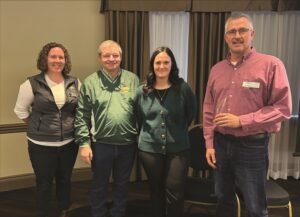
The expanded facility impressed tour participant Shawn Brenneman, chair of St. Clair Soil and Crop Improvement Association. He said ADM Windsor’s operation is yet another reminder that Ontario grain growers are playing in a global market.
“I am overwhelmed with ADM’s reach across Canada and the world,” he says. “I wasn’t aware of all the company’s processing capabilities.”
A HUGE COMPETITIVE EDGE
The proximity to marine shipping gives Ontario grain producers a huge competitive advantage. Dana Dickerson, director of market development and sustainability for Grain Farmers of Ontario, says production logistics require precision timing by grain processors and handlers like ADM.
With the spring thaw, Ontario grain once again starts making its way to overseas customers by ship. It’s a seasonal rite for marine transportation, one which you’d think would be nearly automatic by now. But it turns out that managing the logistics of moving and loading grain-carrying vessels is no simple task.
Take, for example, the Detroit River and western Lake Erie’s Pelee Passage, a highly valued route in the North American commodity trade. From shore, ships appear to glide effortlessly along the busy, narrow waterway, after being loaded with grain dockside in Windsor.
But from weather to scheduling to ship design, getting grain commodities flowing into ships’ holds and then down the river is neither quick nor straightforward, with ample opportunities for logistical snarls.
ADM’s Windsor facility, which district grain officials and producers toured earlier this winter, is a vital regional hub for grain transportation. It comprises a grain terminal and crush plant for extracting and blending soybean and canola oils from eastern and western Canada. Those products, as well as soybean meal and other raw commodities, are exported mostly by ship to customers worldwide. In total, up to 80 vessels visit ADM Windsor in any given year.
Last year, ADM expanded its grain terminal at the Port of Windsor, significantly increasing its export capacity to global markets and its support of agricultural production from southwestern Ontario farmers.
The expansion included new grain dryers, a new roadway and kiosk system to load soybean and canola meal, additional meal space at the ADM crush plant and new silos and conveyance to efficiently load export meal and grain.
“This expansion offers multiple beneficial effects on the local economy, including increasing demand for locally grown products, supporting and growing the regional transportation industry, and contributing to increased use of marine logistics,” Kevin Wright, general manager of ADM Great Lakes Region says.
The expanded facility impressed tour participant Shawn Brenneman, chair of St. Clair Soil and Crop Improvement Association. He said ADM Windsor’s operation is yet another reminder that Ontario grain growers are playing in a global market.
“I am overwhelmed with ADM’s reach across Canada and the world,” he says. “I wasn’t aware of all the company’s processing capabilities.”
A HUGE COMPETITIVE EDGE
The proximity to marine shipping gives Ontario grain producers a huge competitive advantage. Dickerson says production logistics require precision timing by grain processors and handlers like ADM.
“Ontario grows the lion’s share of Canada’s corn, soybeans and winter wheat, and they come off in quick succession from July to December,” she says. “With the seaway closed January to March, we have a narrow post-harvest export window. If we miss that window, our exports are competing head-to-head with Brazil and Argentina’s massive harvests in the spring.”
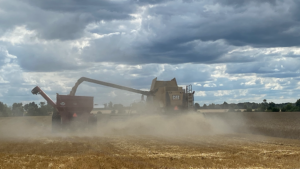
Clearing the summer wheat harvest and making room to move out autumn corn and soybeans can be a huge logistical undertaking. “That’s why shipping capacity investments matter,” Dickerson says. “They give us more space and options to keep the pipeline moving.”
ADM’s soybean crush facility – one of just two in the province – and purchases of winter canola from area producers also contribute to Windsor’s unique positioning. Recent storage and receiving infrastructure upgrades further contribute to the terminal’s capacity and efficiency.
“Farmers often need to harvest and move grains quickly to capitalize on weather windows and to protect quality,” Dickerson says. “Investments into better functioning trucking kiosks and faster unloads help make that possible. And being on the border, and being a global company, helps maintain those state-to-province and city-to-city relationships.”
SALTIES AND LAKERS
In port, crush products and raw commodities are loaded onto two kinds of ships.
“Salties,” a popular term for saltwater ocean-going vessels, are characterized by narrower hulls and higher drafts (the measurement from the waterline to the bottom of a ship’s hull). This design improves the ease with which they can slice through the large rolling waves of the open ocean.
“Lakers,” conversely, sit higher in the water. Lakers are employed throughout the Great Lakes system, including the St. Lawrence River, but never enter the Atlantic Ocean. Lakers loaded with commodities designed for overseas customers offload cargo at ports further east.
ADM Windsor generally loads 10,000 to 22,000 metric tons of cargo on vessels, even in cases where ships are capable of transporting significantly more cargo. That’s not uncommon for salties; while sailing inland, these vessels must be under the displacement restrictions at the locks further east. They can top up their cargos when they reach terminals such as Quebec City, before making the voyage across the ocean.
Working with smaller salties has advantages for ADM Windsor, says Kyle Schroeder, ADM commodity trader at the company’s Windsor facility.
“With soybean meal, for example, we deal with a lot of smaller ports in the UK that are draft restricted,” he says. “We can work with smaller vessels more efficiently.”
COMPLICATED LOGISTICS
The number of vessels docking at ADM Windsor varies year to year depending on factors such as how much product from western Canada is brought in, as well as overall export level. Vessels are constantly arriving in port; canola from Thunder Bay alone arrives about every 10 days, in line with the crush capacity.
Planning for the arrival of so many ships is inherently complex, particularly as their arrival is compressed into the ice-free months between March and December. Inclement weather can significantly impact departure and arrival times year-round. Schroeder says vessels otherwise ready to sail can be stuck just off their loading dock for days waiting for the weather to subside, while the lock systems further east can themselves shut down when Mother Nature is particularly uncooperative. This all but halts ship traffic in the Great Lakes. Because of this contingency, vessel crews also do not have to declare their expected arrival time until 10 days before.
“From a terminal’s perspective, vessels are an everlasting moving target. We can have a plan, and two weeks from now have to change it because we have three different vessels showing up in a week, and they’re changing (estimated time of arrival) based on weather, or where they’re loading and offloading. We really don’t know what the plan is until sometimes a day out,” Schroeder says.
Loading and unloading vessels is also a complex process. A vessel’s captain issues the terminal a load plan, detailing how the commodity should be brought onboard to maintain ballast and fit the design of the ship. ADM Windsor is generally able to load 600 metric tons of commodity in an hour.
Total loading times vary considerably, however. Maxim Charbonneau, ADM Windsor’s commercial manager, says load time depends on the vessel size, the number of holds, and if workers are loading or offloading different products. Two to three days per vessel is typical as a range, though smaller barges can take as little as 16 hours. Larger vessels may take three to four days. Load times also vary depending on the product.
Due to risks to product quality, loading is not carried out during rainy conditions, unless purchasers issue a “rain letter” stating they assume the risks of doing so.
While the terminal operator is not held accountable for any weather-related delays,
Schroeder says taking too long to load or unload a vessel in good environmental conditions can incur significant financial penalties – $10,000 per day to $55,000 per day, depending on the vessel.
“If we have three vessels showing up in a week and they’re overlapping each other, we have to run the calculation of how long one’s going to take, which one charges more [for delays], and which one do we want to sit,” Schroeder says.
PILOTS ARE PIVOTAL
The logistics of loading and unloading is challenged further by the requirement for ships to employ pilots – local experts who board vessels to help the crew navigate local watercourses.
“These crews may be Sri Lanken, Indian, Russian, or some other nationality. Anyone that comes in, they’re not technically allowed to drive their vessels by themselves anywhere within the Great Lakes lock system. So anywhere from Montreal to down here, they must have that pilot to drive the vessel for them because their expertise is in the Lakes,” says Schroeder.
To get a pilot onboard, a small boat pulls up beside the vessel while it’s moving, so the pilot can climb up a ladder. A vessel coming from Montreal destined for Thunder Bay may have to change pilots up to nine times.
In the Detroit River, the removal of navigational buoys over winter necessitates two pilots be onboard, further complicating logistics for operators at ADM Windsor.
“There are even times where a vessel shows up and it must wait because we already have one on dock. It might have to wait a day. It’s just sitting there out in the river,” Schroeder says. “As far as bringing it from there into our dock, you need to arrange a pilot to make a move that lasts half an hour. We need to line those up 12 hours in advance. Half the time it’s a guessing game. It makes it very complicated.”
Yet despite the significant challenges and changes facing commodity trading, southwestern Ontario continues to be supported by an effective marine shipping system. ADM Windsor contributes to the system’s strength. •