Putting the 4Rs to work on Ontario farms
The renewed 4R program links profitability, sustainability, and verified practices
Renewed industry collaboration and growing retailer certification are expanding Ontario’s 4R Nutrient Stewardship program, giving grain farmers practical tools, trusted advice, and stronger environmental credibility.
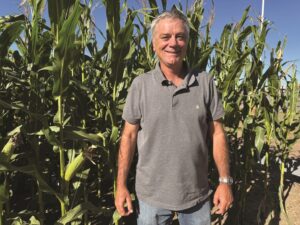
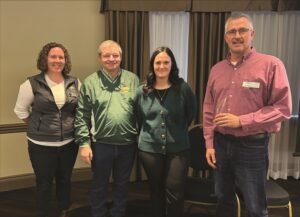
Efficient nutrient management is an economic, environmental, and personal priority for northern Ontario grain farmer Jason Seed. The District 15 director for Grain Farmers of Ontario believes science-based management approaches and tools, such as the AgriSuite tool from the Ontario Ministry of Agriculture, Food, and Agribusiness (OMAFA), that promote sustainability are good for his family, for his bottom line, and for Ontario’s environment image. Seed works closely with experts at Coop Regionale de Nipissing-Sudbury’s office in Thornloe to create a nutrient management plan suited for his family farm.
And with sustainability in mind, Seed is enthused about the co-op’s efforts to achieve 4R Nutrient Stewardship program certification, to give his farm’s stewardship plan an even stronger foundation.
The program, which received its third renewal in Ontario in January, has grown steadily since its inception in 2018. It now involves almost 40 agricultural retailers and 75 certified crop advisors who certify 1.5 million acres of farmland in Ontario for having sound stewardship management.
With fertilizer prices skyrocketing and farming practices under increasing scrutiny, Seed believes the 4R program is now poised to attract more producers.
“The drive for sustainability is here to stay,” says Seed, who consults on his nutrient management plan with local agronomist and crop specialist Tanja Seed at the coop. “Most farmers are already involved in some 4R practices, and this evidence-based program gives our management decisions even more rigour, credibility, and a firm foundation.”
Adds agronomist Tanja: “We want to be involved in the certification program, to be able to pass on more knowledge and support to our customers.”
4R certification is a voluntary program that evaluates Ontario agricultural retailers and nutrient service providers on sustainable 4R Nutrient Stewardship practices. Not all retailers are certified – only those who go through a certification process.
Retailer practices are evaluated every two years through a private third-party audit by the Agri-Chemical Warehouse Standards Association that analyzes the four pillars of accreditation: training and education of staff, nutrient recommendations, nutrient application, and documentation.
Marty Vermey, senior agronomist with Grain Farmers of Ontario, says the only way acres get certified is through a certified retailer. A certification program ensures customers can access recommendations from experienced nutrient service providers rooted in the 4Rs.
“4R certified retailers are trusted advisors of both 4R knowledge and sustainable practices,” says Vermey. “When growers work with 4R certified retailers, they should know they are getting the most up-to-date information about responsible nutrient stewardship as certified dealers are required to maintain their 4R knowledge with continuing education as part of their accreditation.”
The program is built on four principles for optimal fertilizer application, which are well known to Ontario grain farmers: Right Source, Right Rate, Right Time, and Right Place. Vermey says these principles help growers apply nutrients more efficiently, supporting strong crop performance while minimizing nutrient losses to the environment.
NEW YEAR, RENEWED AGREEMENT
In January, Grain Farmers of Ontario, the Christian Farmers Federation of Ontario, Fertilizer Canada, the Ontario Agri Business Association, the Ontario Federation of Agriculture and OMAFA renewed a memorandum of cooperation for the 4R Stewardship program.
Through the memorandum, Fertilizer Canada says the involved parties will advance the implementation and adaptation of the 4R program in Ontario in collaboration with 4R certified retailers. “This effort supports farmers in completing 4R Nutrient Stewardship Management Plans and ensures the delivery of 4R-aligned agronomic advice,” it says.
Crosby Devitt, CEO of Grain Farmers of Ontario, calls the agreement a “powerful example” of what can be achieved when farmers, industry, and government work together. In the big picture, he says 4R program collaboration improves soil health, protects water quality, and reduces greenhouse gas emissions in support of climate-smart agriculture.
“The program’s renewal reflects our continued commitment to nutrient management practices that protect the environment while supporting productive, resilient grain farms across Ontario,” he says. “It’s a very creative, novel approach, involving all stakeholders.
The agreement reinforces the shared commitment of industry and government to advance sustainable agricultural practices that protect Ontario soil and water, while supporting farm profitability.”
Participation in the 4R Nutrient Stewardship program is voluntary. It’s practiced nationally, but provinces individualize parts of their own agreements to reflect their agricultural production systems and unique regional climatic, soil, and operational conditions.
Ontario’s approach is unique. It’s the only province whose program is based on actually certifying nutrient service providers — including agricultural retailers and certified professionals — on their implementation of 4R practices through independent third-party audits of almost 40 protocols.
These protocols include auditable recommendations and documentation for nutrient management, nutrient applications onto soil, and staff and grower training.
ONTARIO FARMERS ARE TUNED INTO 4R CONCEPTS
The most recent Fertilizer Canada fertilizer use survey, from 2023, shows that more than 80 per cent of the 500 farmers surveyed are either somewhat familiar or very familiar with 4R concepts.
A little over 70 per cent said they believe their fertilizer practices comply with 4R stewardship. The same percentage say the main benefits of having a 4R plan in place is using the best environmental stewardship practices.
However, just 43 per cent say they are working with a 4R certified dealer, and even less, 35 per cent, are working with a 4R nutrient management specialist certified crop advisor. According to the Fertilizer Canada survey, 43 per cent of respondents say they don’t have the right equipment. Just over 30 per cent say they lack information and knowledge to adopt 4R practices, and 21 per cent believe it’s too expensive.
Survey respondents said the main barrier to putting a formal 4R plan in place is a lack of incentive, followed by a lack of information and knowledge, and the feeling that a 4R plan is too complex or onerous to implement.
BEST PRACTICES FOR NUTRIENT MANAGEMENT
- Conduct soil tests at least once every four years in areas no larger than 25 acres.
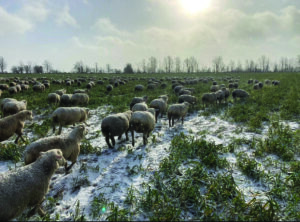
- Do not apply nutrients on frozen or snow-covered ground.
- For all nutrient recommendations and/or applications, include a minimum setback distance near known sensitive areas, such as tile inlets, wellheads, gullies, and water bodies. Document and discuss the setbacks with the fertilizer applicator.
- Urea or UAN broadcast on bare ground or not applied to a growing crop must be incorporated within 24 hours. It is recommended that it be applied with enhanced-efficiency nitrogen sources.
- Phosphorus injection, subsurface banding, or broadcasting with immediate incorporation are the recommended placement methods unless the risk of phosphorus loss to surface water has been demonstrated to be low.
- No broadcast applications of crop nutrients should occur if the weather forecast indicates more than a 50 per cent chance of rain over one inch in the next 12-hour period.
- Record all nutrient management planning recommendations and applications.
HERE’S HOW IT WORKS
Growers work with a crop advisor at a 4R certified retailer to create tailored nutrient plans based on individual soil tests that reflect each farm’s soil conditions and variabilities. Tillage and fertilizer application practices and timing are discussed – for example, avoid fertilizer applications on snow-covered ground and incorporate fertilizer after applications– along with product recommendations such as nitrogen stabilizers, and practices like cover cropping.
Russel Hurst, executive director of the Ontario Agri Business Association, says about 40 hours per year of administrative work is required on retailers’ behalf to represent the 4R program. But, he adds, it’s worth it, because growers’ interest in 4R certification is expanding. Some participating retailers say they have doubled the number of soil samples they’ve analyzed since becoming part of the 4R program. As part of the program, they are privy to a bevy of research and field advice that they can then share with clients.
Hurst believes the renewed agreement reflects the changing role of extension, and farmers’ desire for evidenced-based practices that add credentials, prestige, comfort, and confidence to production.
“Growers are counting on retailers more now for agronomic advice,” he says. “Ontario Agri Business Association members, who serve as fertilizer suppliers and trusted advisors, are providing sustainable third-party programming. They underscore that science-based nutrient management is good practice and part of farmers’ corporate responsibility. It’s fundamental to the long-term sustainability of Ontario’s farms, watersheds, and environment.”
ADDRESSING PUBLIC CONCERNS
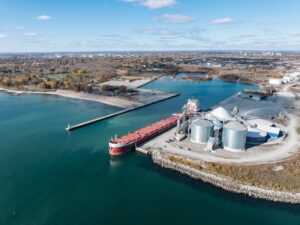
The 4R Nutrient Stewardship program was launched in 2008, in response to some troubling circumstances. Lake Erie’s western basin was experiencing nutrient-fed algae blooms, giving agriculture a black eye.
Phosphorus- and nitrogen-laden farmland runoff from both sides of the border was not the only culprit. But generally, the public was angry at agriculture, fueled by the neonicotinoid insecticide controversy. Rumblings were surfacing about legislation to limit input use. Public outcries to keep the Great Lakes “drinkable, swimmable and fishable” echoed everywhere, bringing Canadian and U.S. agricultural interests together on an action plan. After a test run in Ohio, the program expanded to Ontario and the 4R certification program was born.
And now, changing weather patterns are causing problems. A 2024 study by University of Waterloo researchers Nandita Basu and Nancy Goucher of 300 streams in the Great Lakes basin showed an increase in dissolved phosphorus concentrations. which they attribute to warmer winters.
“When climate change results in warmer winters, the soil thaws earlier, releasing phosphorus or nitrogen that would otherwise remain bound until spring and summer,” they wrote in The
Conversation. “But the plants are dormant during the winter, so the phosphorus released runs off into streams and lakes, where it sits until temperatures rise, providing ready fuel for the algal blooms. This differs from the past when phosphorus wasn’t released until spring and summer, allowing plants to absorb it for growth and preventing it from running off into rivers.”
They say this means we will see algal blooms occur earlier in the season and more frequently. Plus, they say blooms will more widely appear in lakes across the Great Lakes basin, including previously unaffected water bodies such as reservoirs and small pristine lakes.
Off-farm concerns about sustainability and good production continue to grow. In February, members of the Canadian Centre for Food Integrity appeared before the federal Standing Committee on Agriculture and Forestry, as part of its of food security study, and underlined the need for public trust in the food system. “Strong public trust in Canada’s agriculture and agri-food system is essential for innovation , economic growth and national resilience,” said Centre representatives Ashley Bruner and Lisa Bishop-Spencer.
“Public trust is not just communication, it is our social license to function as a society. When Canadians trust their food system, they are more willing to support the innovation that allows Canada to feed the world.” •