Seeing where Ontario grain really goes
The Grains in Action tour gives young farmers a firsthand look at the vast network that moves Ontario grain through the global food system
A behind-the-scenes tour of the fertilizer terminals, processors, research stations, and export infrastructure that connect Ontario farmers to global markets.

For most Ontario grain farmers, the journey of their crop ends when the truck leaves the yard. From that point forward, grain enters a complex supply chain network of processing facilities, transportation networks, manufacturers, and global markets — systems most producers rarely see firsthand.
The Grains in Action tour offers a rare opportunity to step inside this broader agricultural ecosystem. Over several days, participants follow Ontario grain and crop inputs through fertilizer terminals, processing plants, export infrastructure, research institutions, and finally back to seed production.
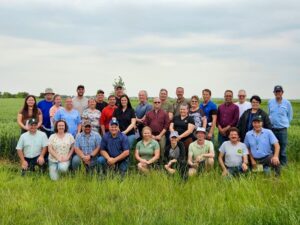
Grains in Action is a program developed by Grain Farmers of Ontario for young farmers, providing them with the opportunity to gain knowledge about the end uses of the grains they grow. Participants also learn about the role of Grain Farmers of Ontario within the grain industry.
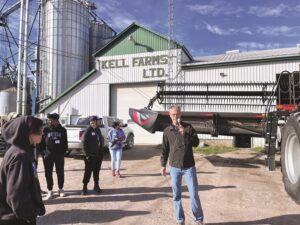
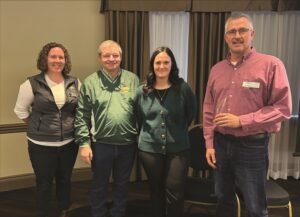
I had the opportunity to join tour participants for the 2026 Grains in Action event, held Feb. 9-12. The experience revealed just how interconnected modern agriculture has become, and how central Ontario farmers are to keeping the entire value chain moving.
POWERING PRODUCTION: FERTILIZER SUPPLY AT SCALE
One of the early stops on the tour highlighted the immense logistics behind nutrient delivery at Sollio Agriculture’s Hamilton terminal.
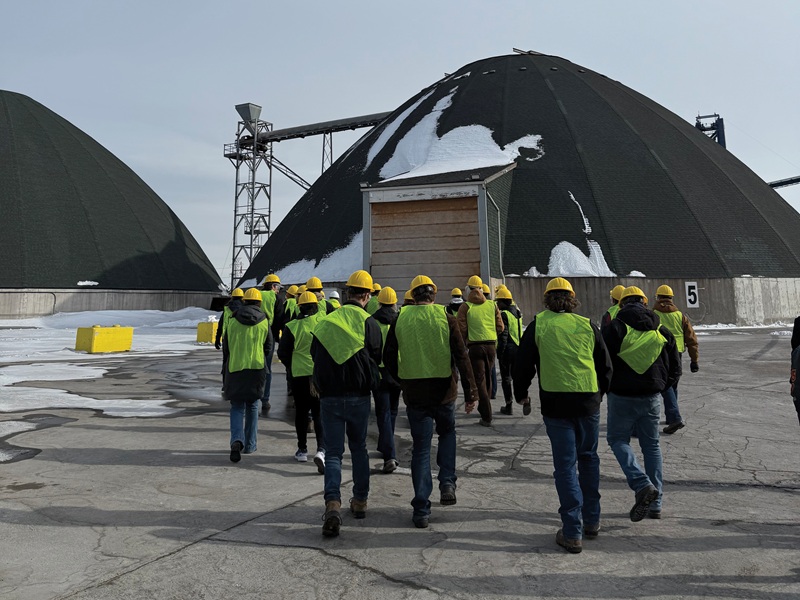
The first thing we noticed at the fertilizer terminal is the size: those storage domes rising like low mountains along the water.
Somewhere behind the scenes, product that arrived by vessel headed toward fields across Ontario. It’s easy to think of fertilizer as something that simply appears each spring. Standing inside Sollio Agriculture’s Hamilton terminal makes it clear how much coordination it takes to make that happen.
Five massive domes hold thousands of tonnes of dry fertilizer — urea, MAP, and potash — while nearby tanks store liquid UAN, some of it blended on site to meet regional demand. During peak season, the terminal runs around the clock, loading truck after truck in a tightly choreographed operation.
Behind every timely nutrient application is an industrial system working continuously. And this was only the first layer of the grain value chain.
FROM FIELDS TO FACTORIES
If the fertilizer terminal shows how crops are powered, the processing plants show what those crops become. At ADM, grain moves through milling and export systems where nothing is casual. Moisture levels are checked. Falling number and protein content matter. Uniformity isn’t a preference, it’s a requirement.
A small variation in grain quality can ripple through an entire processing line. At Ingredion, corn is no longer just corn. It becomes starches, sweeteners, and specialty ingredients used in foods most Canadians eat every day, such as bread, beverages, sauces, and packaged goods.
What struck many participants wasn’t just the scale, but the precision. Each product stream requires consistency that starts with how grain is grown and handled on the farm. Ontario grain, it became clear, isn’t simply sold, it’s engineered into food systems.
GRAIN AS CRAFT
The tour then shifted from industrial scale to craftsmanship. Inside J.P. Wiser’s, grains are fermented and distilled into Canadian whisky, where consistency of raw ingredients is essential for maintaining flavour year after year.
Nearby at Paris Beer Company, barley and specialty grains shape smaller-batch beers, where subtle differences in grain profile influence taste. The same crops grown across Ontario fields end up powering both global food supply chains and local craft production. It was a reminder of just how versatile grain really is.
WHERE GRAIN LEAVES ONTARIO
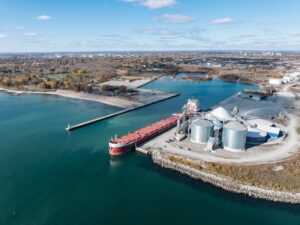
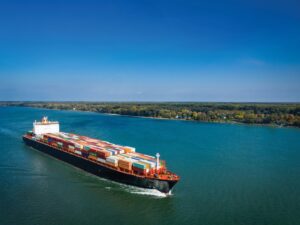
The value chain doesn’t end at processing. Along the waterfront, bulk vessels line up at export terminals, waiting to be loaded. At the St. Lawrence Seaway, grain moves through one of the most efficient transportation corridors in North America, connecting Ontario farms to international markets.
At G3 Hamilton, grain is received, stored, and loaded with precision to meet customer specifications worldwide. Discussions with London Agricultural Commodities made it clear how global forces shape local outcomes. Weather in South America, shipping disruptions, political tensions, and currency shifts — all of these influence what Ontario farmers are paid. The grain in those ships carries the weight of global markets.
RESEARCH THAT FEEDS THE SYSTEM
Between production and trade lies research, the quiet work that improves every season. At the University of Guelph Ridgetown Campus, one of our tour stops, crop trials, soil health studies, and agronomy training connect science directly to on-farm practice.
Students move between classrooms and fields. Plots are measured, sampled, and compared. It’s here that yield improvements, nutrient efficiency, and climate resilience are tested long before they reach commercial fields.
BACK TO THE BEGINNING: SEED PRODUCTION
The final stop brought the tour full circle, back to where the grain value chain truly begins. At Pride Seeds, participants walked through the intricate process of seed production, a level of management far beyond standard grain farming.
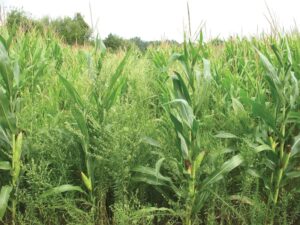
Seed corn fields are carefully mapped, planted with male and female rows, and managed intensively. Timing is everything. Male plants must release pollen exactly when female plants are ready to receive it.
Crews move through fields detasseling. Off-type plants are removed to preserve genetic purity. Fungicides are used to protect developing seed. Once pollination is complete, male rows are destroyed so resources flow into seed development.
Harvest doesn’t wait for full field drying. Seed is taken at specific moisture levels and dried at the plant to preserve quality. Seed soybeans follow a similar and equally controlled path, from pedigree selection to plot management, rogueing, sampling, and strict quality checks.
What stood out was how much labour, planning, and precision goes into producing the genetics that drive Ontario yields. Every hybrid planted across the province begins in fields like these.
THE BIGGER PICTURE
The Grains in Action tour wasn’t about visiting impressive facilities, though there were many. It was about understanding how deeply connected Ontario agriculture has become. Fertilizer arrives by ship and is blended overnight for spring planting. Grain becomes food ingredients, beverages, and exports within months. Research improves next season’s performance. Seed systems determine long-term productivity.
Each step relies on the one before it. For farmers, the takeaway is simple but powerful: Ontario grain is not just grown, it moves through a living system of infrastructure, people, technology, and global markets. Quality matters. Timing matters. Sustainability increasingly matters. And behind every bushel is an entire network working to keep grains in action.
Ibrahim Mohammed is Grain Farmers of Ontario’s sustainability and environmental specialist. •