Putting crop disease ratings to the test
Corn and soybean trials use local disease pressure to measure variety tolerance and management tools
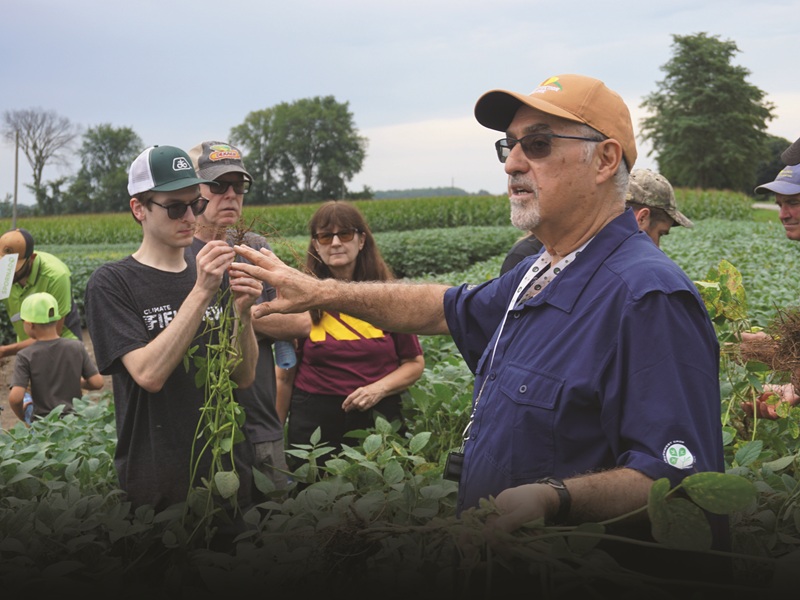
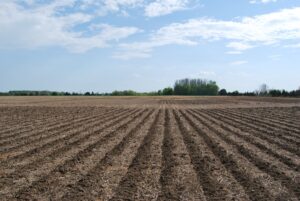
Research plots in West Elgin help turn crop disease challenges into practical information for Ontario growers, seed companies, and breeders.

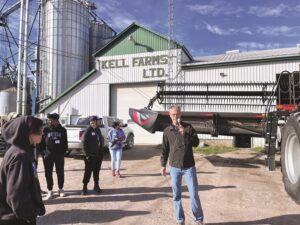
Although dark skies were building over much of southwestern Ontario on the afternoon of September 3, the mood on the ground in a pair of West Elgin fields was far more optimistic.
In these fields — one planted with corn and the other with soybeans — Albert Tenuta, field crop pathologist with the Ontario Ministry of Agriculture, Food and Agribusiness (OMAFA), and his team study how crop varieties perform when exposed to local disease pressure, and how different management tools affect those results.
The goal is to verify whether the tolerance characteristics promoted in corn and soybean varieties hold up under southwestern Ontario growing conditions, a message Tenuta shared clearly with the visiting farmers as storm clouds gathered overhead.
LOCAL PRESSURE, RELIABLE DATA
Tenuta is the first to admit he delights in seeing diseased crops. Diseased crops, after all, mean data, and that data helps inform future disease management.
The reason for partnering with growers in the two West Elgin fields is the consistency in disease pressure the sites provide, particularly for soybean cyst nematode (SCN) and root rots in soybeans, and tar spot in corn.
“When we put crops in a field with good, even disease pressure, we get good results,” says Tenuta, in this case referring specifically to high SCN pressure.
He later generates a chorus of laughter by saying, “There is excellent disease pressure here. I love it.”
The value of generating good local data is twofold: first, so farmers in southwestern Ontario know the varieties they are purchasing work as advertised, and second, so corn and soybean breeders can improve their breeding programs. The research plots also serve as a means of benchmarking yield potential. Tenuta and his team work extensively with both public and private breeders, with a wide array of corn and soybean varieties undergoing analysis each year.
“Whether it’s public breeding or private breeding, it all starts here,” Tenuta says.
SOYBEAN DISEASE PRESSURE
Generalities aside, the September 3 event covered the specifics of Tenuta’s ongoing disease research program and provided an overview of useful best management practices in disease management.
SCN populations in Tenuta’s soybean research area are estimated to range between 2,000 and 5,000 eggs. Despite this, Horst Bohner, soybean specialist with the ministry and one of the attendees, says it is possible for varieties with good SCN tolerance to achieve full yield potential, as high as 100 bushels per acre in some cases, if “everything else lines up.”
This assessment was anecdotally confirmed by a representative from Devolder Farms in Chatham, who said they had achieved a fairly uniform 98-bushel crop in one field in recent years.
Tenuta reiterated that local environments “can react differently” to soybean varieties, and for this reason, a lot of the SCN tolerance ratings in local seed guides use data from his team’s research.
He also encouraged attendees to actively monitor for the presence of SCN, particularly if they are experiencing mysterious yield losses. To check for SCN, growers must dig, not pull, soybean plants to examine roots.
Pulling plants, he explains, leaves nematode eggs in the ground and misconstrues SCN assessments.
Tenuta also touched on red crown rot, a pathogen identifiable by reddish discolouration on lower stems just above the soil, and one that can sometimes produce symptoms very similar to a variety of other common soybean diseases.
Red crown rot has not yet been confirmed in Ontario, but it is spreading from the Midwest into states bordering the Great Lakes. Like SCN, red crown rot spreads primarily through the movement of soil on equipment. For this reason, he says anyone “buying equipment from Iowa or Illinois” should “make sure it’s clean.”
A novelty for 2026 was highlighted as well: the first trials outside of the United States of a soybean with Bt-based SCN resistance. A Bt soybean is something Tenuta says he “was promised 35 years ago” at the start of his career and will be another source of SCN resistance growers can layer into their cropping plans.
“We have nothing that is totally resistant to SCN. It’s a numbers game,” Tenuta says.
TAR SPOT — SEASON SIX
In Tenuta’s corn research plots, the attending crowd wove between rows of hybrids with varying degrees of tar spot damage.
With the arrival of tar spot in southern Ontario in 2020, Tenuta decided it would be useful to test for the pathogen at West Elgin in 2021.
This turned out to be a prudent move.
“Damn, 2021 was a good tar spot year,” says Tenuta, again spurring many chuckles. Since then, a lot has been learned about tar spot management, including the susceptibility of different corn hybrids and in-season control. Regarding the latter, it was discovered that fungicide application timing for tar spot fit well with pre-existing timing strategies for controlling Gibberella and DON.
“We’ve had an 80- to 90-bushel yield response with some experimental tools,” says Tenuta. “There are new things coming down the pipe, new fungicides and formulations.”
“We do a lot of experimental work before things are registered.”
Now well into the sixth season of researching tar spot, Tenuta and his team walk and assess its development in their corn research plots every one to two weeks. His advice for growers is to choose hybrids by balancing yield and other agronomic needs with tar spot resistance ratings, and to “always ask the seed companies for their tar spot rating and where they do their testing.”
If those ratings come from West Elgin research data, they can expect as-advertised performance. •