Where crop protection products are put to the test
Syngenta’s Honeywood research station helps develop and troubleshoot seed treatments and sprays for Eastern Canadian farms
Testing is a critical step in bringing crop protection products from the lab to the field.
A lot of research and troubleshooting goes into the development of new crop protection product sprays and seed coatings.
By examining how seed treatments perform under Canadian conditions and how sprays mix, move through equipment, and reach the crop, researchers can help ensure products are practical, reliable, and supported by clear guidance for growers and applicators.
For Syngenta customers in Eastern Canada, much of that research and development happens at a small research facility in Plattsville, Ont.
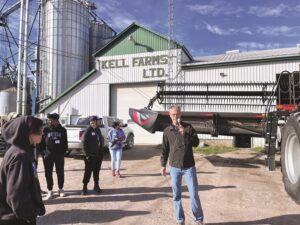
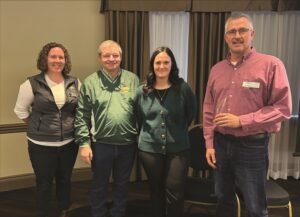
Built on the site of an old farmstead, Syngenta’s Honeywood station houses a chemistry and application lab, a pathology lab, and the Canadian Seedcare Institute — one of 17 globally. The station hosted a tour for the Eastern Canada Farm Writers Association on May 26 to showcase some of the high- and low-tech methods used to develop and troubleshoot new products.
A DIFFERENT AI
Matthew Coulter, formulation and application technology manager, says his team’s overarching job in the chemical laboratory is to “improve the application process” by ensuring new active ingredients — referred to as “AI” in his chemistry industry parlance — can be effectively incorporated into a solution.
That work involves many steps, including blending new actives with surfactants, thickeners, antimicrobials, and other substances to ensure products dispense uniformly and cleanly through application equipment.
“Formulation selection is really driven by both product requirements and the properties of the active ingredient,” says Coulter. Some formulations can have “20, 30, even 40” different chemical compounds, while others are in the single digits, or can stand on their own.
Coulter and his team also regularly conduct compatibility tests to determine if, and how, new products can be tank-mixed with other chemicals commonly used on the crops for which the new active will be registered.
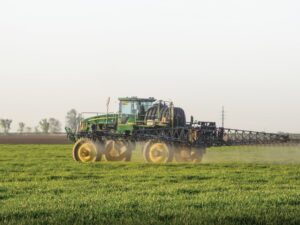
Another room within the lab features droplet science — a series of machines designed to measure how new formulations move from sprayer nozzles to the crop.
All this work, says Coulter, informs what applicators read on the label once the new active ingredient is successfully registered.
COLOUR MATTERS
Seed coatings are another complicated area, and one that is put through the proverbial wringer in a separate outbuilding.
In a room equipped with a variety of mixing devices, including a cement mixer and other pieces of equipment reminiscent of a kitchen or construction zone, Michelle Wall, head of Syngenta’s Canadian Seedcare Institute and technical lead for the company’s Eastern Canada operations, says the goal is to ensure seed treatments adhere to crop seeds under “Canadian conditions.”
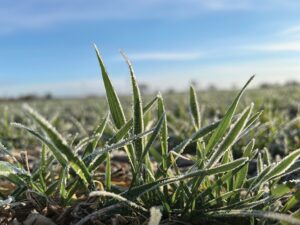
In practice, that means looking at the durability and effectiveness of seed treatments under environmental conditions ranging from very dry to very humid, and very hot to the cold characteristic of Canadian winters.
The testing is necessary because extreme conditions, as well as sudden shifts between extreme conditions, can have a significant effect on how seed flows, and how uniformly product adheres to seed. While the latter is more of a concern for western Canadian farmers, who are more likely to treat seed on-farm, Wall says her team still needs to know how to advise customers who call asking whether their unique circumstances — if several days of -20 C will affect coated product left exposed outdoors, for example — are cause for concern.
“The goal is to have seed flow as well as, or better than, untreated seed,” says Wall, later reiterating that Syngenta Canada’s approach at the Honeywood farm differs significantly from practices in other parts of the world.
“Australia uses a lot of similar products in cereals and canola as us, but when we tell them we’re going to treat them in -21 C conditions, they just laugh.”
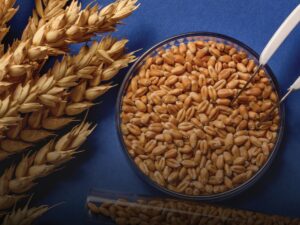
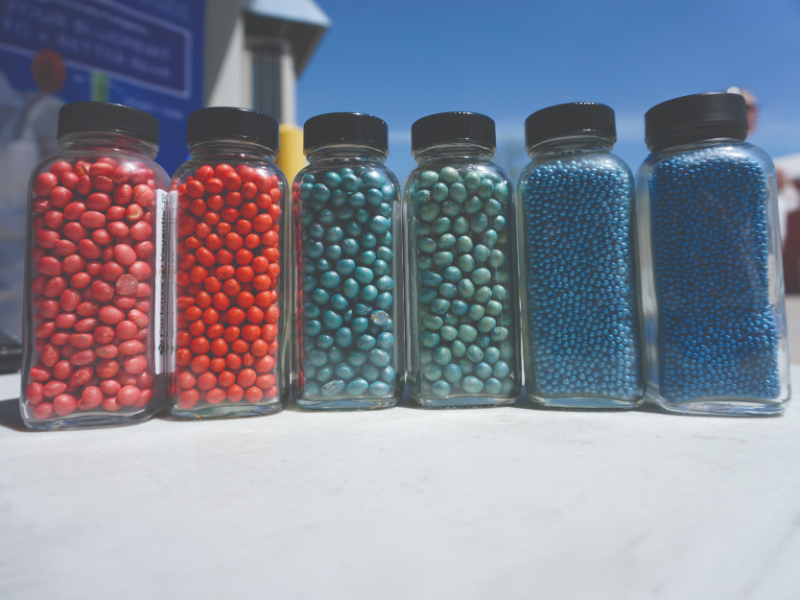
The colour of treated seed itself also matters. Not only does a uniform red, blue, or green coating visually indicate effective coverage of a given chemical formulation, it also plays into product marketing.
“Different companies that sell seed that’s already treated will care because they want their growers to have that aesthetic,” says Wall.
SEVEN ACTIVE INGREDIENTS?
In a later interview, Wall says the number of formulations Syngenta now offers on modern seed would have seemed “out of the realm of possibility” two decades ago.
“We definitely have five — Cruiser Vibrance Quattro for cereals and Vibrance Cinco for corn both have five active ingredients in them,” she says. In the future, she says, it may be possible to have seven active ingredients combined in one seed treatment.
“It’s always easier for growers to have a premix than treatments that need to be added to the seed separately, so ideally, everything would be together. Who knows what the future holds, with climate change leading to different pest pressures.” •